July 11, 2011

A New Painting: "Blue Clamp"

Blue Clamp, egg tempera on calfskin parchment, 6 1/2 x 4 1/2 inches.


A bright greenish blue in the midst of a sea of red; volumetric lines straight or curved; diagonals of light. The blue, actually mixed as a tint of phthalo green, startles in its insistent intensity, and is itself centered with red. I think/hope the richness of the dark reds are a balance in shadow to the light carried in the blue. Like with my last painting, Black Hoses, the issue of a title came to mind, with a brief thought of Blue Center, but no, I like the hard "p" of clamp; it repeats in sound the physical feeling of holding, pressing, clamping down.


July 8, 2011

The Lay of the Land: Looking Back


When I first saw this property in the summer of 1989, it was the land that I fell in love with; it took longer for me to recognize the treasure that is the house. Each step I took around the lawns and fields showed a new view, a different perspective, a changing sense of beauty. There is a small rise behind and to the west of the house, so the view back towards it has a bit of drama. In this final post of the series "Lay of the Land", I've walked past the house towards the west and faced back east to photograph, first the back yard...


then swinging to the south to take in the shed on the western end of the house...


and a little further to see the pond in the distance.


I then walked down the little hill (I'd been standing to the west and north of the telephone pole you can see on the upper left) and positioned myself to the south and west of the vegetable garden.


And now I turn the camera toward the east to take in the house, and in the foreground the raspberry patch. I'm going to have a bumper crop of raspberries this year since they love the rain and we've had a lot of it.


Here is my house and barn, with the hill called Blue Mountain between them; the land in front of the house slopes to the pond, which you can't see in this photo. There is a good deal of rock ledge up here, and the granite pokes up in places: under the house, in the lawn, in a large outcrop close to where I stood to take the first photos. I can be grateful for the geography of this area of Vermont because it's given me a varied and lovely place to call home.


Previous blog posts in the series:
"The Backyard Garden"
"The Approach"
"Facing East"
"Looking West"

July 7, 2011

A Walk in the Woods: The Quality of Light


Each time I go for my walk, I cross my back field, where I've beaten a path through the high grass, and enter the woods through a gap in the stone wall. In that brief moment, I cross from one habitat to another and am immediately aware of a change of air, of temperature, of scent, and of light. I live amid open fields, so the light is unobstructed and flows directly over ground and object, elucidating their forms. From that vantage point, the world is an orderly place.


In the woods order is dissolved in shifting splashes of light. There is gloom in spots and there is sparkle. Leaves and branches catch light and then release it, making space itself seem uncertain as all is caught in a tangle of bright and dark.


Reflections on water, running or still, add another layer of confusion to the layers of space, and another form of beauty.


The light finds its way through this conifer woods, with trunks standing dark and tall in front of textured light in the distance. Light falling on the needle covered ground is warm and rich, making this one of my favorite spots.


The bright blue plastic of maple sugaring line adds a foreign note to the greens and browns of the woods, but lovely in bright sun nonetheless, don't you think?

July 6, 2011

For Anchovy Lovers: Pasta with Broccoli and Anchovies


The early crop of broccoli from the garden is ready, so I am happily eating some of it in favorite ways. A simple salad of lightly steamed broccoli, dressed with olive oil and lemon juice is an early summer pleasure. Another dish I love comes from Marcella Hazan's The Classic Italian Cookbook, now out of print, but available in used mass market copies. I make her "Broccoli and Anchovy Sauce for Orecchiette and Other Pasta" all year round, in winter with frozen broccoli, but it is especially delicious with the fresh vegetable. You definitely have to love anchovies to enjoy this recipe.


As with many recipes, this one is very adaptable. I am giving you the recipe as Hazan has written it, with my variations in parentheses. She uses this sauce for homemade orecchiette (little ears), but I use 1/2 pound of factory pasta.

for 2 to 4 servings, depending on the appetite

2 cups fresh broccoli florets (I use the stalks too, because I like them, and for this recipe used a small head of broccoli, about 1/2 pound.)
salt
6 Tbs olive oil or 4 Tbs olive oil and 2 Tbs butter (Hazan prefers the sauce with some butter, but I use only olive oil.)
6 large or 8 medium flat anchovy filets, chopped
freshly ground pepper, 8 to 10 twists of the mill
1 Tbs butter
6 Tbs freshly grated Parmesan cheese
6 Tbs freshly grated Romano pecorino cheese (I don't like a lot of cheese in this dish and use only two or three tablespoons of Parmesan)

  1. Steam broccoli until crisp tender.
  2. Put 1/4 cup oil, or all the oil if you're not using butter, in a skillet with the chopped anchovies.Cook over medium heat, mashing the anchovies with the back of a wooden spoon until they're a paste.
  3. Add the broccoli, the pepper, the butter if you're using it. Turn broccoli in the sauce for 4 or 5 minutes. Taste for salt.
  4. Add the sauce to the cooked pasta, add the tablespoon of butter and cheese(s). Serve hot.

Update: I have learned in a comment from the great Marcella Hazan that the Classic Italian Cooking books are now in a different format, available as Essentials of Classic Italian Cooking. I think I will have to order this book since my paperbacks are the worse for years of heavy use, and this book has more recipes and techniques.

July 4, 2011

A New Textile: "Objects #3"

Objects #3, hand dyed wool on linen, 9 x 15 inches.


I have finished the third work in my series of four that are based on screen shots from the documentary film Objectified. I have again used a bar and triangle in the composition, just as in #1, though here the triangle is seen in its entirety, and the "object" is a circle. The color is a bit lighter in value than in the two previous pieces.


As before, I have hooked the wool in straight lines except for within the shape I've designated as object; so here, the circle is made from concentric lines of hooking from outside edge to the center. Below you can see the three finished pieces together. I'm pleased with the group so far: the color, the repeating triangle and bar shapes, the one different shape in each.


July 3, 2011

The Red, White and Blue


Wishing all of you a wonderful holiday, with good food, family, friends...


and wishing a Happy Birthday to the US of A.


July 1, 2011

Small Treasures


Walking in the woods, and through the fields, my attention is caught by tiny growing things; I bend down, kneel, lie on the ground to get closer. Looking through my camera lens I can observe these new worlds better than with my aging eyes. And what I see is a wonder, a miniature forest of varied greens and changing textures, with mushrooms, only a half inch wide, standing as the giants.


The pale blue green of the stalks of Pixie Cup lichen add a note of whimsy. When I watched the movie Avatar, I recognized the forms of lichens and mosses, miniature in our world, enlarged to make the magical forests of Pandora.


I assumed that these teeny, 1/8 inch wide, toadstools, with their thin black stalks and white crinkled caps are mushrooms, but it's possible they are the fruiting bodies of the mosses, which look like juicy very small versions of ferns.


Like a mysterious code, these small dots of brilliant red decorate the surface of a fallen log; they huddle together or cast themselves in arcs and lines.


Lying in the path was a small fallen branch, maybe an inch and a half in diameter. Growing on it were these little masses of rising red-brown tubes, at the most an inch high; I'd never seen anything like it before. In my mushroom book, I found what I think it an identification: Chocolate Tube Slime. I don't know why it is called a slime; it seems closer to the coral shaped mushrooms and is quite beautiful.


All the previous treasures are delights to the eye, but the wild strawberry, now fruiting abundantly in the fields is also a taste treat. They are so very small that the eating is just a light touch on the tongue, a very different experience from a big juicy bite into a local cultivated strawberry, but delicious nonetheless.

June 29, 2011

More Medieval Manuscripts at the Rauner Library

Book of Hours, France ca. 1440, 7 3/4 x 6 1/4 in., Ms. Codex 003141


We are very lucky in this part of the world to have a special collections library like the Rauner at Dartmouth College. Last year I discovered that any member of the general public could go there and look at their amazing holdings of manuscripts and rare books; we are welcomed, and allowed to photograph. I wrote a blog post about my experience, which you can read here. There is nothing like the feeling of handling and turning the pages of an ancient book, noticing the difference in weight and texture from one page to the next, seeing the individual hand of the artist, sensing history in your touch. Because they are made with parchment, the consistency of paper we moderns are accustomed to does not exist. Each sheet is unique, as is each page, whether text or image. Illuminated manuscripts are also important to me because it was seeing a show of a Book of Hours, The Hours of Catherine of Cleves, at the Morgan Library that inspired me to begin to paint on parchment.

Yesterday I had a desire to look at art, and the place to look at it closely is the Rauner Library. The first thing I saw when I walked in was the elephant folio of Audubon's Birds of America in a large glass case. How I would love to turn the pages of that amazing book! but my list of Books of Hours was quite wonderful enough. I looked at four manuscripts from the 15th century, three French and one Flemish. In this first manuscript, Ms. Codex 003141 (the links are to the manuscript pages on the Rauner Library website; you can browse the collection here.), I fell in love with the small, approximately an inch wide, images of seasonal activities. Above, I made a collage of several of these and below, you can see how they looked on the page. Of course, as with all my blog posts, you can click on the images to enlarge them.


Book of Hours, France, ca. 1450-1475, 7 3/4 x 5 1/8 in., Ms. Codex 001918


When I see the refinement and marvelous detail of the borders surrounding the illuminations, I have a feeling that the makers of these pages loved color, loved ornament, loved nature. I believe that much of this was convention, but such a terrific convention. Attention and care and sometimes even humor were lavished on these books: on the lower edge of the border are two creatures, a bird and what looks like it might be a mouse, convening around a flower.


Ms. Codex 001918, detail of above


Ms. Codex 001918


The other aspect of this Book of Hours that I found entrancing were the decorative flourishes emerging from each illuminated letter, flowing with grace and energy, as though to enliven the regularity of the gothic script, or even add a touch of wit.


Book of Hours, France, 15th century, ca. 4 x 3 in., Ms. Codex 001919


This is a tiny book with paint that is clearly worn, missing or rubbed off entirely, as in the page below. It is touching to think of the years of hands turning pages and the toll they take. When I think of how much does survive, I realize how precious these objects must have been to their owners, how cared for and treasured.


Ms. Codex 001919


Book of Hours, Flemish, ca. 1425, 7 3/4 x 5 1/8 in., Ms. Codex 003134


I have a soft place in my heart for "primitive" painting, as in the illuminations of this manuscript and the one before. I find the flat forms and naive renderings of creatures and landscape engaging and charming; their directness enhances an air of religious faith. I wonder if a different artist painted the borders because they seem to me to have more sophistication than the narratives.


Ms. Codex 003134


Isn't the distant landscape wonderful, with the bannered castles and odd bird forms flitting through the air? The clarity and simplicity of the illumination is a respite from the busy decorative border and dense illuminated Gothic text.


Ms. Codex 003134


I love this Last Judgment: the souls floating about on a green sea, the castle of Heaven on one side and a strange gaping red maw on the other, with curlicues of gold surrounding Christ. The color relationships, subtle with the green and violet and soft red, more strident with the splashes of deep ultramarine, create a bouncing pattern.


Antiphonal, Catholic Church, ca. 1525-1575, 33 x 23 in., Ms. Codex 003203


Finally, to end my visit, there was a huge book resting on one of the tables and I couldn't resist opening its very heavy original cover and looking inside. It is an Antiphonal, music for a call and response kind of singing, for congregation or religious community. I was very intrigued by the notation, which is square; it made the entire page look to me like a modernist grid, with squares rising and falling along it. But on another page I found this gloriously fanciful illumination, adorning with flowing plant forms the severe geometry of notes and Gothic script.


Ms. Codex 003203


I encourage anyone within driving distance of Hanover, NH, and with an interest in ancient manuscripts, to take a trip to the Rauner Library; it will be an aesthetic experience like no other you've had before.

June 27, 2011

The Lay of the Land: The Backyard Garden


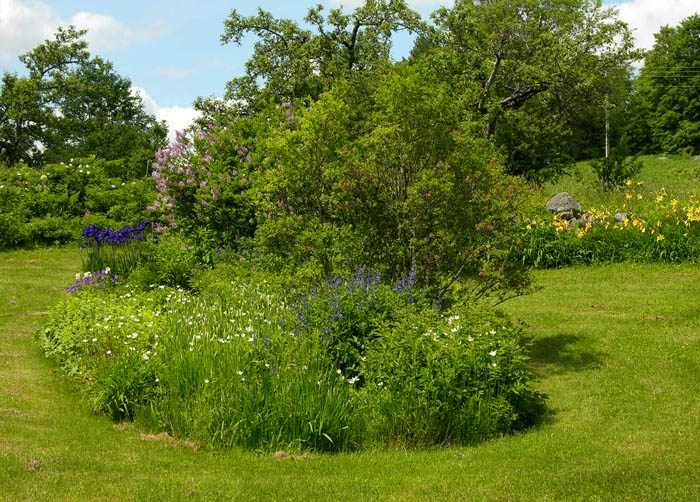
I thought I'd move my tour to the back, north side of the house next, after having surveyed the front in earlier posts (links below). To the east of the house is a stone wall, now hidden by vigorously growing ferns. Beyond them is the huge lilac and to the right and behind is a glimpse of the backyard. In Vermont, the front of the house is called the dooryard, a term I had never heard before moving here. My back space is bounded by two stone walls on the east and north and is open to the west.


Moving to get a further glimpse of the yard, you can see the ash tree that I planted about 20 years ago and now provides ample shade for the picnic table and a lounge on a summer afternoon.


At the side of the house, I enter the backyard between this rose bush and the ever expanding lilac,


and once in the new space, the large flower border comes into view, and another round of wild pink roses, with flowers growing alongside the stone wall at its north end. At the time I shot these photos a couple of weeks ago, lemon lilies and white rugosa roses were blooming; later it will be daylilies and tiger lilies. Behind the wall of flowers is the apple orchard, containing some very old antique varieties.


Here's a closer view of the border, with the bright white spots being snowdrop anemone, the purple baptisia and the deep purple at the back Siberian iris Caesar's Brother.


Moving my camera over to the left (south), I take in the picnic table and tree, and in the distance my laundry line.


Then some old fashioned metal chairs, the kind you can sit in and bounce a little, which I find very relaxing. The door is the back door to the mudroom and the flower border is where my peonies grow, very happily. Most of my land is quite wet and that is the only border with well drained soil. It seems strange that land on a hill at 1300 feet would be wet, but it is, very.


Finally, a closer view of the peony border, and behind it against the wall of the house, a snowball viburnum. When I first moved here, the backyard was quite bare and stark; I've been happy that in recent years it's begun to look lush and welcoming.


Previous blog posts in the series:
"The Approach"
"Facing East"
"Looking West"

June 26, 2011

A New Painting: "Black Hoses"

Black Hoses, egg tempera on calfskin parchment, 7 x 4 1/2 inches.


When I began to think of a title for this painting, the words that first came to mind emphasized the metaphoric nature of the image, a dark mouth spewing forth black snaky tubes: Maw, Spurt, Spew, Disgorge. But those words would push a certain reading and deny multiple interpretations. I can also see this as humorous, the bright blue enhancing that feeling: the hoses emerge from a chattering mouth like so many lengthened thought balloons. Or to see it non-objectively, a spray of black forms pinwheeling across a surface. So, frightening or funny or abstract, I did not want to direct a response from the viewer, so settled on the neutral title Black Hoses; but not entirely neutral because it alludes to the real objects I've painted. Would Black Lines be better? Do you find that a title guides your response to an artwork?


June 24, 2011

A Walk in the Woods: The Shapes of Leaves


When I go for my walks through the woods adjacent to my home, I spend a lot of my time looking down, paying attention to the shapes and colors and textures of low-growing things: plants, mosses and lichens, fungi. A couple of weeks ago I decided to document some of my favorite leaf shapes, shapes of plants I can't identify except for one. The charming mass of almost cartoonishly bulbous three part leaves above are my favorites, and I look out for them each spring; they simply make me happy.


There is so much variation within a three part pattern, from the first plant to this, and even within the growth pattern of the same plant, as the leaf adds complexity as it grows.


This is bunchberry, a low growing form of dogwood that carpets the path in one area of the woods. The leaves grow by fours or sixes from a perfect center, whorling their points in a circle. The white "petals" of the flowers are actually bracts, a specialized leaf, and the flower is the small round mass at their center.


I also love these leaves, rising from a center, and displaying a kind of corrugated folding which catches the light in vertical and horizontal movements. Last year I tried to watch out for flowers that might emerge from the leaves, but never saw any.


Three leaves attach to the end of a stem, and their edges are serrated so finely that it seems a frothy mass.


This plant rises above the ground. I find its new leaves, softly and delicately folded, with a lighter and cooler color than the older leaves, so poignant. They give a sense of the tender vulnerability of new life, wherever it emerges.