February 13, 2012

At the Met: The Power of Portraits

Domenico Ghirlandaio,  Portrait of an Old Man and a Boy, ca. 1490; tempera on wood, 24 3/4 x 18 1/4 in.


 When we look at a portrait painted hundreds of years ago, do we enter into the life of the person portrayed? For me, it is less the understanding of a particular life, than the human feelings of tenderness, beauty, vulnerability, thoughtfulness, or strength, that come when looking at portraits; my heart yearns toward them. I sense these qualities more intensely in the direct, simple clarity of form in Quattrocento painting and sculpture. How lucky I was to be able to see a great collection of this work in the exhibition currently at the Metropolitan Museum of Art: The Renaissance Portrait from Donatello to Bellini. I'm beginning this post with the Ghirlandaio double portrait because it's one of the most touching paintings I have ever seen. An old man, with wisps of gray hair, a wart, and a diseased nose, looks down gently at his grandson; his soft expression is met with serious adoration from the small boy, whose hand rests lightly on his grandfather's chest as he is encircled by the old man's arm. As with most of these portraits, the subjects are the elite, as we see from the fur escaping from the old man's collar and the elegance of the red clothing. Out the window is a perfect little landscape, a road winding up a rounded hill, a sheer mountain in the distance. The touch of the artist is sure and precise.


 Florentine Artist (Piero Uccello?), Profile of a Man; ca. 1430-40; tempera on wood, 16 3/4 x 12 3/4 in. 


Precision is a characteristic of tempera painting, which made it very well suited to the sensibility of the time (or did the sensibility demand the technique?). In this portrait, a magnificent headdress sits atop a dignified and simple profile. The form of the face is lightly indicated, but full of calm dignity.


Fra Filippo Lippi, Portrait of a Lady, ca. 1445; tempera on wood, 19 1/2 x 13 in.


There were many profiles in this show; it must be that the crisp differentiation of the curving lines of the head with the background were very appealing. In this painting, those lines flow from a pearl-bounded head scarf and swoop down a wide forehead to the nose and mouth. A rounded chin is delicately shadowed; all is highlighted in front of a blue sky. The pale color harmonies seem close to those of fresco.


 Antonio and Piero del Pollaiuolo, Portrait of a Lady, ca. 1460-65; oil and tempera on wood, 20 5.8 x 14 3/8 in.

This portrait seems more like a real person to me than the one by Fra Filippo. Like the Uccello above, the outline of the head takes precedence over the rendering of volumes within it (I wonder if the paint has been abraded over the years). A great deal of attention has been lavished on the complex patterns of the dress; the contrast with the elaborate dress makes her face seem quite serene.


Attributed to Sperandio of Mantua, Eleonora of Aragon, ca. 1475; marble, 11 1/4 x 9 1/4 in. 


I thought it interesting to compare this low relief with the painted portrait just above. The two women are wearing similar patterned dresses. What is curious to me is how much softer this work in hard marble is: I feel that I can sense the flesh on cheek and chin, and the rounded folds of the sleeves. Eleonora is before us as a real person, lovely, but not idealized.


 Pisanello, Leonello d'Este, 1444 (?); tempera on panel, 11 5/8 x 7 5/8 in.


I love this painting; it is so personal and quirky. The strange hairdo, the extravagant clothing, the flowers scattered behind the portrait, make it seem almost like a miniature from a medieval manuscript.


 Florentine Painter, Portrait of a Woman (detail), ca. 1440-50; tempera on wood, 16 1/4 x 12 1/4 in; see the entire painting on the Metropolitan Museum website.


The severity of this head intrigued me. This is the only image of a woman in the show which I thought evinced strength and certainty rather than beauty. The set of her mouth, the intense focus of her eye with the extreme curve of eyebrow, even the particularity of her nose combine to make an assertive image (as we might say in Brooklyn: "she's one tough cookie").  The geometry of the head covering enhances this feeling, as does the careful modeling of form.
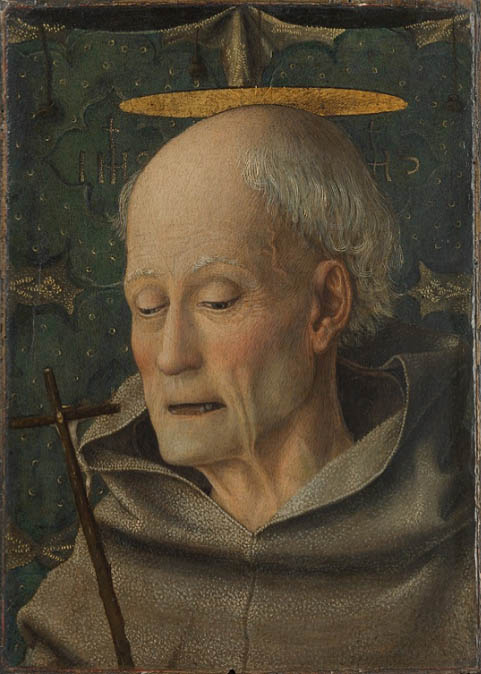

 Jacopo Bellini, Saint Bernardino of Siena, ca. 1450-55; tempera and gold on wood, 13 1/2 x 9 3/4 in. 


This Bellini is a sensitive portrait of age and of faith. An open toothless mouth, loose flesh, shining strands of gray hair are facts of age; they are surrounded by elements of faith: a halo, a simple cross, the clothing of a monk. It is a very moving painting.


Rogier van der Weyden, Francesco d'Este, ca. 1460; oil on wood, 12 1/2 x 8 3/4 in.


 Most of the works in this show were Italian, but there were a few Northern European paintings, including this solemn portrait of the illegitimate son of the ruler of Ferrara. He'd been sent to the Netherlands to be educated, and van der Weyden was an important portrait painter at the time, so it's not surprising that this portrait was commissioned. The long fingered hands hold symbols of power, and rest provocatively on the picture's frame.


 Mino da Fiesole, Piero di Cosimo de'Medici, 1453-54; marble, H. 21 1/2 in.


I sometimes have a hard time with sculpture; its presence as a real object in space makes it seem too real, not transformed enough into art. But some of the portrait sculpture in this show was remarkable, and I couldn't help but feel stunned by its life and energy, this portrait of Piero most of all. The artist managed to make this very powerful man both a specific human being who seems our contemporary, and a symbol of dignified grandeur.


Workshop of Antonio Rossellino, Cosimo de'Medici, ca. 1460; marble.


This portrait of Cosimo, the head of the Medici family, is a very different picture of age from the one of Saint Bernadino above. It is an image of determination, from the clear eye to the set of the mouth, and shows a man who is still at the height of his power. The focus on the individual that these portraits proclaim was a new development in Europe during the 15th century; this exhibit gives us a reason to celebrate that change.

February 10, 2012

New Hooked Wool Drawings, and the Benefits of Doodling


 I've always doodled during meetings. When I was teaching, my notes at department meetings were covered with little inked shapes, but they had little to do with my artwork. They were a way to keep my hand busy while my mind was both concentrating on the matter at hand and wandering about. I still ply my pen during the rare meetings I now attend, usually building interconnected piles of flat and volumetric squares, sometimes with circles added. Nothing much, just doodling. For some reason, at my last meeting of my local town library's trustees, I began to doodle little images that could work as sketches for my ongoing series of drawings. And I came up with some pretty good ideas, which I later filled in with color at home. I could call this group of works "The Library Drawings".


2012 #2, hand dyed wool and egg tempera on linen, 16 3/4 x 13 1/4 in.


As with most of my drawings, these have centered images, and as with many, they have a light, humorous quality. I pushed the primaries red yellow blue, so that they become a zippy brilliant flag, like that of a hot and happy country.


 2012 #3, hand dyed wool and egg tempera on linen, 14 1/4 x 12 in.


An orange square creeps out and ensnares a green circle.


 2012 #4, hand dyed wool and egg tempera on linen, 16 x 12 3/4 in.


Three cuddling ovals sit atop two hooked circles.


2012 #5, hand dyed wool and egg tempera on linen, 13 3/8 x 12 1/2 in.


And I leave it to you to find a metaphor for this one (I'll keep the image that pops into my mind to myself for now).


February 9, 2012

Gestures on Snow


There hasn't been much snow this winter, so branches and grasses, brambles and twigs, rise above the thin layer of white, gesturing with thin dark lines as across a blank canvas.


A bent stem and its shadow create a diamond on the snow.


A curved branch, covered with circular bumps like little suction cups, moves across and down through space, its curved diagonal countered by a line of light; the subtle texture of snowy ground is soft behind the crisp dark.


The open arms of a branch are partly covered with snow, their generous gesture visible; the straight body points the way for a small animal.


Woodland objects fallen on snow sink into it as though it was a soft featherbed.


A small twig, rising up through its own tiny hole, casts a delicate shadow. Little events such as this touch me; the vulnerability of life, and its resilience, are pictured here.


February 7, 2012

A New Painting: "Pin"

 Pin, egg tempera on calfskin parchment, 5 x 5 3/4 inches.


This painting brought a couple of issues to mind as I worked on it, both related to levels of realism and abstraction: detail, and texture, which is a kind of detail. A cotter pin holds center stage in this work, becoming an animated character atop an arrangement of rectangles. Since my work has moved closer to abstraction in recent years, becoming simpler in composition, I wondered what would happen if the one element that ties the image to the real world was eliminated....


Thanks to photoshop, I can easily see the result. To my eye, the work loses its punch without the odd element of that cotter pin. When I see something like this, I feel that I'll never become a purely non-objective painter; I am too much in love with the odd tension between actual things and abstract structure.


Here is a detail of the pin, which is placed on a slightly textured ground. At one point in the process, I had more variation in the colors of that rectangle on the left, attempting to paint a closer imitation of the rusted surface, which you can see below. Then I realized that I wanted a much more subtle shifting of color to suggest texture, rather than illustrate it. One of my great fears is of making work that is sentimental, causing a romantic response as to old machinery lying about in a field. So I glazed a couple of layers of color on top of the textured surface, which allowed for some of the color shifts to show through while tying them closer together. Now I feel fairly satisfied with the balance of detail within the sense of the whole.


February 6, 2012

At the Met: The New American Wing

 Ammi Phillips, Girl in Red Dress with Cat and Dog, 1834-36; oil on canvas.


One of the many treats awaiting me during my visit last week to the Metropolitan Museum of Art was the new wing for American art, with spacious rooms exhibiting a range of painting, sculpture and objects. There is even a large study collection, which I will write about soon. This post is a very personal tour of the work on view; because of my love for primitive art, that was my primary focus in my first trip through the galleries. First up is one of my very favorite paintings by one of America's foremost portrait painters. The form is clear and simple, the child's portrait is touching, as are the charming faces of her pets. I had been used to seeing this work at the American Folk Art Museum, but since their recent troubles, they've made an extended loan of this and other works to the Met, which is very fortunate for us.


 Oliver Tarbell Eddy, The Alling Children, ca. 1839; oil on canvas.


This group portrait is very different from the Phillips work; the form is much softer and there's more sentiment in the portraits. But I still find a great deal of charm in the painting, in the child holding the cat, in the figure at left, who is a little boy who died; (I'd wondered why what I thought was a girl was holding a hammer and nail).


 The Alling Children, detail.


And I loved the bold pattern of the rug, with the little black slipper and white sock clad feet on top of it.


 Side Chair, Connecticut, 1740-70; painted maple.


I could see a similarity in design in this embroidered chair cushion with the rug above. Both have grand swirls of stylized foliage.


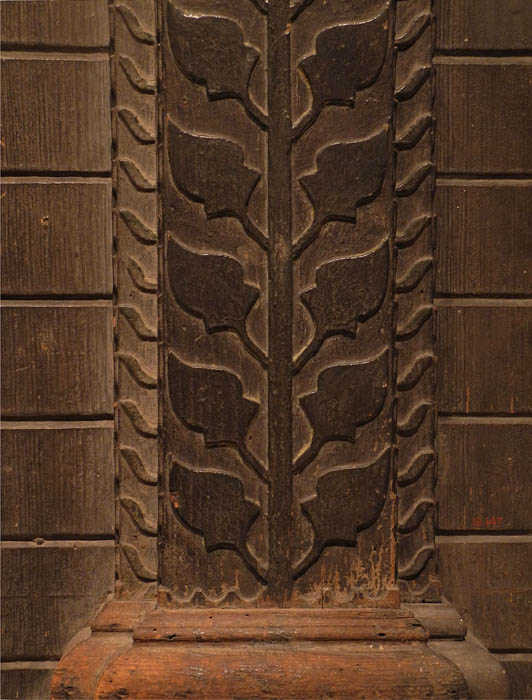
Doorway, Westfield, Massachussetts, ca. 1765; painted white pine.


Another example of foliage design rises on columns surrounding an imposing doorway from a house in Massachussetts.


 James Peale, Still Life: Balsam Apple and Vegetables, ca. 1820-30; oil on canvas.


 Peale offers us a bounty of vegetables, naturalistically rendered, fresh and lively.
 

Decoys from the Collection of the American Folk Art Museum, 19th century. 


 From the plant to the animal kingdom: a beautiful collection of sensitively carved and painted decoys. I'm very fond of decoys of all sorts; last summer I blogged about about the animals in the collection of the Shelburne Museum


 Attributed to Asa Ames, Phrenological Head, ca. 1850; polychromed wood.


This strangely compelling sculpture, also from the Folk Art Museum collection, has carefully mapped areas of the head, which according to phrenology (called a pseudo science) are keys to character. 


 Edward Hicks, The Falls of Niagara, ca. 1825; oil on canvas.


Still in the animal kingdom, a detail of Edward Hicks painting of Niagara Falls, with three animals native to North America: a moose, a beaver and a rattlesnake. I tend to see the snake in its biblical character, knowing some of Hicks' other paintings.


 Martin Johnson Heade, Approaching Thunder Storm, 1859; oil on canvas.


My final three images are of water, so important to those of us on the Northeast coast. This painting by Heade, with its dark sky and ink black water, is one of my very favorites of American landscape. It perfectly captures that moment when the sky is letting loose in the distance, but near at hand all is still. The water reflects the dark sky, absorbing all light, while white spots of sail and rowing man are illuminated. The scene is unreal, yet believable; we can feel the weather in our bones.


 Fitz Henry Lane, Stage Fort across Gloucester Harbor, 1862; oil on canvas.


Another artist of light and stillness, Lane (formerly known as Fitz Hugh Lane), distills forms into a clear essence and creates a mood of transcendent calm.


Albert Pinkham Ryder, The Toilers of the Sea, 1880-85; oil on wood.


The turbulence of Ryder's sea and its storm tossed boat are calmed by the glowing moon which illuminates clouds and foam. Like much of 19th century American landscape painting, there is a sense of spirit in nature, of the life and harmony in all things. 


February 5, 2012

At Sheepshead Bay in Brooklyn


 It's sometimes hard to remember that New York is a port city, surrounded by water, since I am so focused on its buildings and people. On my trip into the city last week I stopped at Sheepshead Bay, which was one of the magical places of my Brooklyn childhood, along with Coney Island, which I wrote about here. When I was young, my parents sometimes took us to Sheepshead Bay to look at the fishing boats, pulled up at docks across the street from stores and restaurants and apartment buildings, a strange mix of concrete and water, the mundane and the romance of the sea.


 I was thrilled to see a pair of swans floating gracefully in the bay. The big birds I am used to seeing, wild turkeys, have a funky, waddling charm, very different from the elegance of a white swan in dark water.


Of course seagulls are numerous, keeping watch, like finials on seaside posts. 


 My eye was attracted to the tension of twisted rope....


the rhythm of draped rope alongside textures of wood and dried grass...


and the casual flinging of rope across a piece of burlap, all alongside water.


Lastly, a subtle arrangement of color with geometric form, found on one of the docks. It was a pleasure to visit one of my childhood places and find images there for the adult to savor.


January 31, 2012

A New Textile: "Empty Center: Turquoise/Red"

 Empty Center: Turquoise/Red, hand dyed wool on linen, 9 x 9 inches.


This is the second in my series of Empty Center textiles; you can see the first below, and here. The shapes at the edges give this work a very different feeling from the first: where the rectangle and truncated circle seemed to be calling to each other across a vast expanse, the red and turquoise curves seem to me to be embracing the center, or holding it within bounds.


As with the last piece, I dyed the wool for the center using very dilute amounts of the colors at the edges, then hooked it in a random pattern, different from the regularity of the colored shapes. The transformation from small sketch to finished piece brought an unexpected kind of mood and energy in these two works. It's fun to be surprised by your own work.


Note: I'll be away for a few days; see you next week!


January 30, 2012

Balthus' Memoir: Beautiful, and Infuriating

 Balthus, The Mountain, 1936-37; oil on canvas, 98 x 144 in. From the Metropolitan Museum website.


Of what use are an artist's words about their work? do they elucidate or obfuscate? How do they make us feel about the artist as a person and does that affect our view of the work? I remember my first encounter with van Gogh's letters and how stunned I was by his vivid, intelligent writing, so far from the popular image of the disturbed artist. While I was mulling over writing this post, I read a blog post by the artist Deborah Barlow about Philip Guston's writings and life; reading his daughter Musa Mayer's memoir left her feeling uneasy about his life. So I come to Balthus (Balthasar Klossowski), certainly one of the great 20th century painters, but one who engenders continuing controversy. When I recently wrote a blog post on originality,  using Picasso and Balthus as examples, a lively conversation about Balthus on Facebook ensued. I mentioned this to my friend, the artist Susan Jane Walp, who then loaned me her copy of Vanished Splendors, an "as told to" memoir compiled during two years at the end of Balthus' life.


 Balthus, Nude with Cat, 1949; oil on canvas, 25 1/2 x 31 1/2 in. This and the following images from Wikipaintings website.

Balthus speaks beautifully about his vocation as an artist:
what painting really is, a skill like that of a laborer or farmer. It's like making a hole in the ground. A certain physical effort is needed in relation to the goal ones sets for oneself. It is a discernment of secrets and illegible, deep, and distant paths that are timeless.
He then goes on to berate modern painting, decrying Mondrian's desertion of landscape painting. He is deeply conservative, and religious, which evokes an eloquent statement:
To paint as one prays. By doing so, to accede to silence and what is invisible in the world....To join with what is essential in this sacred world through a humble, modest availability that is also presented as an offering.
After this lovely statement, he goes on to complain of the "majority of morons mak(ing) so-called contemporary art" and I fume as I read it. And what of his most controversial paintings, those of young girls in sexual poses, paintings that make us horribly uncomfortable? 


 Balthus, The Room, c. 1953; oil on canvas; 106 1/2 x 132 in. 


I remember seeing this huge canvas at the Balthus retrospective at the Metropolitan Museum of Art many years ago. The light, the paint, are beautiful, but the image is shocking, almost violent. The girl pulling back the curtain seems evil to me as she exposes the prone girl to the light of day. These complex images of young girls, mixing seduction and grace, light and darkness, sexuality and death, with deep mystery, push Balthus' work beyond that of mere figure painting. What does he have to say about his young models?
Some have claimed that my undressed young girls are erotic. I never painted them with that intent, which would have made them anecdotal, mere objects of gossips. I aimed at precisely the opposite, to surround them with a halo of silence and depth, as if creating vertigo around them. That's why I think of them as angels, beings from elsewhere, whether heaven, or another ideal place that suddenly opened and passed through time, leaving traces of wonderment, enchantment, or just as icons. 
Is it possible he really did not see what he painted? but he also wrote this, which seems to belie his more simple statement above:
Behind nature's docile stillness and people's behavior, I've always perceived a secret, dark complexity that attracts all artists and makes them advance to the depths of forests and the abyss. This mysterious architecture gives art its vertigo.

 Balthus, Large Landscape with a Tree, 1957; oil on canvas; 51 x 64 in. 


Balthus' landscape paintings have a deeply quiet presence; a distillation of form, and a quality of paint make them timeless. They are an aspect of his work that draws no controversy.
This love of landscape remained with me always...I don't try to paint of reproduction of nature, but signs of a universal community and identification of a thought and deep meaning, at the same time coherent and obscurely mysterious. 

Balthus, Japanese Girl with a Black Mirror, 1967; oil on canvas; 59 x 77 in.


Later in his life, Balthus painted his much younger Japanese wife, Setsuko Ideta, who he calls "The Countess", much to my annoyance. How do I feel about this admittedly great artist after reading much of the memoir? I don't like him. He was extremely conservative, snobbish, arrogant, and in love with aristocracy. Does that change my view of his paintings? I don't think so, any more than knowing about the bad behavior of so many of the New York School artists changes my attitude toward their work. Can we separate the art and the life?