April 15, 2013

A New Painting: "Untitled (Pink, Black)", for Mary Heilmann


Untitled (Pink, Black), egg tempera on calfskin parchment, 4 1/2 x 9 in.


I've been inspired to play with color in my new series of cloth paintings, here pink and black, inspired by a group of paintings by Mary Heilmann, a painter I much admire. Pink is a funny color, funny as in humorous and also as in strange, with odd associations. Paired with black, there can be a life and death aspect to it, heightened by the organic curves, but I'd prefer to think of it as simply nervy, like "how dare you appear in a serious painting!"  


Untitled (Pink, Black) detail


It's a challenge to achieve a lively quality of light, to have warmth in the cast shadows and half lights.


Mary Heilmann, Guitar, 1979; acrylic on canvas, 30 x 40 in. 


 This painting was in an exciting retrospective of Heilmann's work that was at the New Museum in 2008. I photographed it from the catalog To Be Someone, a wonderful resource for fans of her work. I look to her paintings for color ideas, bright, unexpected, bold, and fresh.


April 14, 2013

Piero della Francesca: Severity and the Eternal


Saint Augustine, 1454-69; oil and tempera on panel, 53 1/3 x 26 1/6 in.
images courtesy of the Frick Collection website 


Standing in front of this painting of Saint Augustine, in the Oval Room at the Frick Collection, was like being in the presence of a powerful soul, one who looks past the immediacy of dailiness to an inward essence of life and faith. For me, seeing just this painting, from a museum in Lisbon, would make a trip to the Frick worthwhile, never mind the other works in the current show Piero della Francesca in America. At the link you can see the seven paintings in the exhibition and go on a virtual tour of the room in which they are hanging. 


Saint Augustine, detail


There is something essential in the works of Piero della Francesca, beyond their skill and clarity, a quality I've been pondering, trying to understand; I believe that there is something here to help me understand my own painting. So I look at this head, so solid and present, and think of it in relation to portraits by Velazquez, such as this one in the Met's collection. Velazquez depicts palpable life, blood flowing under the skin, a figure about to move; Piero's figures are still, fixed in solemn contemplation. 


Saint Augustine, detail


Some of Piero's linear clarity is of course related to the painting style of his times, the Quattrocento in Italy. He went beyond and deeper than many of his contemporaries, I believe through his study of mathematics, of geometry and perspective, a set of abstract truths pointing him to the divine; plus his own personal genius and aesthetic sensibility.


Saint John the Evangelist, detail, 1454-69; oil and tempera with traces of gold on panel, 
52 3/4 x 24 1/2 in. 


When people speak of his work as being calm, I would say "still". Rather than calm I see an austere presence, a severity of form and mien, in the sense of "a strict or stern bearing or manner" (Mirriam-Webster). Many years ago, when I first saw the great Piero fresco cycle at Arezzo, I was surprised at how passionate the paintings were; I'd been expecting something cool and intellectual from looking at reproductions. This passion is contained within tight bounds, lending the works a sense of the eternal, of life not easily spent, of looking beyond "this mortal coil".


Seated Luohan, ca. 1000, Yixian, Hebei Province, China. Earthenware with 3 color glaze, 41 inches high.


It came to me that the Piero portraits of the saints strongly reminded me of Buddhist sculptures at the Metropolitan Museum of Art, eternal, austere, and still, and deeply spiritual. I am going to make another leap, and compare this work to a similar yearning toward the essential and spiritual in the work of Kazimir Malevich's Suprematist period, and of other artists painting minimalist abstractions. I wrote a blog post, "Geometric Abstraction: Toward the Essential" on this work. I feel that the sense of order, the precise form, the austerity of image, ties all this work together. Looking at Malevich, or at Mondrian, I realize that abstraction can be as powerful and moving as a figure painting; Piero points the way with his emphasis on geometry and perspective. As for my own work, I've felt that my paintings of the past few years are quite severe in sensibility as they move closer to abstraction. Without the softening effects of trees and sky and space they have an austere presence. The paintings of Piero give me courage, as does minimalist abstraction; my paintings are kind of tough, not lovable, but then the Pieros aren't lovable, except by the few: the lines at the Frick were for the Impressionist drawings.


Kazimir Malevich, Plane in Rotation, called Black Circle, 1915, oil on canvas, 31 1/8 x 31 1/8 in.


April 12, 2013

Spring Emergence

Yellow Flag Iris at the edge of the pond.


It is a miserable day today: snow, sleet, freezing rain. I hear the hard little pellets of sleet making a rat-a-tat-tat on the skylight windows; the ground is getting white; it is treacherous driving. I am staying on my hill. So, it's good to remember that yes, Spring is advancing. Yesterday morning, during a couple of hours of sunshine, I went out with my camera to document the plants that were showing their shoots above ground, or above water as with the Yellow Flag iris. 


Daffodils


Daffodils, flowers whose bright faces speak Spring, are coming up.


Iris Reticulata


The tiny Iris Reticulata, the earliest of the irises, has ends that look like small flames. A bud has already formed.


Tulips


The beginnings of tulips are bright red in the garden.


Egyptian, or Walking Onions


Egyptian onions are the first greens I harvest each year, adding a mild onion taste to salads or other dishes. You can see that deer have been munching on them, so I put up the electric fence to keep them out of the garden.


Sorrel


Another plant that starts out red: the herb sorrel, rising from last year's dried leaves.


Rhubarb


Rhubarb wins the prize for the funniest, and sexiest, way of beginning spring growth, with its shiny red knobs.


I stepped out on my porch to take a picture of today's ice, nearly slipping on the tiny glassy balls of sleet. It's nice to remember that all these beginnings of plants will be there when the weather warms again, ready to resume their growth.


April 11, 2013

A New Textile: "Green Ribbon"

Green Ribbon, hand dyed wool on linen, 7 3/4 x 21 1/2 in. 


Here is my third piece in an illusionistic series of works, shaped pieces using value shifts to give a sense of form, of curving in and out, of twisting. It's fun for me to be using using thin strips of cloth, via the rug hooking technique, to represent a piece of whole cloth. The representation is a bit clunky and crude, as opposed, say, to painting it, but I believe it still has some presence.


Green Ribbon detail


This detail shows more clearly the shift in values; even here the illusion is strong, arguing against flatness, though the piece is perfectly flat. I get these colors by dipping a long piece of cloth in the dyepot, in and out, with the end of the cloth most often in the pot getting darker than the end dipped lightly into it. A range of values from light to dark can be achieved that way.


Here are two "ribbon" textiles hanging in the studio, along with a painting, and another textile with volumetric forms. It's amazing to me how much more illusionistic the shaped pieces are; without the surrounding rectangle they seem to be what they portray.


April 9, 2013

Traditional Maple Sugaring


A sure sign that winter is loosening its grip is when the sap begins to flow in the sugar maples. People start excitedly asking "did it run today?". And from the sap comes that wonderful wild food, maple syrup, delicious and a lot healthier than sugar. The weather has to be just right for the sap to run: nights below freezing and days above. Once there are a string of warmer nights, the season is over. A few days ago I went to visit my friend Boots Wardinski of The Green Reaper farm to watch him gather sap with his percheron Bart, a strong and patient partner. Here Boots is hitching Bart to the handmade sled that will carry the sap barrel. 


They are heading up to the sugarbush.


Boots gathers syrup the traditional way, with galvanized buckets....


...and metal taps. This year he had 180 taps. If that sounds like a lot, there are many huge operations that have thousands of taps. 


The afternoon before, Boots had emptied the sap buckets into large containers placed around the sugarbush. A friend helps empty the large container and pour the sap through a filter into the tank. And yes, he does use some plastic. That tank was full by the end of the gathering, and holds 125 gallons.


Here is the sugarhouse, the place where the sap is boiled over many hours to reduce it to syrup. The ratio of sap to finished syrup is around 40 to 1. The sap gathered in the woods is pumped up to the white tank above, where gravity will feed it into the evaporator.


Here's the evaporator, which has pans on top where the sap is boiled; it is wood fired, and you can see the firebox door on its side. The boiling sap has to be watched, and tested, until it achieves the correct sugary solution. Very sweet syrup is very light in color, with a lighter maple flavor; in the grading of syrup, it's called Fancy, or Grade A Light Amber. This is my favorite, and happily Boots was making all Fancy syrup so far this year, and I brought home a half gallon.


You are more likely these days to see plastic pipe and plastic taps for gathering sap. The lines from the taps feed into another line that goes to a gathering tank. The trees have to be on a slope for this to work, unless the producer is using a pump.


Here's a very large stainless steel tank, which is just down the road from Boots' small operation. You can see the lines, some of them quite large, coming from the sugarbush and leading into the tank. Making maple syrup has become an industrialized business for many. It's good to know that some people are still working in a hands-on, simple way, getting full physical pleasure from the earth's bounty.


April 8, 2013

B. Wurtz: A Modest Formalism


Some plastic net bags, pieces of ribbon, plastic straws, shoelaces: common things used to poetic effect by B. Wurtz in his current show at Metro Pictures. Each humble object is treated with a kind of reverence, and is placed carefully within a structure. There is a humorous kind of rigor here: of formalism tweaked; each element remains very much its ordinary self, yet lends its color and shape to a focused composition.


For me there's also a heart aching poignancy: the found objects seem so provisional, as if they might blow away with the rest of the detritus around us. The delicate meeting of net and line and wire is attentive and touching. But the curious thing about this body of work is that it is also full of joy and delightful surprise...


...and whimsy. Tiny sculptures grouped on shelves, bright ribbons as colorful exclamations, buttons adding geometry and weight, all on "serious" marble bases, telling us that yes indeed, this is Art.


Almost like mini-mobiles gone haywire, this group of works have wire lines expressively wiggling through space, all topped by a plastic straw, capping the line with color. Two arms balance buttons, like a milkmaid with her buckets. Seeing a group of these together gives an illusion of buoyant movement. 


These four paintings seem the most formal in the show: a central, loosely painted circle, surrounded by a circular line, 


...but then, marking each center, a button, rich with metaphor, with memory, and with fun. 


A series of drawings have snaky lines, painted and actual, made by shoe laces.


On the drawings they are tied at top and bottom, adding another physical layer to their linear presence. Two laces are tied at the bottom of each drawing, hanging gently down, gravity's line, as opposed to the meandering lines above. Oh, how I love those small knots, evidence of touch and care, and wit; they are "the end". In a fascinating discussion with the sculptor John Newman, which you can read here at Bomb Magazine, B. Wurtz writes, in reference to Alexander Calder, but which certainly applies to his own work:
Joy is a huge part, almost the most serious part, of art. Think of life without joy––what's the point? 

April 7, 2013

A New Painting: "Untitled Diptych (Yellow, Blue, Green)"


Untitled Diptych (Yellow, Blue, Green), egg tempera on calfskin parchment;
2 panels, each 6 3/4 x 2 7/8 in. 


I like the idea of a diptych, with two panels, similar yet different, having a conversation across a small gap. I've done several, though not for a couple of years. Because I had some small pieces of scrap plywood, I thought I'd use them for diptychs instead of discarding them.


El Lissitzky, Proun 1C, 1919; oil and metal foil on plywood, 26 3/4 x 26 3/4 in. 


My idea for the composition partly came from seeing this El Lissitsky at the show "Inventing Abstraction" at MoMA, which I wrote about here. I was fascinated by the forms leaving the edges of the painting, so included a blue cylinder dropping off the bottom right. I enjoy painting the sensuous curves of cloth, and seeing them contrasted with the more geometric forms. I still have no sense of the quality of this new series of still life paintings, but they interest me enough to keep on with them for now. I have not given up on my other paintings, of images derived from farm machinery; just one more of these and then back to the machines. As I go back and forth between the two bodies of work, I hope to have more of a sense of where I'm going with them.


Untitled Diptych detail

Untitled Diptych detail


Above are two details from this new painting. I like to show details in the hope that they give a better sense of the paint, but of course everything tends to be flattened out online. There is a subtle sense of touch, of paint, in my work, but it is quiet and reserved; the hand is evident, but restrained. Of primary importance to me is the tangibility of the thing portrayed: I want shape and form to present itself, solid, as though real, catching light and casting shadows.


April 5, 2013

The Gift of a Flower


Three years ago, one of my sisters gave me an orchid in flower as a gift. When the flowers were spent, I cut off the spike and left the plant on my living room table, where I enjoyed seeing its green leaves. I was very inattentive to the poor plant, watering it just when I remembered, not feeding it, so of course it did not bloom. So I was very surprised one day to look up from the couch where I was reading, and notice that there was a spike with buds on it; it wasn't another root, but an actual flower spike after three quiet years.


This was very exciting for me, so I decided to document the growth of the buds. The first photo above was taken on February 18th, this one, with the buds slightly larger, ten days later on February 28th.


The buds continued to enlarge, and developed a downward curve; this from March 8th.


Then I decided to stake the spike so I'd see the flowers from a more upright position. I was very careless and broke off the largest bud in the process, which made me quite sad. This was photographed on March 14th.


By March 22nd, the largest bud began to have a more rounded shape, like a pregnant belly, and to lighten in color.


Finally, on March 30th, the bud began to open, and I saw that the three parts enclosing the bud became what seemed to be petals, but are actually sepals.


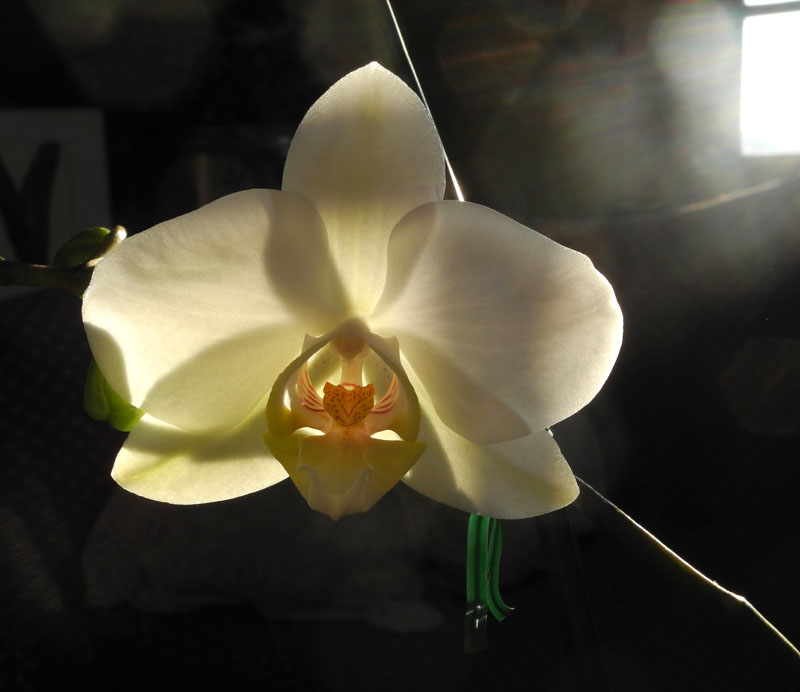
In two days the flower was fully and gloriously open. Click on the image to see the almost animal-like form at its center, like a portrait of a leopard with wings. There is so much that is magical in the world: the fact that from small seeds a plant will grow and flower and produce fruit is still something that at times strikes me as miraculous, as did this flower's appearance on a seemingly dormant plant.