November 11, 2013

A New Painting: "Blues"


Blues, egg tempera on calfskin parchment, 8 1/2 x 6 1/2 in. 


Like my most recent painting, Curves and Square, this new painting plays with symmetry/asymmetry. My choice when working out the composition for Blues was whether or not to have the central cylinder actually centered. It seemed to me that the weight of the painting would be off if I centered it, with the angled bar and leftward shape at bottom pushed too far to the left, leaving too much open space at right. So I decided that the angled bar would be centered instead. As for color, I worked with a redder blue at top, which might or might not be sky, and a cooler blue for the rest of the painting, separated by a light grayish bar. The image has a somewhat figural feeling to it, which I don't mind, since it adds a humorous touch; this would have been less pronounced if I'd left out the two circular shapes at top, but I thought "why not?".


Blues detail

November 10, 2013

The First Snow


The defining events of each season are always exciting: when I hear the peepers I know it's spring, and the first robin also thrills; summer's height is marked by the first ripe garden tomato; the first apple is an announcement of the coming fall. For winter, there's nothing that points to its arrival, sooner or later, than the first snowfall of the season; in my last post "The Larder is Full" I announced I was ready for winter; this morning I woke in the dim light and saw that something was different about it: everything was covered with a light coating of snow. The pumpkins decorating the front steps had white caps, mixing colors of fall and winter.


A few orange flowers still grace the honeysuckle by the front door; this morning along with the leaves, they're topped with snow.


The pond appears dramatically black within a white landscape.


Golden grasses contrast brightly with white.


Other forms, like the pumpkins, attract caps of snow. Here the dark dried heads of bee balm have their white helmets. The sky this morning was a beautiful pink-gray-pale yellow, and though light-filled seemed almost heavier than the ground.


Snow also catches in the interstices of branches, as though building new structures.


Sometimes there's a benefit to not cutting back the perennial garden, as here when I have the ochre leaves of Amsonia glowing in front of the snow draped honeysuckle.


And in the back yard, a reminder that summer will return.


November 7, 2013

The Larder is Full; I'm Ready for Winter


Almost all the crops are in, processed and waiting for winter eating, stored in various places in my house. I enter the house through the mudroom, a place to remove jackets and boots, to wipe the muddy feet; a place to hang onions and garlic as they dry, and to hang the stalks of oat straw, which make a delicious and calming tea.


Also in the mudroom are my washer and dryer, and my chest freezer, which is now filled to the brim with the summer's crops of fruits and vegetables. There are hot and sweet peppers, green beans, corn, greens (swiss chard and spinach), zucchini, peas, broccoli, tomato sauce, fried eggplant; and fruit: blueberries, raspberries, rhubarb; some meat: organic free range chickens grown at a farm nearby, a little beef raised by a friend in northern Vermont.


The cool spare bedroom becomes a storage room during winter; here I hang garlic and onions and store winter squash and pumpkins because the mudroom has some heat and is too warm.


There is more food storage down in the cellar, perfect for a root cellar with its granite foundation and dirt floor.


There is old shelving in the cellar that was in the house when I moved in. I store paint here, and flower pots and soil; I store my dye pots. And in those cardboard boxes are the fruits of my canning labor....


...here tomatoes; I canned 15 quarts. There are also quarts of apple sauce and jars of home made jam: blueberry, rhubarb, green tomato, apple butter, an essential part of my daily breakfast.


Through a door into a walled off room is the root cellar, where I store the root crops and cabbage. In the old box (left here in the house) are carrots and the buckets hold beets. I cover them with plastic to keep in the moisture.


Here's a view of beets and carrots, covered with peat moss, which I moisten from time to time.


The potatoes are in another box that was left in the house, a huge one that I separated into two storage units, making it easier to identify the four types of potatoes that I grow: Red Norland, Green Mountain, Carola (my favorite), and French Fingerling (the best boiled potato). I had a pretty poor crop this year because of all the rain, but the large size of the box makes it look even punier; it's actually about 50 pounds of potatoes.


Lastly, here are my cabbages wrapped in brown paper, which store beautifully in the root cellar until May, though they're usually eaten by then.


The most hardy crops are still in the garden, the last holdouts of summer: brussels sprouts....


....and kale; there are also hardy leeks. As it darkens outdoors, I am heading out to pick a few leaves of kale to make kale chips (recipe here)  as a treat for dinner; delicious! as is all my food, grown healthily at home, full of nutrition. It is so satisfying to think of this bounty from my garden and how it will sustain me in the months ahead.


November 5, 2013

A New Textile: "Transparent Triangle"


Transparent Triangle, hand dyed wool on linen, 13 x 12 in.


My titles tend to be straightforwardly descriptive, and this work, until I began writing this blog post, was titled Circle and Triangle on Gold. Then I began thinking about how awkward that was as a title, a little long, not tripping off the tongue, and realized that an important part of this piece is the translucency of the triangle as it sits on top of the circle and the background, so the title became Transparent Triangle, more mellifluous sounding. I mixed the colors of the triangle with a blue added to the cherry red and to the gold. When I was working on the drawing in preparation for this new piece, I started with a square format, but soon realized that the balance of shape and background called for more space at the bottom, so I added an inch. 


In this detail you can see the hooking patterns more clearly. The gold is hooked in an overall pattern, to have it feel like background to the shapes hooked in lines paralleling their outlines. The lines of the triangle overlap those of the circle to reinforce its illusion of transparency. 


When I finished hooking the piece, but before I bound the edges, I tacked it up on the wall above a print of a Tantric drawing. I was surprised at the feeling in the textile, more than I'd expected; there was something about the simple strong shapes that seemed elemental, so it inspired me to begin a second piece related to this one.


November 4, 2013

An Interview


An interview with me was just published in the online journal Figure/Ground Communication. I am very grateful to the artist Jeff Hogue for being interested enough in my work to want to question me about it and about my early years as an artist; also to the artist Julia Schwartz, the editor of the artist interview series, who agreed to publish it. For those of you who are long time followers of this blog, much of what I say will be familiar, though stated differently, but you might be interested in my description of my life in NYC as a young artist. Here again is the link. Thanks in advance for taking a look.


November 3, 2013

At the Met: Animals


Antelope Pendant, Iran 3100-2900 B.C.; silver.


In his essay "Why Look at Animals?", which you can read here, John Berger begins by writing that before the 19th century, when the human connection with nature began to be disrupted,
...animals constituted the first circle of what surrounded man. Perhaps that already suggests too great a distance. They were with man at the center of his world.
and
Animals first entered the imagination as messengers and promises. 
Wandering through the Metropolitan Museum of Art recently, I thought to focus on the rich representations of animals in their collection which certainly make Berger's thoughts manifest. There is a power and presence to so many of the animal works, and a sensitivity to detail and form, even if abstracted, that makes clear the artist's attentiveness to the subject. The small antelope pendant above, only 4 inches long, is a favorite of mine that I visit often. I love its refined forms, so carefully described, so real and alive. It goes beyond naturalism to touch something more enduring and essential.


Bronze Horse, Greek (Geometric), 8th century B.C. 


Although it is quite abstracted, this sculpture of a horse is an embodiment of horse, with its graceful curve of neck and full limbs.


Animal, Mali, Bamana; 19th-20th century; wood, sacrificial materials


Quite a different kind of abstraction is used in this animal from Mali. It is a magical figure, called a boli, containing great power within the spiritual world of the Bamana. From the sculpture's description on the Met's website (more there if you are interested) I learned that
The primary function of a boli is to accumulate and control the naturally occurring life force called nyama for the spiritual benefit of the community. The composition of the encrusted patina varies, but all the ingredients possess this inherent and important spiritual energy.....As the sacrificial materials accumulate over time, each added layer affords the structure greater spiritual power. 

Bronze statue of Artemis and a Deer (detail), Greek or Roman, ca. 1st century B.C. - 1st century A.D.


This graceful creature stands looking up at Artemis, also known as Diana, the goddess of the hunt, of wild animals and wilderness.


Waterfowl in a Clapnet, Egyptian Dynasty 11, ca. 2051-2000 B.C.; painted limestone.


Egyptian reliefs have some of the most beautiful depictions of animals in the history of art. Their outlines are elegant and specific, and the interior carving delicate and finely observed. They balance a simplifying vision with a keen understanding of animal forms. They are achingly touching.


Horse, Tang Dynasty China, 8th century; earthenware with brown glaze. 


My animal selections wouldn't be complete without a Tang dynasty sculpture. This horse is another favorite; he looks about to prance, or to be ready to pull a load, solid and full of life.


Hunting Dog, European, 15th-16th century or later; iron.


When I walk through the European sculpture galleries on the way to the American wing (café), I love to stop and visit this small dog, whose curves never fail to delight me.


Figure of a Hare, Egypt, 11th century; copper alloy, cast.


This exclamatory bunny was a new find, so utterly charming with its happy face and extended ears.


Seal Amulets in the Form of a Reclining Cow, Mesopotamia, 3300-2900 B.C.; various stones.


Animal Brooches, Roman, 100-300; copper alloy with enamel. 


Group of cosmetic Flasks, Iran or Central Asia, probably 9th - 12th century; soapstone, carved and drilled and serpentine, carved and incised. 

Stags and Ear Pick in the Shape of an Alligator, China, 13th-11th century B.C.; jade and bone (alligator)


Other new discoveries were a variety of small sculptures, made over a wide period of time in different cultures, all objects for ordinary use; ordinary for those who could own such things, who I imagine were the elites.


The Crow Spy Talks to the King of the Owls and His Ministers, Egypt or Syria, Ottoman period, 18th century; ink and opaque watercolor on paper.
 

Laila and Majnun detail, Iran, mid 18th century; oil on canvas. See the entire painting here.


I found the two paintings above, one from a manuscript the other a painting, in the Islamic wing. The Crow Spy has wonderfully patterned imagery; the animals in Laila and Majnun, though more naturalistic, are still quite fanciful and tender. In all the works I've shown there is a sense of attention, of reverence, of deep interest in these lives that surrounded and were part of these various cultures, yet separate, as Berger described them, "parallel lives".


October 31, 2013

Four New Drawings


#23, egg tempera and graphite on hand toned paper, 15 x 15 in. 


I just finished four new drawings based on the overlapping circles from Islamic design. During my last drawing session a couple of months ago, I had two failures; they were pieces that just did not work, though I knew I wanted to revisit their ideas. #23 comes from one of those. I began with a dark red ground and had previously planned to work with opaque shapes on it, but as I worked I found the idea of overlapping transparencies more interesting. At that time, I couldn't shift gears easily, so the drawing was a mess. This time I understood more clearly where I was going so handled the paint more attentively. 


#23 detail


I slowly painted several layers of thin paint on each shape, and where they overlapped was a stronger yellow. Something I changed: I put the point of the "triangle" downward when it had begun up. I liked the feeling of the many ending by balancing on the one.


#24, egg tempera and graphite on hand toned paper, 15 x 15 in. 


In this group of four, #24 was the most surprising to me. I start with color sketches but sometimes the resulting drawing has a very different quality from the study. Here the two circles have a wacky presence with the vesica piscis shapes within them, as though they are strange insect eyes. They float above the translucent violet ground, mysteriously. These drawings continually end up in places I could not have imagined.


#25, egg tempera and graphite on hand toned paper, 15 x 15 in. 


When I prepared the papers for this group of drawings, I thought that this ocher-colored ground was too gray and dull and I wasn't sure I would be able to salvage it. I think, though, that the intense blue and dark red work to enliven the yellow; the monumental centrality of the simple shapes helps too. So I think it's okay.


#26, egg tempera and graphite on hand toned paper, 15 x 15 in. 


Two "V" shapes, one pointing up and one down, the pink opaque and showing through the blue above it. Both are more opaque than the translucent cool green ground so have a strong presence, as though they are symbols. All the images are discovered, or perhaps I should say uncovered, from the overlapping circles beneath: joining points with lines, following curves, to a seemingly endless number of compositions.


October 30, 2013

A Walk in the Woods: Still Green


My lawn is still bright green, not yet faded into its winter drab, but in the woods it is almost all dull browns and grays, the dun of late fall. The brightly colored leaves that fell on the path have lost their color and are now curled and dry. But here and there are bursts of green, rising gleaming, ongoing life amid death. Here is a bouquet of plantain-leaf sedge...


....and here another circle of green amid brown, a grass or a sedge. I love how the green seems more vibrant, and the leaves happily disheveled, in contrast with the surrounding dried leaves.


Some ferns stay green all winter, peaking their color through snow.


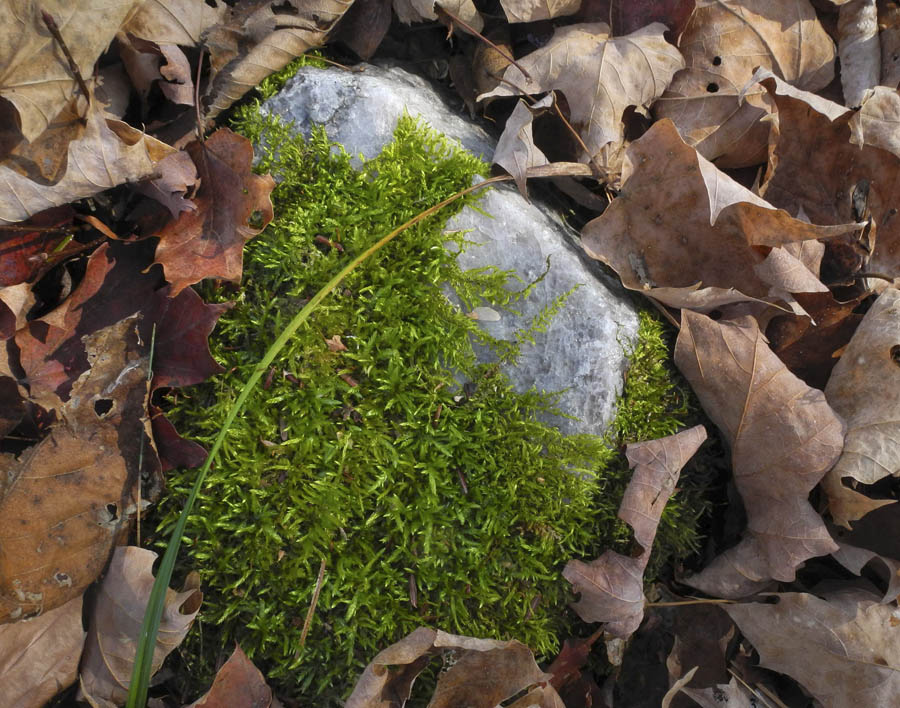
The richest greens of the woods now come from mosses, growing on the ground, on wood, on rocks.


A beautiful white rock, probably quartzite, with its covering of glittering moss, looks like a gift hidden on the woodland path.


The plants in the woods that seem happiest right now are the clubmosses, a group of plants that have been classified as "fern allies", like ferns using spores to reproduce. I believe the clubmoss above is running cedar clubmoss; as you can see, it sends out runners above ground.


Here is a beautiful, almost frothy looking clubmoss, looking very perky as it catches the light. Or is it a spike moss, another fern ally?....


....which these plants may be. At their tops you can see the "candles", which contain spores. These small green spires spread across areas of the forest floor, looking like a miniature Christmas tree farm.


These sweeps of green, low growing and vivid, join with the evergreen conifers to remind us that there is life in the seemingly dead earth.