July 8, 2014

New Hooked Wool Drawings


2014 #11, hand dyed wool and egg tempera on linen; 3 panels: 11 x 5, 11 x 10, 11 x 5 in. 


When I was working on the studies for this group of hooked wool drawings, I seem to have had crossed straight lines in my mind, because these 3 new pieces have straight lines with shapes appended to them. In this triptych, the first I've done, the straight line moves across the 3 panels, demarcating differently colored planes in each hop across space. Colors are primary (though not pure hues) for the hooked areas and secondary for the painted ones.


2014 #12,  hand dyed wool and egg tempera on linen, 16 1/2 x 17 7/8 in.


A line moves from a square to a rectangle, with triangles full and empty above and below it.


2014 #13,  hand dyed wool and egg tempera on linen, 15 x 12 in.


Two simple deep pink rectangles and two of linen are lined with lime green, and a blue square marks their meeting place.


2014 #13 detail


I continue to be interested in the varied textures of linen and paint and wool, how they relate and how they change the space and the physical presence of these pieces.


July 7, 2014

What If.....?


Pierre Bonnard, Bather, 1935. Image courtesy WikiArt


I remember being stunned by Bonnard's late paintings in the 1998 exhibition at the Museum of Modern Art. The color was brilliant and shimmering, and of a peculiar intensity; it was from this world but pushed beyond it, past the everyday.


Pierre Bonnard, Nude in the Bathtub, 1935. Image courtesy WikiArt


The paintings of bathers were especially compelling, along with the late self portraits. The woman in the bathtub seemed to hover between life and death. The woman pictured was always Marthe, Bonnard's wife and long time partner and muse. In his book of essays, The Accidental Masterpiece: On the Art of Life and Vice Versa, Michael Kimmelman suggests that Bonnard's noticing of Marthe on a Paris street may have profoundly influenced his life and his work:
By one of those accidents of fate, in 1893 the painter Pierre Bonnard was walking down a street in Paris (or so the story goes) and he spied a young, elfin woman alighting from a tram....He followed her to work (it turned out that she sewed artificial pearls onto funeral wreaths). 
For the next half century, as Bonnard's biographer, Timothy Hyman, has put it, Marthe became "the defining figure of his life and work". Her increasing nervousness, her misanthropy, her jealousy and hypochondria conspired to determine what became their solitary and circumscribed life together. And that life, in turn, shaped Bonnard's path as an artist of ecstatic and inward-looking vision. 
Of course Kimmelman points out that no art is defined by any one thing, but he does believe that Bonnard's meeting with Marthe, and their life together, was a strong influence on his painting:
...[Bonnard] dated the birth of his painterly identity to shortly after they met. Had he walked down another street that day, or had he looked the other way when she stepped off the tram, or had he not pursued her....he might have met another woman and pursued a different life.


Philip Pearlstein, Female Nude on Yellow Drape, 1965. Image courtesy Betty Cunningham Gallery.


Lois Dodd, Wild Geraniums, 1967. Image courtesy NY Times.


I'm a Brooklyn kid, so when it came time to go to college, Brooklyn College seemed the logical choice. There I studied with Philip Pearlstein and Lois Dodd, among others; it was there that my path as a representational painter was laid out. But what if I'd gotten on the subway into Manhattan and gone to Hunter College instead, along with a good neighborhood friend of mine?


Robert Morris, Untitled, 1967-8, remade 2008. Image courtesy Tate Gallery.


Tony Smith, Untitled, 1962. Image courtesy Matthew Marks Gallery.


The emphasis at Hunter was on abstraction, with the faculty including Robert Morris, Tony Smith, Ralph Humphrey, Ron Gorchov. I believe I would have been a very different painter, one with the same sensibility, but a very different style. Instead of a late, slow turn toward abstraction, I might have begun there. Who knows? It's fun to think how a single choice or action could have changed our lives. The singer John Hartford wrote a very funny song about the role of chance, which you can hear at the link: "I Would Not Be Here" ..."if I hadn't been there"....which goes on and on and on, back and back.....because of this and that and that and that; it becomes absurd. So perhaps it's best not to think about it. 


July 3, 2014

At the Frost Place


Up a gravel path, past the lupins, is a modest white house perched on a hill. This is The Frost Place, where Robert Frost lived with his family for five years, from 1915 to 1920, and for 19 summers thereafter. In 1976 the town of Franconia, NH, where the house is located, bought the farmhouse and land and established a board of trustees to oversee what became an "educational center for poetry and the arts".  Frost had first visited the White Mountains in 1907, staying in the town of Bethlehem; he said about the area that "there is a pang there that makes poetry".


There is a beautiful, expansive view of the mountains from the front of the house, a view that was probably more open when Frost lived here.


Behind the house is a trail through woods that was started in 1997. This land had been meadow in Frost's time, but has since grown up in woods.


"Mowing"


This is the "Poetry and Nature Trail": as you walk on the path you can stop and read poems written by Frost while he was living here, poems with nature as their theme. I have a friend who was just telling me about how much she loved using her scythe; when I sent her the poem "Mowing" she felt that he "nailed it once again". 
To read all these poems, click on the photos to enlarge them. 


"Putting in the Seed"


For me he nails it with "Putting in the Seed", the "watching for that early birth/....


basil seedlings


....When, just as the soil tarnishes with weed,/The sturdy seedling with arched body comes/...."
He captures the magic, the Love of it.


"The Sound of the Trees"


At my house the sound of trees is often one of storm, but their blowing and rustling is indeed more beautiful than many other noises that come from human activity. For all their activity the trees are immobile, stalwart, not like us with our moving on.


"Stopping by Woods on a Snowy Evening"


"The Road Not Taken"


Many of the poems on the trail are famous ones, poems we think of when we think of Robert Frost. It was a pleasure to read them in this setting (and would have been even nicer if the swarms of bugs weren't so intense).


The staff at The Frost Place worked to establish native wildflowers along the trail and manage the forest. Then in 2007 two terrible windstorms undid all their work, so restoration work has been ongoing.


"Nothing Gold Can Stay"


A lesson from storms, from seasons, from life, is perfectly expressed in this brief poem, one that tugs at my heart. Through nature, Frost touched on deep human feelings.


July 1, 2014

A New Painting: "Light Fingers"


Light Fingers, egg tempera on calfskin parchment, 6 x 8 in.


This painting was a clear lesson in how something so seemingly simple can be so hard to get right. I wrestled with the greens for days, making them lighter, darker, warmer, cooler; wiping off the shadow color and starting again: the shadow was too dark, too light, too cool. Each time I thought the painting was finished, I'd walk away from it for a while to get a fresh view, or leave it overnight, and see that the balance of hue and value was still off. One of the challenges was to get the upper part of the painting, including the horizontal plane, to look as though it was in front of the lower part of the painting and to do that with "hue, value, intensity" of color, a rallying cry of my former teacher at Skowhegan years ago, Gabriel Laderman. Those three qualities of color can be endlessly adjusted, balanced and rebalanced. Finally, I think I pinned down those greens.


Light Fingers detail

June 30, 2014

My Wildflower "Meadow"


I have some grassy fields which I mow once a year so that they don't grow up in brambles, shrubs, and small trees. I have others for which I hire someone with a tractor and brush hog, but these areas are my job, as I very very slowly mow through high grasses. I try to treat the work as a time to relax and look out across the landscape, seeing it from points of view that are not my usual ones. This year one small section of grass is vivid with wildflowers, common but beautiful.


There is the violet of vetch.....


....and the rich red-oranges of Devil's Paintbrush, what some folks around here call "Indian Paintbrush". It is Orange Hawkweed, an introduced species. Of course there's lots of red clover.


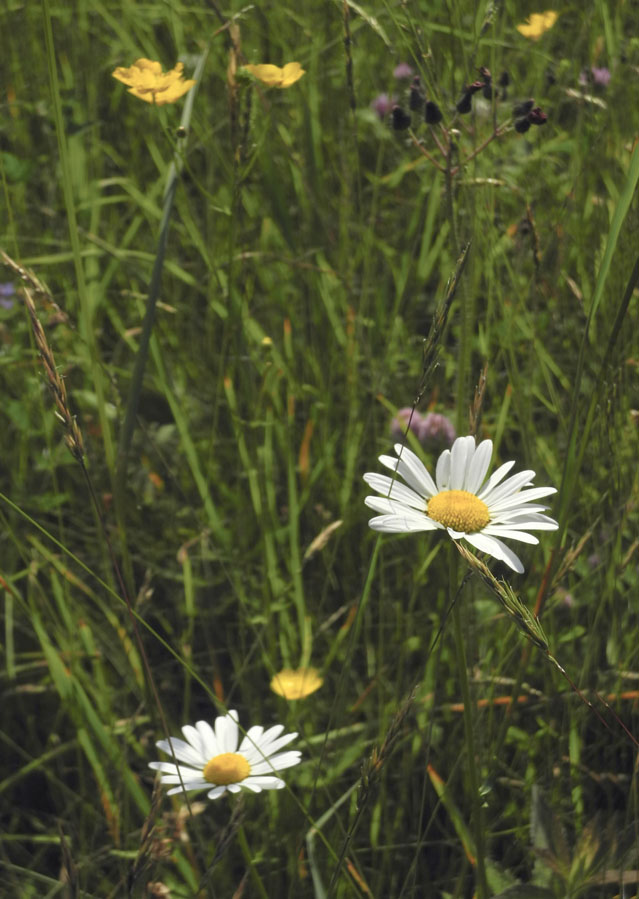
Not all the colors dotting the grass are intense, though the contrast of the bright white daisy petals with their rich yellow center does catch the eye.


The delicate yellow of Cinquefoil has attracted a tiny bee.


Yarrow's white is made up of many small flowers, each with its pale yellow center.


The complex form of Columbine is a delight to see out in the field, popping up here and there, adding its juicy color to the greens. I also love its seedheads, ending in flowing pointed lines.


Black-eyed Susans are beginning to open their sunny faces.


Another plant of royal purple, in bud. I was given some of this plant, which I believe is Campanula glomerata, by a friend; when it turned out to be invasive in the flower border, I tossed it into the grass, where it's been happily growing for years.


A frothy white mass, smelling sweetly under the apple tree: Bedstraw.


Milkweed is in bud, with a couple of flowers opening to show their cupped, waxy five petals. When the masses of milkweed are in bloom, the air is deliciously scented with their fragrance. I've discovered that by searing their cut stems, I can keep them in a vase and their fragrance will waft through the house.


Many years ago when I first moved here, I discovered these rugosa roses growing in the grass. I dug some up and planted them on the east side of the house where they thrived, sending up 6 foot canes and producing many fragrant flowers. And there the original roses are, low in the grass from being mowed over each year. I think that this year I will mow around them and see how they do.


This globe of light, like an enormous warm-colored dandelion, catches the sun as though it were spun gold. It's the seedhead of the Yellow Goats-beard, whose flower also looks like a dandelion. Each of these wildflowers is a pleasure to see, and there will be more to follow––Queen Anne's Lace, Jewelweed, Goldenrod––but in other fields, because, sadly, I have to mow this one in coming days.


June 27, 2014

At Hancock Shaker Village: Men's Work


When you step out of the visitors center at Hancock Shaker Village, you are immediately aware that this had been a farming community, and that the tradition has been carried on by the museum staff and volunteers. As I explained in my last post on women's work, labor at the village was divided into those jobs done by women, and those by men. This is not very different at all from the culture at large, even through most of the 20th century. As in "the World", men did the hard work of farming.


The agricultural implements of the 19th century are certainly different from those of today which are run with internal combustion engines. This wagon has some kind of rotating floor and I'm not sure of its purpose, but I love the way it looks.


This moving floor is part of a horse treadmill, or "tread power". The Shakers used this treadmill to provide power for grain threshing, sawing wood, and for other large farm machinery. Smaller treadmills for small animals such as sheep were used to power butter churns, cream separators, and other small machinery. (from the museum label) Treadmills are an ancient technology, and I did find a modern treadmill for electricity generation: a farmer in Ireland developed one for his cows.


This is a room in the hired men's house. When the number of men converts in the community dropped in the mid 19th century, the Shakers had to hire from outside in order to do the work necessary to maintain the land and buildings. Workers lived here, separately from the community, until 1947.


I find the proportions of this building, an ice house, very satisfying. It is built into a hill, so you are seeing only its upper half. This is the south facing side; the tallest wall is the one facing north, which would keep the building cooler. A large quantity of food was stored here to keep it fresh.


Two hundred tons of ice were stored in this room and another small one above. If you enlarge the photo you'll see slots in the brick wall to enable the cold air to flow into the storage areas. I thought the walls of this room were very beautiful, with the diagonal boards and the open grid. Ice was used until the Shakers switched to mechanical refrigeration in the early 20th century.


Shaker Brothers made shoes for the community into the 1800s. This bench was made in the 1840s at the New Lebanon, NY, community.


Basketmaking was one activity that women also took part in. The men prepared the splints for weaving from ash logs and made the heavy work baskets, but women would make the most delicate ones.


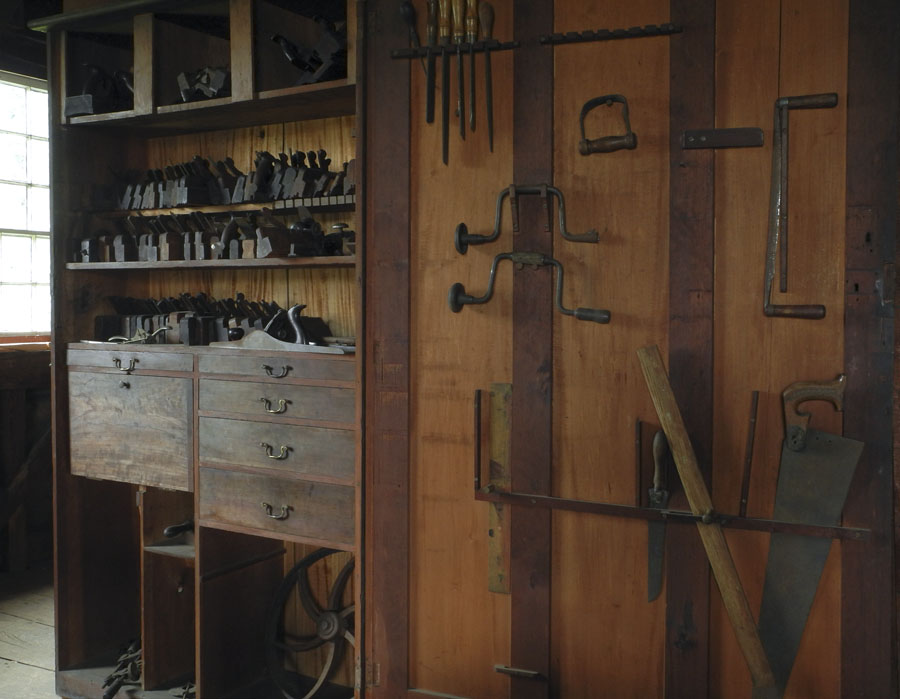
The woodworking shop was in a barn that had been a tannery at one time. There were very large workbenches on view that had vices attached and drawers for storage. According to the museum description:
Shaker cabinetmakers were driven by the necessity of creating practical storage spaces that reflected the gospel simplicity required by their religion. Their methods of joinery were similar to those used by their neighbors, yet their designs and lack of ornamental elements were decidedly not of "the World". 


Beautiful, useful cabinets hold tools for woodworking.


Finally, there is the machine shop, housed in a large building, in half of which was the laundry, run by women. For some reason I find machine tools fascinating; I wrote about a machine tool museum in Vermont, The American Precision Museum, a couple of years ago. I suppose it's part of my visual interest in agricultural machinery, which provides me images for my paintings, because I don't like or trust power tools. In this shop, saws and drills and lathes were run by pulleys and belts powered by water.


Underneath the floor was a water turbine (earlier a water wheel) that was powered with water flowing through an underground channel from a reservoir north of the building. When I visited this building, I was lucky in having a knowledgeable docent who turned on the power; it was quite amazing to see how strong the water was. It then flowed out under fields, in a stone lined aqueduct of sorts, to a wooded area some distance away.


Upstairs was a drill press that had been operated with water power. The belts are elegant linear elements alongside the curves of the machine.


I thought I'd share this very touching photograph with you. It is a portrait of Brother Ricardo Belden, taken sometime around 1953. He was the last of the Hancock Brethren . He worked in this clock shop until his death in 1958. After visiting the Hancock Shaker Village, I felt that the life here had great value to its members, but with no childbearing and no connection to a major religion, I suppose it was inevitable that it couldn't sustain itself.


It was very moving to walk among the buildings and see the artifacts of a now vanished community, artifacts of utility and beauty. This simple wheelbarrow, made wholly of wood, resting among many other objects on the upper floors of the machine shop, touches my heart as I think of the bent backs moving the loaded tray, just as I do now with my red metal one.


Previous posts on the Hancock Shaker Village:
The Shakers: A Community of Faith and Work
At Hancock Shaker Village: Women's Work