December 10, 2014

A New Painting: "Zigzag"


Zigzag, egg tempera on calfskin parchment, 6 1/2 x 9 in.


Each summer when I go out to find motifs for my paintings I think that my vision will become more pared down, more and more minimal. In general it has done so over the past few years, but I still fall in love with quirky, more complex images such as in Zigzag; I find myself unable to be a minimalist purist. Though in a way, I can see this as a humorous variation on a stripe painting. 


Zigzag detail


I had to paint many layers of color––lighter/darker, warmer/cooler––to get the hues and values to show convincing light. It is easy to do with the fast drying egg tempera, and its translucency, which shows the shifting color, adds richness to the surface. People think of egg tempera as laborious, but it's not at all like that; it is quick and full of light.


December 8, 2014

At the Met: From Assyria to Iberia, the Ageless Beauty of Objects


Plaque with lioness attacking a youth, Nimrud, 9th-8th century B.C.; ivory, gold, semiprecious stones, and vitreous material. Image courtesy NY Times


Wandering the galleries at the Metropolitan Museum of Art––from the Near East to the Far East, to Africa, and the Americas, and Europe; from millennia B.C. to the current day––I often marvel at the human desire for beauty. We seem to need it, along with a need to picture, to represent the world around us. The objects that remain, that are exhibited in museums, are of course the most beautiful and are often for the elites of a culture, but aren't we lucky to have them! The other characteristic of human culture that the Met at times emphasizes in special exhibitions is our wandering nature; whether to conquer or to trade or out of curiosity or need, we move about the globe. In the current exhibition, Assyria to Iberia at the Dawn of the Classical Age, we see works from the Near Eastern empires to those of the Mediterranean, and see influences flow back and forth.

I have to admit, though, that I am less interested in the complex histories of the works––some of which you can see in an excellent slide show at the NY Times––than their aesthetic qualities. The remarkable plaque above was my favorite piece in the show, small though it is. In it, the lithe bodies of man and animal are locked in an embrace; rather than a struggle we see a kiss and an ecstatic surrender. The elegantly patterned surroundings emphasize the beauty of the moment, rather than its horror.


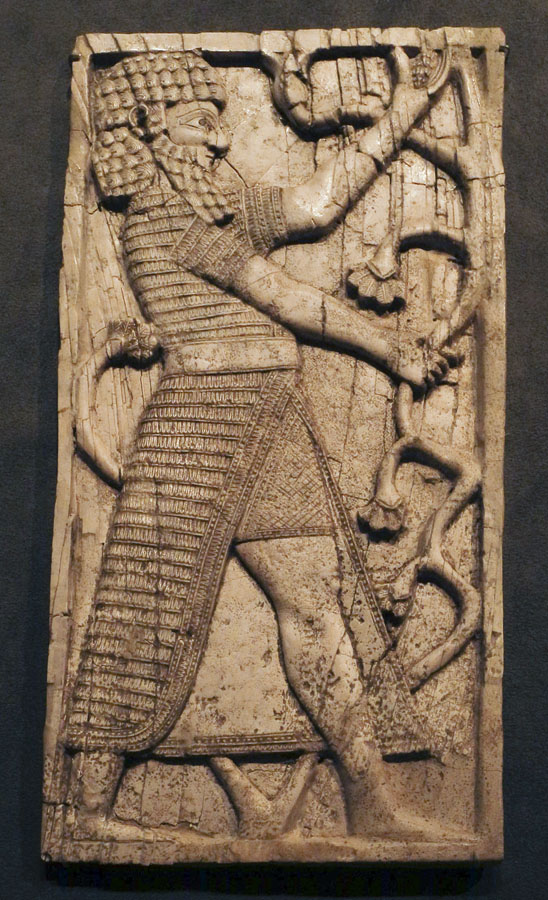
Chair back panel with striding man, Nimrud, 9th-8th century B.C.; ivory.


There were other beautifully carved small ivory pieces on view. Photographs were not allowed, the Met's website has very few images, so I "stole" a few photographs when I could. I love relief carving. maybe because it's between sculpture and painting; a subtle three dimensionality doesn't overwhelm the elegant composition of flowing line and the sensitive depiction of the forms of plant, animal, and human.


Relief showing a lion hunt, with king pouring a libation over the dead lions, Nineveh, 
ca. 645-640 B.C.; gypsum alabaster.


Reliefs showing the battle of Til Tuba, Nineveh, 660-650 B.C.; limestone.


Bodies upon bodies: the Assyrian kingdom was a violent and bloodthirsty one, whether killing lions in a ritual hunt or killing men in battle. But....the artists of the kingdom made from these events powerful and moving sculpture. There is very careful and detailed observation, especially in the picturing of animals. The men are stiff, their emotions contained, but the lions have both pathos and grandeur. I remember being moved to tears by the panels of the Assyrian lion hunt when I first saw them at the British Museum many years ago.


Cauldron with lion attachments, Caere, 675-650 B.C.; bronze.


Lions appear again, in more stylized form, on a large cauldron. This is from ancient Etruria, near Rome, and was influenced by designs from the Near East. To me it looks like a magical, ceremonial object, almost frightening in its decorations of open-mouthed, fierce-toothed lions. The curved forms of the attachments echo the bulbous form of the container.


Cosmetic container, Etruria, 700-650 B.C.; Tridacna squamosa shell.


Lastly, objects I found utterly charming: cosmetic containers made from large shells. In the several on view, a woman's head was carved into the top of the shell, the part called an umbo. The shell itself, with decorative carvings, became the flowing lines of a dancing cape. There is such pleasure for me in these works and others in this exhibition, seeing imagination and artistry powerfully present centuries after their making.


December 5, 2014

A New Textile: "Translucent Curves"


Translucent Curves, hand dyed wool on linen, 10 x 19 1/2 in.


The titles I use for my works are generally flatly descriptive, but I was tempted with this textile to be a little funny and metaphoric and call it Hill and Dale; then I thought, no, the idea of landscape will be annoying fixed on what is an abstract idea, so I changed it to Green and Pink Curves; but that missed a main component of the piece, which was the value shifts from lighter to darker in each hue, so I finally settled on Translucent Curves.


Translucent Curves studies


This is a page of thumbnail sketches, where I am working out some major decisions about color and about the direction of the hooking. Once I'd decided on the darker red/green on top of the image, there were several ways I could hook the piece: all-over curves, or two directions of curves, as in the bottom two sketches. I ended up going with the middle sketch, so as not to break up the flow of reds. Below is a detail of the meeting of the four colors, two directions of hooking. 


Translucent Curves detail


December 3, 2014

Winter Fog: Mystery/Clarity


Fog makes a mystery of the world, as it sinks into a soft obscurity; fog illuminates the clarity of space as each plane––the near, the middle, the far distance––shows dark, mid-toned, and light.


On a clear day the form of this ancient apple tree––I think of it as a bent old lady––would not show up as strongly as it does with the background grayed by fog.


A stand of dried weeds echoes the shape of pale trees in the middle distance; the fog creates a poetic relationship, and the snow creates the drama of dark on light.


Dried grasses, which just a few days ago were sparkling white with hoarfrost, are now warm colors, a screen before a grayed landscape (ah, the wonders of winter's moods).


Close to us, the clarity of grasses against snow; the distance has two layers, the closer with some color, behind it, gray. 


The distant hills are completely obscured by fog; we see soft outlines of bare trees, then the clearer form of a young maple, still bearing some leaves; closest to us, a repeated form of small tree, with dark, crisp branches.


A drop of moisture, hanging from the branch of an apple tree, contains another branch within it. A day like this makes the world seem as though so much is hidden; it feels sad and distant, yet at the same time, it is life seen anew.


December 2, 2014

At the Met: "Ragamala: Picturing Sound"


Vasant Ragini, India (Rajastan, Amber), early 17th century; ink, opaque watercolor, and gold on paper;
9 13/16 x 7 7/8 in. 


It is always a delight to see an exhibit of Indian paintings; their forms and colors are so engaging, and their intimate size invites close looking. Their worlds are magical, with attention paid to flowing, brightly colored garments and elegant limbs, and to the riches of nature. And some paintings are celebrations of music and of love. There's a small show of paintings, titled "Ragamala: Picturing Sound", in one of the Met's almost-secret galleries, up some stairs at the end of the Indian galleries. Any information I have comes from the Met's description of the show and of the individual paintings, all 20 of which you can see at the link. A ragamala is a group of paintings, gathered in a folio, which depict a range of melodies, with different moods. In some paintings, as the one above, the mood is written as poetry in the margin. And to quote the exhibition description, "The unifying subject of a ragamala is love...."


Vasant Ragini detail


This painting is a celebration of spring. I love the flowers in the nobleman's hat, the pot of flowers he holds high; he dances, like Krishna, surrounded by beautiful maidens. He carries a musical instrument, made with two gourds, beautifully decorated, like the one below.


Mahati Vina, India, ca. 1885; gourd, various materials; 56 x 14 in.


This type of stringed instrument is pictured in many of the paintings; it was wonderful to see it, and see the care with with it was decorated. 


Ruknuddin, Kedar Ragini, India (Bikaner, Rajasthan), ca. 1690-95; opaque watercolor and ink on paper; image: 5 7/8 x 4 11/16 in. 


This image is so subtle and delicate, the evening light soft and color subdued. The artist has illustrated texts that describe "an ascetic 'in penance, adorned, gray [with ashes]' listening to a disciple, who is described as 'a young man beauteous in every limb', playing the rudra vina."


Vasant Ragini, India (Madhya Pradesh, Malwa), ca. 1630-40; ink and opaque watercolor on paper; 
7 5/8 x 5 3/4 in. 


Krishna dances in another homage to spring. The line of flowering plants at bottom, and trees at the top of the painting, are fanciful and celebratory.


Setmalar Ragini, India (Madhya Pradesh, Malwa), ca. 1630-40; ink and opaque watercolor on paper; 
13 1/4 x 9 3/4 in. 


The rainy season is evoked here with the bands of clouds at the top of the painting, with stylized lightning looking like brown snakes.


Setmalar Ragini detail


What is most wonderful are the imaginatively patterned trees and the vivid birds, and Krishna's delicate gesture in feeding one of them.


Shri Raga, India (Rajasthan, Bundi), mid 17th century; ink and opaque watercolor on paper;
8 1/4 x 4 3/4 in.


What I love most about Indian painting is the use of color: the juxtapositions of different hues and values is brilliant; orange against red; violet with orange, blue and pink and tan and yellow; a rectangle of green topped by bands of violet and orange; yellow parapets, white ones. There are so many ideas about color that I often refer to my books on Indian painting when I'm working.


Solanki Raga, India (Deccan), ca. 1590; ink and opaque watercolor on paper; 
10 5/ 16 x 8 3/4 in.


This painting has a very different color mood, deep and rich. 


Panchama Ragini, India (Rahasthan, Bikaner), ca. 1640; ink, opaque watercolor, and gold on paper; 
7 3/4 x 4 7/8 in. 


More gorgeous color adorns this painting; a strong salmon pink creates a structure that is punctuated by the greens of clothing and wall. This painting "expresses entertainment, happiness, and love".


Andhrayaki Ragini, India (Himachal Pradesh, Bilaspur), ca. 1710; ink, opaque watercolor, and gold on paper; 8 1/2 x 6 1/8 in. 


What a marvel of pattern adorns this painting, pattern to describe a terrible storm, lightning outlined in gold. The storm is meant as "a metaphor for the turmoil of love". 


Bairadi Ragini, India (Rajasthan, Bikaner), ca. 1605-06; ink and opaque watercolor on paper;
8 1/4 x 6 1/8 in. 


A strong, beautiful red shape above an orange floor and yellow bedspread, surrounded by a violet structure: the painting would be wonderful with just those shapes and colors, but there is also a story, which is told in the ragamala text: "That most beautiful one, wearing fine armlets....[is] holding off her beloved with her fly-whisk." A quarrel, her finger pointed upward...no!...his hand attempting to touch her. With elegance and beauty and restraint, the tale is told.


November 29, 2014

Winter Radiance


The loveliest of winter weather phenomena is hoarfrost, which turns the early morning landscape into a sparkling vision, with icy crystals coating the finest of surfaces. It doesn't occur often, and when it does it's magical; this morning it invited me to bundle up for the 6ºF weather, grab my camera, and go outdoors to photograph.


A single stem of a grass is bristling with ice crystals, each of the angled surfaces catching light.


Instead of the usual golden weeds and grasses, there are shards of light against the darks of distant hillsides.


Weeds in a ditch become glorious....


....and grasses are transformed into a symphony of light.


Ordinary weeds, festooned in sparkling white, are briefly among the most beautiful things on earth.


Perennials are also decked out in brilliant winter whites, the flowers of ice rivaling those of summer. The stems of loosestrife, bent under the weight of crystals.....


.....and the rounded seed heads of bee balm, topped with a tall white cap, join the weeds in celebrating this brief moment filled with crystalline light, the gift of an early winter.


November 28, 2014

Eight New Small Drawings


sd 17, egg tempera on hand-toned paper, ca. 7 x 7 in.


When I began this series of small drawings last spring, I toned the sheets of paper with a fairly solid wash of color (I use powdered pigment in a gelatin size for the toning; see this post for instructions). As I've continued with it, I've allowed my inner painterly painter to emerge: the gesture of brush laden with pigmented size has become as important as the small egg tempera shapes painted on top of it.


sd 18, egg tempera on hand-toned paper, ca. 7 x 7 in.


My sensibility tends toward the geometric, toward precision and control, so it's both fun and frightening to work on these: fun to do something new (though somewhat closer in feel in their improvisation to my potato prints), frightening to work on something new, where I don't have years of experience.


sd 19, egg tempera on hand-toned paper, ca. 7 x 7 in.


With my wide, 2 inch wash brush I laid down thin layers of reddish color, then added a heavier mark of more saturated pigment. Later, I added the small square of blue egg tempera.


sd 20, egg tempera on hand-toned paper, ca. 7 x 7 in.


Geometry creeps in, with horizontal and vertical strokes framing looser ones; then the horizontal/vertical is emphasized with the addition of painted rectangles.


sd 21, egg tempera on hand-toned paper, ca. 7 x 7 in.


Once the toning/painting of the paper is done, there's the decision of what to add to it. I've been moving towards minimal additions for emphasis or contrast, here just the 3 violet lines....


sd 22, egg tempera on hand-toned paper, ca. 7 x 7 in.


....here an ochre band on top of the red at bottom.


sd 23, egg tempera on hand-toned paper, ca. 7 x 7 in.


And in this piece a very small green curve.


sd 24, egg tempera on hand-toned paper, ca. 7 x 7 in.


Finally, a green vertical dropping from a horizontal band. I might treat the drawing as complete without the addition of the egg tempera lines/shapes/brushstrokes, but there's something about the layering of another medium, and the thought and attention involved in choosing to make those marks, that makes the drawing richer and more solid for me.


November 26, 2014

Potato Leek Gratin: More Than the Sum of Its Parts


Cooking is often like alchemy: ordinary ingredients become magically transformed into heavenly tastes. The first time I made this recipe, a Potato Leek Gratin from the New York Times, I thought it was so delicious that I ate nearly half of a recipe for 6 people. I had been searching for a recipe with potatoes and leeks, and couldn't have been more pleased with this one. I realize that I'm sharing it a little late for inclusion in Thanksgiving dinner, but it's not difficult to prepare and will work for a special or everyday dinner. 


Potatoes in dish


2 Tbs unsalted butter, plus more to grease the dish
2 large leeks (I used 4 small ones) trimmed and halved lengthwise
1 1/2 lbs peeled Yukon Gold potatoes (I used a similar variety that I grow: Carola)
1 teas salt
1/2 teas pepper
2 thyme sprigs
1 cup heavy cream
1 fat clove garlic, finely chopped
1 bay leaf
1/4 teas ground nutmeg
3/4 cup Gruyere, grated (I used cheddar)

1.Preheat over to 350º. Butter a 2 quart gratin dish (I didn't have a large enough dish so used a souffle dish, which meant the potatoes were piled more thickly so got less crispy.) Wash leeks to remove any dirt and slice thinly.

2. Using a sharp knife or mandoline (I used a very thin, 2mm, blade with my food processor, which made the slicing easy work) slice potatoes 1/8 inch thick. Toss them with 3/4 teas salt and 1/4 teas pepper. Layer the potatoes in a gratin dish.

Leeks added to the dish

3. Melt the 2 Tbs butter in a large skillet over medium heat. Add leeks, the rest of the salt and pepper, and the thyme. Cook, stirring, until the leeks are tender and golden, 5 to 7 minutes. Discard thyme and place leeks over the potatoes.

4. Add cream, garlic, and bay leaf to the skillet, scraping up any bits of leeks sticking to the pan. Simmer gently 5 minutes, stir in nutmeg.

5. Pour the cream over the leeks and potatoes. (there's nothing in the recipe to suggest removing the bay leaf, but I remove it.) Top with the cheese. Cover with aluminum foil and bake for 40 minutes. Remove the foil and bake for an additional 15 -20 minutes, until the cheese is bubbly and golden. Cool a bit before serving.


I hope you all have a wonderful Thanksgiving holiday. Although there's much that's wrong with the world today, I know that I have so much to be thankful for, and I hope that you do too.