February 6, 2015

A New Batch of Small Drawings


sd 25, egg tempera on paper hand-toned with pigment and size, ca. 7 x 7 in.


I enjoy doing these small drawings because with them I can let out my inner painterly painter; because my painterly side is so hidden, I have tremendous uncertainty about them. I feel most secure working in a deliberate and fairly precise way, with images that have a grounding in geometry. But at this point in my life, I enjoy the challenge and the play. Years ago I did a series of small painterly oils on panel; they were a mashup of deKooning and Mitchell and Hodgkin. I gave up on them after a while. Now that I'm a senior citizen I allow myself to wander about in my art making; as long as I'm engaged with the work, I keep going.

I work on the toning of these small drawings at the same time as I'm toning paper for my larger drawings. When I began doing them, the backgrounds were fairly simple, then I began to loosen up. Now I layer color, and move the brushes around freely. I am mainly using 2 inch flat brushes with pigmented size; the size is a solution of food grade gelatin. In sd 25 almost all the paint is size, or perhaps I would call it distemper paint, but distemper has some added chalk. So...I paint all the backgrounds during my "toning" day. Then, I spend some time looking at what I've got, and with a brush hovering above the drawing, I add something to it. It was only two light green curved lines above....


sd 26, egg tempera on paper hand-toned with pigment and size, ca. 7 x 7 in.


....and here it was a line of gold paint across the opening. I feel that what I'm doing is pinning down the drawing, making a deliberate mark on the more fluid background, saying here I am, here it is, a decision. These additions feel necessary to me.


sd 27, egg tempera on paper hand-toned with pigment and size, ca. 7 x 7 in.


Two thick yellowish rectangular lines pick up the ocher above.


sd 28, egg tempera on paper hand-toned with pigment and size, ca. 7 x 7 in.


I never know if I've done the right thing, or should have done more; I'm floating in a sea of doubt.


sd 29, egg tempera on paper hand-toned with pigment and size, ca. 7 x 7 in.


This drawing was difficult to photograph because the three egg tempera squares are very shiny (I glazed them with extra egg medium) so look different in different light. They are a dark red.


sd 30, egg tempera on paper hand-toned with pigment and size, ca. 7 x 7 in.


For this drawing I added three yellow arcs, one on the red and two below. I meant to echo the sweep of red. The other thing the additions bring is a different sense of space: they tend to float above the glue size paint below.


sd 31, egg tempera on paper hand-toned with pigment and size, ca. 7 x 7 in.


For sd 31 I added a green rectangle, using several layers so its opaque quality would assert itself on top of the translucent blue and green.


sd 32, egg tempera on paper hand-toned with pigment and size, ca. 7 x 7 in.


The underpainting for this drawing was just the yellow; it looked almost like a floating landscape to me. I began adding a couple of curved lines, but didn't like them at all. Then I painted the horizontal transparent brown washes, and maybe I saved it, but maybe not. I sincerely don't know. What I do know is that I am giving myself permission to try all sorts of things, and giving myself permission to fail.


February 4, 2015

Michel de Montaigne: A Man in his Tower, Thinking and Writing


Montaigne's tower where he had his library.
Images courtesey of Wikipedia.

Here I want to be seen in my simple, natural, everyday fashion, without striving or artifice; for it is my own self that I am painting..../And therefore, Reader, I myself am the subject of my book: it is not reasonable that you should employ your leisure on a topic so frivolous and so vain.  
I undertake to write without preconceptions on any subject which comes to mind, employing nothing but my own natural resources...What I myself have thought up and produced is poor feeble stuff, but I let it go on, without plastering over the cracks or stitching up the rents which have been revealed by such comparisons [with the great authors of the past]. 
Ah, how can one not be charmed by these sentiments––as overly modest as they may be––and how amazing that they were written in the 16th century by a French nobleman, Michel Eyquem de Montaigne (1533-1592). In his massive books of essays, Essais written over 20 years (the French essayer means to try, to attempt) he ranged widely in his thoughts, writing essays:
On sadness; On liars; On idleness; On constancy; That the taste of good and evil things depends in large part on the opinion we have of them; On Moderation; On the Cannibals; Judgements on God's ordinances must be embarked upon with prudence; On the uncertainty of our judgement; On smells; To philosophize is to learn how to die; On educating children; On drunkenness; On cruelty; On vanity.....
....and that is just a small sample. Although each essay has a subject, Montaigne wanders about while discussing it, adding stories that he heard or witnessed, classical quotes, ideas sometimes tenuously connected to the subject at hand. This makes for a casual read, comfortable, like chatting with a friend. He is the originator of the essay form, looking inside himself and writing what he thinks. And, he was at times very funny. In writing about his memory, which he "can hardly find a trace of it in myself"; but its lack has its positive aspects: it has helped him to avoid ambition in worldly affairs and 
Then again, I talk less; it is always easier to draw on the storehouse of memory than to find something original to say. If my memory had stood fast, I would have deafened my friends with my chatter......Once you are off, it is hard to cut if short and stop talking. Nothing tells you more about a horse than a pronounced ability to pull up short. I have even known men who can speak pertinently, who want to stop their gallop, but who do not know how to do so. While looking for a way to bring their hoofs together they amble on like sick men, dragging out trivialities.
I quote this to give you an idea of how easy going and rambling and interesting the essays are; how readable and thought provoking. Of course, praise must be given to the translator of the complete essays. The version I have was translated by M.A. Screech, originally published in 1991; it includes a short and helpful introduction to each essay and copious notes. 


I was introduced to Montaigne via a wonderful biography, worthy of his character: How to Live: Or a Life of Montaigne in One Question and Twenty Attempts at an Answer by Sarah Bakewell. Bakewell loves her subject; her engaging writing leads us to also love him. Her book is biography and philosophy combined; it's a book that both entertains and invites us to think about big questions, not only how to live but also how to die. Montaigne lived during a terrible time in France, that of the religious wars between Catholics and Protestants, a time of such violence that our current religious brutality seems minor in comparison. This made him conservative in supporting the Catholic church over the new Protestants (although he did support Henri of Navarre, a Protestant, to be king, showing his pragmatism and his belief in good character above all else); he wrote "I abhor novelty....for I have seen some of its disastrous effects...". Montaigne was also remarkably modern in his relativistic acknowledgment––explicit in the essay "On Habit: and on never easily changing a traditional law"––that we are most comfortable with our own customs, thinking those of others unnatural and even immoral:
Peoples nurtured on freedom and self-government judge any other form of polity to be deformed and unnatural. Those who are used to monarchy do the same... 
The laws of conscience which we say are born of Nature are born of custom.  
...usage hides the true aspect of things from us.
Bakewell tells us of Montaigne's unusual education as a child: his father's unusual educational ideas led him to engage a Latin scholar as tutor so that Latin was his first language. Another essay of his that is very modern in its ideas is "On educating children". He insists that learning should be a joyous activity:
The most express sign of wisdom is unruffled joy: like all in the realms above the Moon, her state is ever serene.
He is dismissive of just book-learning; he wants the child to learn judgement, and to experience the world.
For our boy any place and any time can be used to study: his room, a garden; his table, his bed; when alone or in company; morning and evening. His chief study will be philosophy, that Former of good judgement and character who is privileged to be concerned with everything.
Montaigne is very much of his time in dismissing the abilities of women, although he did have women friends who he respected. There is so much about him to be admired that I can overlook this lapse into customary prejudice. This post is very long because it's difficult to summarize Montaigne's writing; I keep wanting to quote this and this and this. But if this is at all intriguing to you, I highly recommend Bakewell's book How to Live as a great introduction to the man and his thought. I will leave you with one last characteristic statement from Montaigne, one that is so modern and so modest; these sentiments could be/have been my sentiments:
Anyway these are my humours, my opinions: I give them as things which I believe, not as things to be believed. My aim is to reveal my own self, which may well be different tomorrow if I am initiated into some new business which changes me. I have not, nor do I desire, enough authority to be believed. I feel too badly taught to teach others.


*You can read a selection of Montaigne quotes at this Wikipedia link

February 2, 2015

Four New Drawings


#45, egg tempera on hand-toned paper, 15 x 15 in.


With this new group of drawings, I've returned to some stronger color relationships; my last group attempted much more subtle ones. For the background of #45 I used viridian green with a bit of titanium white added, in several layers. I use a glue size medium to tone the paper, a solution of food-grade gelatin and water, to which I add pigment, usually powdered.


#46, egg tempera on hand-toned paper , 15 x 15 in.


I've always found yellow a difficult color to work with because it is so strident, so when I toned the paper I used some ochre to deepen the hue and lessen its harshness. I think that the transparent hues of green and orange aren't bad with the yellow.


#47, egg tempera on hand-toned paper, 15 x 15 in.


I have used the motif of overlapping hexagons before, but this time I added lines to delineate the diamond shapes that occur....


#47 detail


....and I added additional layers of transparent color to separate the shapes. I used a thin layer of white on the upper right green and lower left blue diamonds; I darkened the other outside diamonds with a thin layer of blue. It was a very simple way to create more complexity.


#48, egg tempera on hand-toned paper, 15 x 15 in.


This final piece is more subtle, with a pale blue and very transparent sienna layered background. I tried to pick up the colors of the toned paper in the rectangular shape at the center. I glazed a layer of a darker sienna on the top half of the rectangle; underneath is the painted blue rectangle and the blue of the toned paper. I love the way egg tempera makes it so easy to achieve luscious and varied color effects.


January 29, 2015

A Walk in the Woods: Tracks


It was a beautiful day today, mild enough, with temperatures in the teens, for me to take a snowshoe. The storm earlier in the week brought only a few inches of very fluffy snow, so it wasn't a strenuous walk. The world looked beautifully pristine with the new whites brightening the landscape. It was a fresh canvas for the marks of animal tracks, laid over the pentimento of earlier passings. Deer tracks wandered across the woodland path, curving and crossing.


My snowshoes and pole marked a trail alongside that of a large mammal....


....who I can't identify although I was taught the difference between canine and feline tracks (my mind is a sieve).


What I most enjoyed were the wandering tracks of small mammals, adding another linear element to the landscape, across tree shadows. This animal went into the old sugarhouse, and I could see its tracks leaving on the other side; perhaps it sought shelter there.


The rhythmic line of tracks flows up to the tree, around it, and up and down across the drifts.


Here an elegant curve from rock downwards, and around a small tree. These are lines worthy of Matisse.


Then there are wide tracks made by small mammals; it's possible that because the snow is so soft a wider track is formed.


With the track above and with this, there is a look of a railroad, a highway, as opposed to the thinner lines. It's wonderful to think of the hardiness of all the wild creatures, who make it through bitter winters. The woods come alive with the crisscrossing of many tracks.


I took this photograph a couple of weeks ago, not in the woods, but in front of my house. A mouse headed across the snow to my compost pile, which is behind me. All winter I see small tracks leading to the compost, a feast for winter survivalists. Some come from my shed; as my FedEx driver put it "everyone needs a home". A couple of mornings ago, early, while it was still quite dark, I looked out my kitchen window toward the garden. I saw a large shape on top of the post near the compost pile. It was an owl, waiting for his rodent meal. He noticed me and flew off. I hadn't seen an owl there in several years, so it was exciting; it was also a reminder of how precarious life is for all wild beings, especially in winter.


January 28, 2015

"Chasing Ice": The Tragic Sublime


Meltwater on surface of Columbia Glacier, Alaska, June 20, 2008 (detail)
All photographs are by James Balog and are from the following three sites:


The word "sublime" has become a commonplace––"oh, that pie is sublime!"––but to philosophers of aesthetics and to 19th century landscape painters the concept included horror. To Kant (I quote from the Wikipedia link on the sublime) it included "the noble, the splendid, and the terrifying". For Schopenhauer beauty was pleasure in seeing a benign object, while the sublime was seeing "an overpowering or vast malignant object of great magnitude, one that could destroy the observer." It seems to me that nothing could express this idea of the sublime better than the icy regions of the globe, terrifying in their grandeur. These regions of glaciers and frost are now also frightening to contemplate, in that they are giving us disastrous news about the state of our planet.


Lindblad Cove, Antartica, January 11, 2011


James Balog, a photographer concerned with environmental issues, went to the Arctic to photograph glaciers on assignment for National Geographic. He was so struck by the evidence of climate change there that he made it his mission to document the changes happening, much too rapidly, to the world's glaciers. From this idea came the Extreme Ice Survey, and Chasing Ice, a stunning documentary about this important project; you can see the film on Netflix. Thanks to my friend, the artist and very concerned citizen, Ravenna Taylor, for alerting me to this beautiful and horrifying film. The beauty of these places is astounding, surprising; Balog's eye for pictorial drama makes the story so much more compelling.


Jokulsarlon, Iceland, "Icebergs that originated in the vast expanse of the Vatnajokull decay and melt in a tidal lagoon." March 4, 2005


Balog began the Extreme Ice Survey in 2007 to document the changes in glaciers over several years. There were many technical challenges in setting up cameras in severe climates that would automatically photograph the views in front of them over months. You can see some of the videos made by time-lapse techniques at the Extreme Ice Survey link above. They clearly show glaciers in retreat.


Ilulissat Glacier, Greenland. "A helicopter flying past a half-mile wide section of the Ilulissat Glacier calving face gives perspective on the staggering immensity of this ice wall (in some places it may be 70 stories tall)."


The enormous size of the glaciers seems boundless, immutable. But in fact, although glaciers always retreated a bit during summer and reformed during winter, now they are simply in retreat.


Ilulissat Isfjord, Greenland, August 24, 2007


Icebergs are pieces of a glacier that have broken off and floated out to sea.


Ilulissat Isfjord, Greenland. "Icebergs that have rolled over and been scalloped by waves metamorphose into fantastic shapes." August 24, 2007.


This has always happened, but the rate at which it is now occurring is much faster than in the past. In the film Chasing Ice, we see an entire wall of a glacier collapse, an astounding sight.


Ilulissat Isfjord, Greenland; Iceberg, July 17, 2007.


The fabulous forms of ice are wondrous and like nothing else. I can understand why artists such as Frederic Church in the 19th century went to the Arctic to paint icebergs:


Frederic Church, The Icebergs, 1861; oil on canvas, 64.5 x 112.5 in.


Svinafellsjokull Glacier, Iceland. "...a massive landscape of crevasses". February 12, 2008. (detail)


The intense blue of some of the ice is a marvel....


Greenland Ice Sheet, "Adam LeWinter surveys Birthday Canyon". June 28, 2009.


....as is the tremendous size and dwarfing scale of glaciers and ice sheets. They are among the great wonders of the earth, and they are surely disappearing due to our actions, and to our inaction about climate change.


Greenland Ice Sheet, "Bubbles of ancient air, possibly 15,000 years old, are released as the ice sheet melts." July 14, 2008.


The Greenland ice sheet is littered with dark holes in its surface, holes that attract more and more heat, and that release eons-old air from its depths. It is melting at a rate of 47 cubic miles per year. If the entire sheet of ice melted, sea levels would rise 24 feet, but that would likely take hundreds of years, though there is disagreement about it among scientists (see the link). It is clear, though, that even moderate melting would not be a good thing. James Balog and his Extreme Ice Survey are performing a great public service in making us aware, by luring us with beauty, of the danger that comes with it.


January 26, 2015

A New Painting: "Angles and Bar"


Angles and Bar, egg tempera on calfskin parchment, 9 x 6 1/2 in.


What interested me in this image was the concentration of small angled forms at the top contrasted with the large simpler space below. And then their were the holes: an ellipse at the top and three descending circles, adding accents to the yellows.


Angles and Bar detail


It's always a juggling act to get the color balanced and the light believable. Warmer/cooler, lighter/darker: I often have to repaint areas several times. Because egg tempera is translucent, the repainting is easier than with opaque oil paint. The layering of color adds depth, a depth the Old Masters knew how to achieve with their glazing techniques in oil, but few of us use now. People tend to think egg tempera is a finicky medium, but I find it very easy and forgiving; and full of light.


January 24, 2015

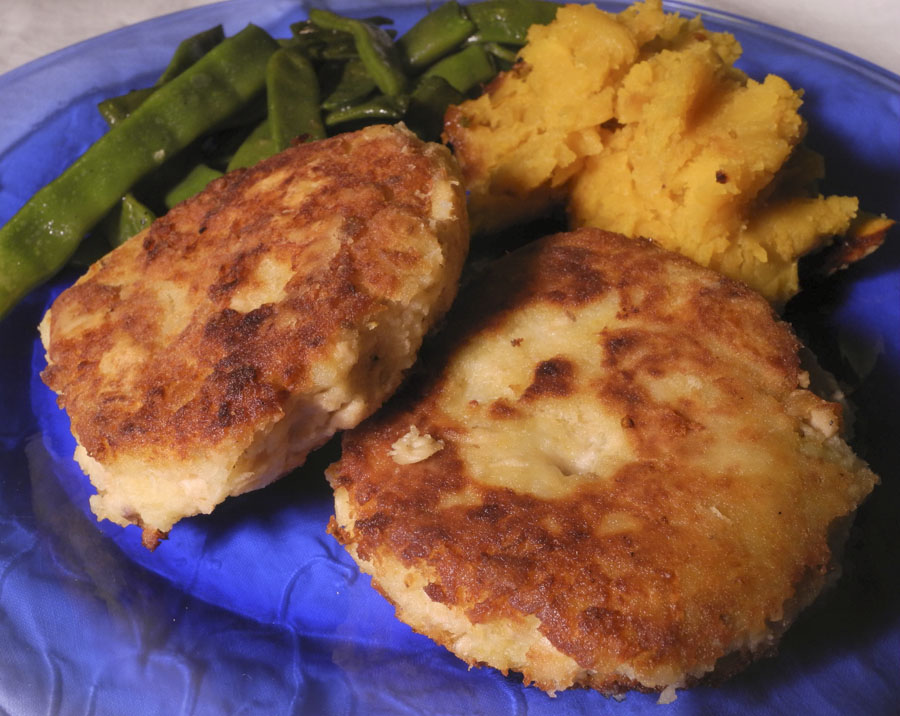
Delicious Salmon (or Vegetable) Cakes


I love simple recipes, of course delicious ones, and healthy adds another plus to the equation. Although I have previously shared only vegetarian recipes, in keeping with the "garden" theme, these fish cakes by Jamie Oliver fit the requirements of taste, ease, and health. Instead of bread crumbs as a binder, Oliver suggests mashed potatoes, a lovely idea. I use canned salmon, which makes the preparation very easy, and it's a great way to get our Omega-3s. Here I'm going to do a little preaching: I buy only wild salmon although it costs more. Farmed salmon are fed an unnatural diet, are given antibiotics, and pollute the waters they are grown in. According to this article from EcoWatch, fish farming is becoming more environmentally responsible, but I'll still hold off and stick with the wild fish. Another nice thing about this recipe is that Oliver points out that since the potatoes and egg act as a binder, you can substitute any cooked vegetables or other ingredients for the fish in this recipe. The recipe serves 4 according to Oliver, but only two according to me; well, I did use a smaller amount of fish, but no wonder I'm gaining weight this winter!

10 oz Yukon gold, russet, or other mealy potatoes (I use my favorites from the garden, Carola)
2 x 3 3/4 oz cans salmon (my can of wild salmon was 6 oz, so I used a smaller amount of potatoes)
a small bunch of fresh parsley (I left this out, not having any)
1 large egg
2 lemons
all purpose flour for dusting


  • Peel the potatoes, and chop in even sized chunks. Boil under cooked, then mash and allow them to cool.
  • Chop the parsley, zest one lemon.
  • When the potato has cooled, add the salmon to it. Add the egg and parsley and lemon zest and mix well; season with salt and pepper. 
  • Divide the mixture into four, then form into patties about 3/4 inch thick. Dust with flour and place on a floured plate. Put into the refrigerator for about an hour to firm up. This is a really helpful hint; cooling the patties makes them much easier to cook without falling apart. 
  • Heat some olive oil in a wide skillet. When hot, add the patties and cook about 3 - 4 minutes on a side, until richly golden and crisp.
  • Enjoy with a sprinkle of fresh lemon juice.  

January 22, 2015

A New Textile: "Shield"


Shield, hand dyed wool on linen, 19 1/2 x 14 in. 


While doing some thumbnail sketches, finding ideas for new textiles, I kept coming up with separate panels, two or 4 part pieces, either related or attached. Then, with the diptych idea above, came the notion of pulling the two panels together by adding a shape behind, something like the curved form of a shield. I liked the way it added a new element to my way of composing. The color is  red/yellow/blue, but not pure hues. 


Shield detail


When I wrote above of the "shape behind", it is only illusionistically behind, since all the hooking is on the same plane, on a flat surface. The two squares seem to be floating on top of the dark red background shape: by having their edges overlap the dark red, by hooking the wool in different directions on the shield and inside the squares, an illusion of depth is created. Fun!


January 21, 2015

At the Brooklyn Museum: A Wandering Eye


Figure of a Cat, Saqqara, Egypt, 350 B.C.E. - 1st century C.E.; wood, gilded gesso, bronze, copper, pigment, rock crystal, glass; 26 3/8 x 7 1/4 x 19 in.


I love wandering through museums without a goal, being surprised and delighted by objects on view. Recently, after seeing the Judith Scott exhibition, which I wrote about here, we had some time for a little stroll through a few galleries; the miscellany of what caught my eye follows. The Brooklyn Museum is the museum of my childhood; my parents would often take us there. I still miss seeing the totem poles in the Great Hall, but the Egyptian collection, a favorite of my early art viewing years, has been beautifully reinstalled. In the Egyptian wing I saw a small show "Divine Felines: The Cats of Ancient Egypt", a treat for anyone who is fond of cats, or of Egyptian sculpture. The cat above was a dramatic presence, lit as she was from above, making a mystery of deep set eyes.


Statuette of a Seated Cat, Egypt, 664-332 B.C.E.; bronze; 5 1/4 x 1 5/8 x 3 3/4 in.


This little sculpture has an alert charm, and a flowing form that would not be surprising to see in a 20th century work. From the wall label at the museum, I learned that felines were not worshipped, but they were associated with various gods and goddesses, who were represented as cats.


Cat with Kittens, Egypt, 664 - 30 B.C.E. or later; bronze, wood; 2 3/8 x 3 7/16 x 1 15/16 in.


One of the feline traits that was highly regarded was fertility, so cats were associated with women and with divinity: "....many peaceful, caring, and protective goddesses were represented as a female cat.....


Face of a Lion, Karnak, Egypt, 1390-1292 B.C.E.; syenite; 9 13/16 x 10 1/4 x 6 3/16 in.
Recumbent Lion, Giza, Egypt, 305 - 30 B.C.E.; limestone; 11 x 27 3/8 in.


".....Yet Egyptians also admired domestic cats predatory aggression...In addition, powerful and majestic lions were venerated as symbols of pharaoh or manifestations of gods..." The beautifully sensitive carving shows an intense level of attention to the characteristics of these marvelous creatures.


Statue of a Seated Man, Egypt, 1759-1675 B.C.E.; quartzite; 27 1/2 in.


Egyptian sculpture was meant for eternity; its simple and clear form, stylized yet observant, has a quality of transcendence.


Louis Sullivan, Elevator Door, Chicago Stock Exchange, 1893; wrought iron, cast bronze, copper; 84 1/2 x 41 x 1 in. 


 To jump a few thousand years, which we can do at a museum, we land in an era of innovative design. I love the repetitive pattern of crosses and spheres and ovals in this Sullivan door. The cast shadows bring additional liveliness to it.


Gerrit Th. Rietveld, Dutch, Armchair, ca. 1917-18; painted beechwood.
Gerrit Th. Rietveld, Child's Wheelbarrow, designed 1923, made 1958; wood, pigment, metal.


Here are two marvelous De Stijl objects, like geometric paintings come to life.


Gio Ponte, Bottle with Stopper, ca. 1949; glass.


This lovely bottle, with its satisfying curves, accented by the green sphere, caught my eye among all the glassware on view.


Ilya Bolotowsky, Opalescent Vertical, 1955; oil on canvas; 34 x 11 in.


I didn't walk through the painting galleries, but while wandering across the Beaux Arts Court, this painting, subtle as it is, jumped off the wall. Its long thin shape carefully balanced delicately colored rectangles of all sizes, geometry into atmosphere.


Chopine, Italy, 1550-1650; silk, metal.
image courtesy Brooklyn Museum.

Winde Rienstra, Bamboo Heel, 2012; bamboo, glue, plastic cable ties. 
image courtesy Brooklyn Museum


Another complete shift in viewing came on the first floor, where the exhibition Killer Heels: The Art of the High-Heeled Shoe was installed. That show was an eye opener: I had no idea that contemporary design––and most of the show focused on recent shoes––had such a sculptural approach to the shoe. The shoes were inventive, outrageous, sexy, fetishistic. It was fun to visit the extremes of high fashion, if only to gawk and gasp....but I also admired. I enjoy mixing it up: fine and applied art, painting and sculpture, recent and the far distant past; all have visual pleasures.