May 27, 2021

At Last, at the Met: Some Favorites


Visiting the Metropolitan Museum of Art is always a delight for me, and a solace. Finally, after a long hiatus, I was back wandering the galleries full of marvels from around the world. In this first of several posts from the Met I thought I'd show some favorite things that I go to see almost every time I'm in the museum. I was very interested to note that I seemed to gravitate to objects, things of three dimensions rather than paintings, during that day. 

First, a charming small bowl––about 5 inches wide––held up by feet, found in the Egyptian galleries. The image is an embodiment of the hieroglyph "to bring" so it's believed that it was an offering bowl. I love its rounded little feet, its imperfect round bowl tilting forward as though saying "here I am".  When I saw that there was a small reproduction of this piece in the museum shop, I just had to have it, and it's now sitting on my desk, offering me joy. 


This small dog is another perfect ceramic piece. He's to be found in the galleries devoted to the arts of the Americas. His expression is both alert, in his raised head and pricked ears, and calm, in the folded forms of his limbs. Such a good dog!


In a gallery on the way to the American wing is a small sculpture of a hunting dog. He has a very different demeanor from the one above: he is active, which shows in the movement of limbs, head, and tail. I love how the curve of his backward arcing neck implies a circle with the upraised tail. I never miss stopping to admire the fluidity and elegance of the lines in this work.


A very different mood is evoked by this figure, which is seemingly monumental, but less than 15 inches high. The flowing garment has lyrical curves, which follow the movement of the body beneath. The enlarged hands emphasize grief, especially the one holding the tilted head, a solemn gesture of sadness. This is such a beautiful, tender piece.


The sense of mourning in this sculpture is austere and restrained. The shadowed face, the downward-set mouth, the quietly crossed hands, all point to an attitude of inner resolve. The deeply carved folds of the cloak add drama. This is a figure of a strong woman. (To see the entire sculpture, go to the link under the photo.)


Although this is a fragment, its sensitivity and presence is compelling; it's almost difficult to look away when standing in front of it. The subject of the work is unknown, but whoever she was, she was beautiful and proud. The sculptor produced a remarkable work.


Here is another powerful portrait of a queen, sculpted in ivory. The heavily lidded eyes are contemplative, the downward lines of nose and mouth are sensitively defined. I'm fascinated by the combination of naturalism and formal idealism in this work. There is also religion in the complex headdress and collar, with mudfish representing the king's dual nature of human and divine.


A Man with High Coloring, Egypt, 161-180 A.D.


Of all the encaustic portraits in the Egyptian galleries, this one is my favorite. The paint is modeled so as to enhance the form of the face and the texture of hair and beard. The gaze is intense. These qualities combine to create a face that is so full of life that he could be our contemporary.


Hans Memling, Portrait of an Old Man, ca. 1475

I love looking at this sensitively rendered portrait of an old man. He seems kind and thoughtful, reflecting on his life as he nears its end. In this painting, Memling shows himself to be a deeply humanistic painter. 


image courtesy of the Metropolitan Museum of Art

Now on to two works which I had hoped to see, but were not on view. The Lamentation by Petrus Christus  is my most loved painting in the museum, so I was crushed not to see it. The clarity of form, the repeating curved lines of the figures, the small mundane details, the landscape setting, the emotional reserve of the figures, all combine to create a strikingly moving scene.


Standing Man, Iran, 2nd century A.D. 


I also missed seeing the jolly face and gesture of this sculpture from ancient Iran. He sends us greetings from across space and time.


May 19, 2021

Growth, Decay, Growth


Early spring: the time of year when I spend most of my time in the vegetable garden, preparing rows, planting seeds and home-grown seedlings, weeding and weeding again. It is also a time when I am struck with wonder at the miracle of it all: the seeds germinating, the growth patterns, the yearly emergence of asparagus spears, the delicious fruits and vegetables I'm able to grow. 


Although I do understand––a little––about DNA, it still seems remarkable that this teeny broccoli seed, put in soil and watered, will grow into the broccoli plant in the first photo; it is mind-boggling to think about it.


These more recognizable seeds of corn will grow into six foot tall plants. Of course other life forms, including Homo sapiens, have tiny beginnings, all wondrous. 


Working in the garden, and walking in the woods,  also reminds me that decay has a major role in the life cycle. A compost pile is a clear lesson in how scraps of food and plant remains can be transformed over time...


,,,,into a nutrient rich soil supplement.


In a more natural way, years of decaying plant material creates a forest floor welcoming to new plants and trees. 


Over a long period of time I've seen an old pile of logs become more and more part of the forest floor, covered with mosses and lichen, small plants, and young trees; it is now a mound of new green growth, softened in outline.


The plant-covered pile of logs above began just like this one, and I expect that in several years these bare dead logs will be covered with plant life.


Decaying tree stumps are also hospitable to new plants, which create a lively mix of greens, and rich textures.


Many mushrooms grow on dead wood, such as these hemlock varnish shelf mushrooms brightening a tree stump. 


Decaying trees support more than other members of the plant family, and fungi: when I see wood chips scattered over the forest floor, I look for the telltale holes made by pileated woodpeckers drilling for insects. I've often heard the loud rat-a-tat-tat of these large birds hammering in the woods.

This cycle of life to decay to new life reminds me of John Cage's words: 

The world, the real is not an object. It is a process.                                                       


May 6, 2021

The Shapes of Things


Sometimes it happens that an ordinary object lying about the house will nudge me to open my eyes and notice things I hadn't seen before. "Seen" is the wrong word: I saw them, but they failed to impress on my conscious mind as something especially beautiful. As Henry Miller put it: 

The moment one gives close attention to anything, even a blade of grass, it becomes a mysterious, awesome, indescribably magnificent world in itself.

This old lap table was leaning against a wall, waiting to be put away, when I saw that lovely curve against the straight line of the outer wall, and the simple elegance of the rounded legs; and the circle, on a piece of wood that looks like it dropped from its original position, giving a sense of time passed. 


I then photographed some legs on old pieces of furniture, as on this dresser. The front legs are complex and inventive in form, curving in and out, in gentle and sharp lines. You can see a glimpse of the rear leg, which is much simpler in design. 


The repetitive pattern of the legs of my bedside table remind me of nothing more than of Brancusi's Endless Column, in miniature: 


An old fan with rubber blades has grace and elegance in its design.

Lest you think that it's only old objects that attract my interest, here are two functional forms attached to the outside of my house that I find quite beautiful in their shapes and lines:


This metal box has an appearance of a torso, with heavy rounded legs.


A fluid line of copper tubing enhances a circular form whose copper screws echo the color of the curved pipe. 


And of course, there are the contemporary machines that provide subject matter for my paintings, drawings, and relief sculpture. In agricultural equipment I find a wealth of unusual shapes, with surprising relationships of color, line, volume, and light. When I go out to look for motifs, it is like a treasure hunt, full of unforseen results. I would like to share John Cage's quote about the woods, because it resonates for me in my trips to farms:
One shouldn't go to the woods looking for something, but rather to see what is there.

April 13, 2021

Artists and Critics


Honoré Daumier, "Well, if you look very closely you might ending finding some quality; the color seems to be good."


In Jean Frémon's marvelous little book, The Paradoxes of Robert Ryman, he writes almost apologetically about his role as a writer on art:

All of us who write on art or artists have an extreme presumptuousness. We hold forth on the ins and outs, means and ends, and in reality we know nothing; nothing of what it is to truly take, on the end of a brush, the color from a palette and put it on a panel. We dissect thoughts while the painter searches for the form. Thought is within it and cannot be formulated in words. The thought of a painting is not discursive. It matters to the greatest degree and at the same time is on no consequence. It is everything, but it is nothing. It is there. In any case. Before and after. The only thing that matters is the form that it takes here and now: a little bit of white pigment taken up the this palette, on the end of a brush, and set down on that surface. 
In this modest declaration, Frémon shows himself to be a most sensitive and thoughtful writer. He has so many insightful things to say in this book that go beyond referencing just Ryman, such as:
Miro, Rothko, Ryman....deepened their thought in order to enlarge our understanding of the work of art, and our perception of the world. They do it not as historians or as sociologists but as artists; the proposition that they advance is not along the lines of semiotic analysis or chemical experiment; it is an object, an unexpected object, even if all the steps of its production have been carefully prepared, an object with no other purpose than itself, made to be seen, simple, and whose mystery holds us attentive, whose mystery touches us. 
 
This quality, obviousness and mystery, is what one speaks of the least when one speaks of a painting, because it is that whereof one cannot speaki. Thus, it is necessary to fall silent. Wittgenstein would say, Fall silent and look.
Frémon has not fallen silent, for which I am grateful because he's a wonderful writer. Artists cannot fall totally silent either, not about their own work or that of others. I've long believed that it is a good thing to be somewhat articulate about one's own work, to think about it as clearly as possible, as it allows us to move forward intelligently. But as the maker of the work, we can't ever have a new eye to see it in a different way.

Many years ago I was at a lecture given by Lucy Lippard, and one thing that she said has stayed with me because it is so important: she believed that the role of the critic was to be a "sympathetic observer". The critic can look at the art object and find connections, explore meanings of both form and content,  respond in an open and intelligent way to what they are seeing; this enlarges our understanding.  Over my long career I've been lucky to have had many reviews in which the writer was certainly sympathetic, and observant, pointing things out in my work that I hadn't thought of. Having the physical object of a painting translated into poetic prose is a delight and a gift. I did once get a nasty negative review, almost 40 years ago, and in the NY Times. I was a young artist and it crushed me (I did get other laudatory reviews in that paper). I now wonder what the point was of writing something so mean spirited? I don't read these kinds of blistering reviews any more, or perhaps I'm just not aware of them. It seems to me that writers on art have adopted Lippard's credo and  have provided us with a rich and informative range of texts, and the arts are definitely better for it. 


April 6, 2021

Regret: Bertrand Tavernier's "A Sunday in the Country"


On a lovely Sunday morning in 1912, the elderly artist Monsieur Ladmiral prepares for a visit from his son and family. We see that M. Ladmiral must be a successful painter: his house in a country setting near Paris is large and beautiful, his studio situated in the garden is spacious and elegant. It is evident from the paintings hanging in the house and studio that he is a very traditional painter, conservative in style; the upheavals in art of the late 19th century passed him by. 

The sense of life not being fully lived pervades this poignant film. Ladmiral's reserved middle-aged son Gonzague visits regularly, bringing his straight-laced wife and three children. At one point Gonzague wonders if he should have pursued painting when he was young; but perhaps he wouldn't be as good as his father, or, he would compete with him. Ladmiral also seems a bit disappointed in his son, a feeling that is thrown into vivid contrast with the unexpected arrival, via motor car, of his beloved daughter Irene. We can see that he adores her brilliant free spirit, her unconventionality, her need to liven things up. She is the only one whose opinion about his work he seeks, and fears. In the studio, she disparages a painting in process on the easel as yet another "corner of the studio" painting; how dull, how ordinary.

Pierre-Auguste Renoir, Dance at the Moulin de la Galette, 1876

Then she whisks her beloved father away in the motor, to a café near a river, where there is dancing. For me this scene is the heart of the film, where Tavernier calls up the spirit of Renoir. And here is where father and daughter have a candid talk about his work. Irene says to him, pointing to the dancers, "That's what you should have painted". His response is beautifully thoughtful, and relevant, I believe, to choices all artists make: 

I painted the way I was taught. I believed my teachers: to respect the traditional rules, maybe a bit too much. I saw originality in others' work. Cézanne's major exhibition in '96 or '97 was interesting, but I thought "Where can that lead me", like van Gogh's work. I'd singled him out. I spent a summer painting in Arles. Perhaps I lacked courage. Some years ago, I considered changing my style. I thought about it seriously, but it hurt your mother that I was still groping at that age. I'd just been decorated; our future was assured. If I'd imitated what was original in other painters––Monet, Caillebotte, Renoir––I'd have been even less original. I'd have lost my own special melody; at least it was mine. I painted as I felt, with honesty. If I didn't achieve more, I at least glimpsed what I could have done. 

Then he recounts his dream about Moses, who saw the Promised Land, so could die without regret. Irene listens to his passionate, yet hesitant words with attentive love. 


When all his guests have gone, M. Ladmiral sits alone in the studio. Although his talk with Irene made it sound as though he had no regrets, the expression on his face––he is sensitively portrayed by Louis Ducreux––reveals uncertainty. He removes the unfinished painting of the studio corner from the easel and turns it against the wall. He places a smaller blank canvas on the easel, which he turns so he can look at it from the studio couch. The camera lingers on his hands, moving as though seeking answers. This scene was so touching, even heartbreaking. Although he spoke of having no regrets, he seems full of self-doubt.

I loved this about A Sunday in the Country: it wasn't only sensitive to family relations, but also astute in its portrayal of an artist's questioning of their work. I wonder if artists reading this have felt that. I certainly have: that sudden crushing sense of bewilderment, the "what am I doing?", the ground sliding out from under my feet. We go on, as best as we know how. 


April 1, 2021

Matzoh, Tradition and Commemoration


There are many foods that I eat in season––asparagus in the spring, tomatoes in summer, brussels sprouts in the fall––but only Passover matzoh is so rich in associations. The Jewish holiday of Passover commemorates the Exodus from Egypt, where Jews were enslaved for 400 years. Because they didn't have time to make raised bread in leaving Egypt, their bread was unleavened, so unleavened matzoh became a ritual food during the 8 days of Passover. For me it's also a tie to family, to our holiday traditions. I love the large family seders, sadly missed the past two years because of Covid. 


I look forward to my breakfasts of matzoh cereal, invented by my father (or are there any other people out there who make this?)  I remember him sitting at the breakfast table, chopping at his cereal. Just crumble two matzohs into a bowl, sprinkle generously with sugar, and pour on plenty of milk. My brother informs me that he has two bowls of this every morning, with lots of sugar. Not very nutritious, but good nonetheless. This is food as remembrance.


Another commemorative food eaten for the Passover seder is Haroseth, symbolic of the mortar that the Israelis enslaved in Egypt used in buildings for the Pharaoh. In my Sephardic community, we make it with dates rather than apples. For me it's a treat spread on matzoh, and is quite simple to make; it can also be thought of as date butter: 
Soak one pound of dates (I use medjool dates) in 1 1/2 cups of water for 1 hour. Bring to a boil and simmer for about 45 minutes until soft and breaking down. Drain the dates; when cool you can slip off their skins, then process them until smooth in a food processor.


My final Passover matzoh treat is matzoh brie––a kind of fritter––another very simple recipe. 
Run cool water over two matzohs until they soften, then crumble them into a bowl. Beat with two eggs and a little salt. Shallow fry them with vegetable oil, butter, or a combination of the two; I use oil. Top with something nice: I like the tart-sweet flavor of rhubarb jam on mine. You can also add a little grated onion for a savory fritter. 

Having food traditions that tie us to history and to family add richness to life. 


March 30, 2021

In the Early Spring Vegetable Garden

Egyptian Onions, aka Walking Onions


I love seasons: with each change comes the excitement of the new. Even though spring is the same year after year, it feels as though it's never happened before. As soon as the garden is dry enough to walk through without sinking into mud, my first chore is to go out with a bucket of small stakes and a tape measure and mark out the rows. I am thrilled to watch the new growth, and especially gratifying with food crops. One of the first plants I can harvest are Egyptian onions, which I snip and add to salads and other dishes. Today I added some to my lunchtime coleslaw, using a cabbage that I harvested last fall. 


Garlic


Garlic bulbs are planted in the fall, and I cover them with a hay mulch. In early spring, I gently move aside the mulch to see if the shoots have emerged. It's an announcement of the start of garden season when those green leaves rise up.


Sorrel


The tiny leaves of sorrel have begun to grow. There are several recipes that I love that use sorrel; I'm fond of its tart flavor. There's a sorrel/onion tart, cream of sorrel soup, potato-sorrel soup.


Chives


Chives are another handy herb to have in the garden.


Cold Frame


My hand-made cold frame is rather rickety and crude, but it does the job asked of it. When the soil dries enough to plant, my first sowing of seed is arugula and lettuce in the cold frame. They are very hardy, and the structure keeps it warmer inside to encourage growth during these cool days.


Arugula seedlings


And today I was so happy to see some tiny new arugula seedlings popping up, from a March 24th planting. 


Pea Stakes


I'm getting ready to plant peas: the stakes are placed, and next I'll put up the fencing, for which I use chicken wire. The three taller stakes––with added height from taped-on broom handles––are for snap peas, which are vigorous climbersl. I love the description for planting peas and spinach: "as soon as the ground can be worked". A handful of soil, squeezed between the fingers, should break apart when your hand is opened and not stick together in a muddy clump. A too-wet soil will rot the seeds. 


Rhubarb

Rhubarb plants grow to an enormous size so are situated outside the perimeter of the garden. Although we treat rhubarb as a fruit, it's actually a vegetable, so is appropriately included in this post.  What I most love to make with rhubarb is jam, deliciously tart and sweet. 

The first spring vegetable that will appear will be perennial asparagus, but I have to be patient until early to mid May before that tasty treat appears. I have to admit that I've let my flower gardens go to rack and ruin, letting the plants fight it out with the weeds, but my vegetable garden gives me such deep satisfaction that I hope I never have to give it up. 


March 27, 2021

A Renewal


It's been several years since I've posted on this blog, but some reading I've been doing lately has got me thinking that I might enjoy writing again. It's early spring here in northern Vermont, the ice is receding from the edges of the pond, green leaves are visible under the shallow pond water: a time to start afresh. 

The poems of Alberto Caeiro, a heteronym of Fernando Pessoa are making me aware again of the value of looking closely at the world around me: 
The astonishing reality of things
Is my daily discovery.
Each thing is what it is,
And it's hard to explain to someone how much joy this gives me,
And how much that joy suffices me. 
And
In my gaze, everything is clear as a sunflower,
I'm in the habit of going for walks along the roads,
Looking to the right and to the left,
And now and then looking back...
And what I see at each moment Is something I've never seen before,
And I'm very good at that...
I know how to feel the profound astonishment 
A child would feel if, on being born, 
He realized that he truly had been born...
I feel newborn with every moment
To the complete newness of the world...

Caeiro asks us to look, to truly see, with no preconceptions, no thought. I've also been reading several modernist French writers, such as Jean Frémon, Pierre Reverdy, Franck André Jamme, and Philippe Jaccottet whose prose styles are inspiring. It is Jaccottet's Seedtime, selections from his notebooks, that also made me think about making notebook-like entries in my blog, along with photographs. Although the blog is titled Studio and Garden, I don't think I'll post my artwork here, but will leave that to Facebook and Instagram. But I do hope to write about art that I see in museums and galleries, once I'm back to visiting those wonderful, much-missed places.


In the woods, the mosses have been refreshed by yesterday's rain, and their intense greens can't be matched in the natural world. Their shapes vary, from tiny tree-like forms to soft cushiony shapes, some that make resting on a moss-covered rock inviting. 


In the first entry in Jaccottet's Seedtime, he urges us towards a "complete forgetting": 
Attachment to the self renders life more opaque. One moment of complete forgetting and all the screens, one behind the other, become transparent so that you can perceive clarity to its very depths, as far as the eye can see, and at the same time everything becomes weightless. Thus does the soul truly become a bird. 


January 9, 2017

At the Met: The Power of Simple Form


Shell Ring ,(Yua), Abelam people, Papua New Guinea, 19th - early 20th century


What is it about beautiful objects that is so compelling? Often, when I have some time to wander the galleries of the Metropolitan Museum of Art, I find myself looking at things, at artifacts and ancient sculpture; I visit old friends and discover new ones. I don't quite know why these often take precedence over spending time in the painting galleries; perhaps it's the satisfaction of seeing three dimensional things I can imagine running my hands over; perhaps it's their mystery. On my most recent trip I looked through the galleries of the Arts of Africa, Oceania, and the Americas and saw a few objects of stunning simplicity, where the purity of form spoke very strongly.  The shell ring, made from the shell of a giant clam, is a form of wealth for the Abelam, and also a part of ceremonial life. The irregularities of the surface play against the perfection of its curving form.


Bannerstones, archaic Illinois and Ohio, 3rd - 2nd millenium B.C.E. 


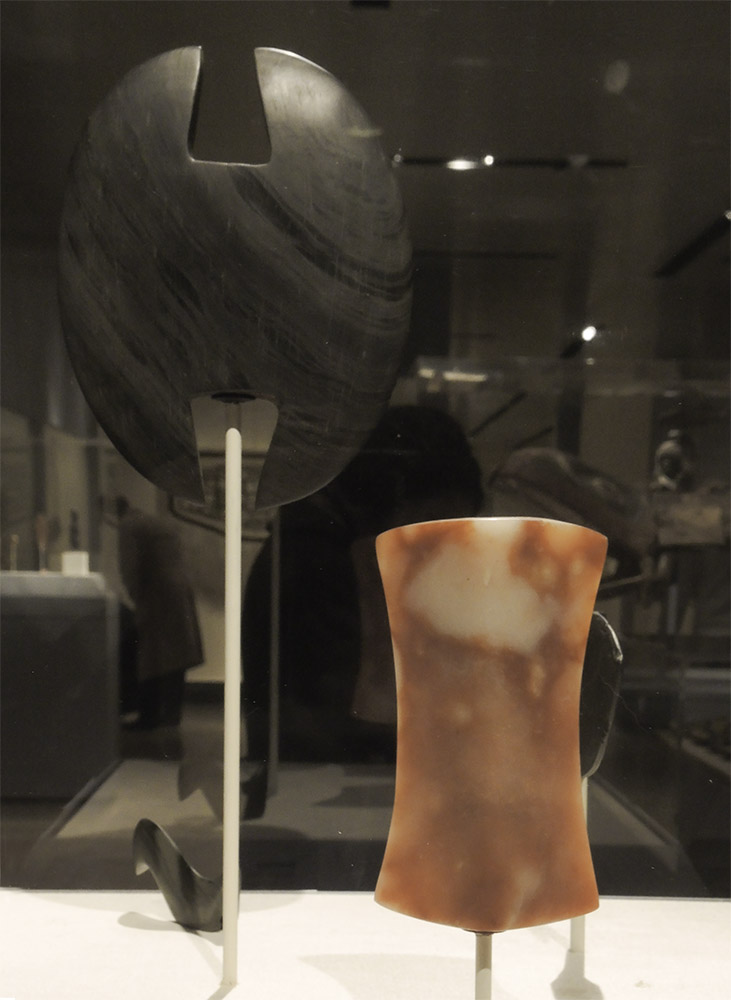
These ancient carved stones were used as spear weights. I love seeing very old utilitarian objects that were crafted with exquisite care, each one an aesthetic object. The fact that thousands of years ago different peoples around the world sought beauty touches me deeply.


Lidded Bowl, Marquesas Islands, 'Enana peoples, late 18th - early 19th century.


The simple shape of this bowl is described as bird-shaped in the Met's wall label. I hadn't recognized that, but I did respond to its graceful curves, which end in a stylized human head.


I'm not sure what this object is because I photographed the incorrect wall label; I'd thought it was a fishing float from the Solomon Islands. But whatever it is, the dark irregular sphere and its elegant decoration are wondrous.


Shield, Australian aboriginal artist, mid to late 19th century


I love both the extended oval form of this shield and its geometric decoration that pushes against the curved edges. The central horizontal band of red creates a break in the rhythm, a sophisticated syncopation.


Egyptian ointment jars and pots for makeup, 1800-1500 BC


The Egyptian jars and the two porcelain works below are objects that I photographed on previous visits to the Met, but which fit in with the theme of clear and simple form, form which I find so pleasurable. I look at Egyptian works often, especially Egyptian reliefs, which inspired me to begin my series of relief sculpture.


Chinese Qing dynasty porcelain, late 17th - early 18th century


On the Met's second floor, in cases to the left of the grand staircase, are many elegant Chinese porcelains, beautiful in color and in shape. I love these pieces, not the highly decorated vases, but the ones that are mainly a single color––white or yellow, or oxblood–––on a pure form.


Moon Jar, Korea, second half 18th century; porcelain, 15 1/4 x 13 in.


There is a gallery dedicated to Korean art in the Asian wing at the Met, with intriguing objects on view, especially ceramics. The Moon Jar with its gently swelling form and delicate coloration is a favorite of mine.


Barnett Newman, Untitled Etching #1, 1969; etching and aquatint, 23 3/8 x 14 11/16 in.


After admiring the objects from the Americas and Oceania, I felt that the pure, simple form of this Barnett Newman etching had an increased resonance and weight. It's not only a modernist abstraction, but it is also an heir to a millennial-old tradition of art's fundamental aspect, pointing to a quality of transcendence. The clearing away of extraneous detail and of narrative, the focus on the essential, gives to all these works a sense of the extraordinary, the magical, and shows the power of art to elevate and enlarge us.