Showing posts with label architecture. Show all posts

December 23, 2015

At the Met: Elegant Near Eastern Architectural Ornament


Panel from a door or minbar (pulpit) with a repeating vine motif, detail, Iraq, late 8th-first half of 
9th cent.; wood, 70 3/4 x 15 1/2 in. See entire door panel here


Many cultures around the world embellish their architectural surroundings with paintings, carvings, and tilework. Currently at the Metropolitan Museum of Art is a beautiful small show focusing on the ornament of the Near East during the years from 500-1000 A.D., Pattern, Color, Light: Architectural Ornament in the Near East. Many of the patterns are based on plant forms, with leaves entwined with curling stems. They are held within geometric shapes, here elegantly carved squares.....


Doorpost with grapevine emerging from a chalice, Egypt, 6th-7th cent; limestone,
25 9/16 x 5 7/8 x 6 7/8 in. 


....and here within the narrow rectangle of a doorpost. The compression of forms within their frame makes the curve of vine more pronounced. The grapevine in this piece is comparatively naturalistic....


Frieze section with bushy plants, Mesopotamia, ca. 6th cent.; stucco, 8 3/4 x 14 1/2 in. 


....when seen alongside this frieze, where the plants have been formed into a more abstract pattern.


Panel fragment with meander pattern, Mesopotamia, ca. 6th cent.; stucco, 13 1/2 x 23 1/2 in.


Engaged column part with meander pattern, Egypt, ca. 6th cent.; limestone, 
12 3/8 x 8 7/16 x 10 1/4 in. 


The two works above combine floral elements with geometry. They got me thinking about the human relationship with nature and with geometry. It seems to me that we have an innate sense of geometry, of right angles, being that most of our architecture is based on rectangles. Even though there are cultures whose houses are round, they are not in the majority. Excavations of ancient sites show rectangular rooms. I do wonder why this is; why is it that people didn't take to the geodesic dome as a dwelling structure? why are we more comfortable in right-angled rooms?


Window with palmettes, Mesopotamia, ca 6th cent.; stucco, 24 1/2 in.


Repeated small circles at the center and outer edge are connected by the spokes of eight leafy shapes.


Panel with beveled carving, Egypt, last quarter of 10th cent.; wood, 18 1/2 x 27 x 3 in.


The depth of this carving emphasizes the luxurious curves of the near-symmetrical patterns.


Cast of ninth century wall panel with beveled vegetal ornament, Iraq, 20th cent.; 42 x 33 in. 


Lastly, here a cast made of ornament that was found in place during excavations in Samarra in 1911-13. It has a wonderful combination of geometry enclosing vegetal forms. Triangles, pointing up and down, are resting on rectangles, and all have curving patterns within them. All of these pieces are a reminder that pattern is endlessly variable and very engaging.


Happy Holidays to all my blog friends!

September 21, 2015

Jefferson Market: The Gift of a City Garden


All sorts of gardens, large and small, are wonderful things to see, but a garden in the midst of the city, surrounded by tall buildings and heavy traffic, is especially magical.


Walking up Sixth Avenue from the West 4th Street subway station in the Village, you can soon see the Victorian Gothic spires of the elaborate Jefferson Market branch of the NY Public Library. The building was originally built as a courthouse in 1877; not in use since 1945, it was threatened with demolition, but a group of active citizens were successful in seeing that it was converted into a library, which opened in 1967. It was one of the first "adaptive reuse" projects in the US. The beautiful garden adjoining the library to the south also has a wonderful story.


A prison, The Women's House of Detention, was built on the site of the garden in 1931, replacing another earlier prison. When it was torn down in 1971, the land was transferred to the New York City Department of Parks and Recreation, and became the Jefferson Market Garden. Here, plants in profusion spill out of the metal fences.


The contrasts of fence and leaves is a perfect metaphor for the life to be found within the boundaries of a small city garden.


Although the garden was closed when I was there, I was able to see a great deal through the fence. I noted how beautifully the garden is designed (it is maintained by volunteers!) with varied colors and textures throughout.


The cool greens of a spiky grass are alongside soft, fuzzy leaves.


Deep reds of small leaves form a base for an explosion of grandeur.


In this late summer/early fall season, there are flowers blooming: tiny violet composite flowers....


....and a singular flaming red.


A special treat were Passion flowers blooming outside the fence along Sixth Avenue. This exotic, complex flower was just opening, and a bee was deep inside. The blessings of nature, however confined, brighten city life; imagine what Manhattan would be without small gardens such as this, and without the grand Central Park.

July 22, 2014

I Remember


Image Courtesy of Brooklyn Memories; the website is a treasure trove of old Brooklyn photos.


When I was a child, lo these many years ago, our yearly trip to the Jersey shore was an exciting adventure. There was no Verrazano Bridge, so we took the ferry from Brooklyn to Staten Island. I remember my mother making sandwiches for the trip, which now takes little over an hour. Back then the distances seemed enormous and the trip lengthy; the destination, Bradley Beach, thrilling. I was just at the shore visiting my family, and because I go there rarely, the old memories filled my thoughts. Like last year, when I wrote about it, I remembered Joe Brainard's wonderful book I Rememberand want to give a brief attempt at an "I remember" of my own. 


I remember the generous porches, and that one year from a porch like this my friends and I played Robin Hood, the raised porch being perfect for dramatic climbs and hidden princesses. 


I remember having crushes on the lifeguards, especially Donny; they were so beautiful, so strong, so wonderful. I remember being made aware of Vietnam and counterculture by a lifeguard on the Second Avenue beach whose name is lost to me. He showed us issues of underground magazines such as The Realist and Ramparts, very unexpected during the lazy days of summer. I believe that my political consciousness was awakened during those summers. 

I remember the poles connected by ropes that demarcated the safe swimming area. 

I remember learning to ride the waves on my father's back.


I remember splinters from walking barefoot on the boardwalk.

I remember the cool sand in the shade under the raised sections.


I remember the delicious feel underfoot as I walked from the gritty cement sections of sidewalk to the smooth slate. On some days it was very hot so I tried to walk on as much cool grass as possible. 

I remember coming home with sandy feet, and legs, and a bathing suit full of sand, and standing in the outdoor shower to wash it all off before going into the house.


I remember, not this small bandshell, but the large pavilion of my youth, a structure built on the boardwalk out over the beach. There were teen dances held every week, opportunities for youthful anxieties and dancing the lindy, the twist, the mashed potatoes, with my girlfriends. 

I remember pinball at the penny arcade, body pushing against machine, trying to keep the ball in play. I wasn't very good at it. 


I remember "fishing" in the lake separating Bradley from Avon. My father would fashion a net out of window screening tied at four corners with string. We'd lower it into the lake and catch guppies (were they actually guppies? I don't know but that's what we called them), watch them flop around for a couple of minutes, and throw them back.


I remember, when this park had swings, swinging back and forth with a friend and loudly and happily singing "Feelin' Groovy". We were feeling young and childish, since we were already an ancient 17 or 18 years old. 


I remember the treat of family dinners at Vic's, with their great pizza and thick tomato sauce on spaghetti.


I do not remember healthy food at the beach or on the boardwalk. I remember candy apples and cotton candy and salt water taffy and Pez and Good Humor bars, especially Strawberry Shortcake. 


I remember the entire family loaded into the car to go to Spring Lake to feed the ducks, and to drive around looking at the beautiful houses....


.....not only in Spring Lake, but also in Deal, where grand houses elicited oohs and aahs from us. They seemed of another time, almost fairytale-like. It was only years later, after painting images of Victorian architecture for several years, that I realized how important those drives were in giving me a subject for my work. Nostalgia for childhood summers, as I wrote in the blog post "Nostalgia as Inspiration", colored my artistic development. I can still remember the awe I felt seeing these houses, and I hope the sense of wonder never leaves.


July 3, 2014

At the Frost Place


Up a gravel path, past the lupins, is a modest white house perched on a hill. This is The Frost Place, where Robert Frost lived with his family for five years, from 1915 to 1920, and for 19 summers thereafter. In 1976 the town of Franconia, NH, where the house is located, bought the farmhouse and land and established a board of trustees to oversee what became an "educational center for poetry and the arts".  Frost had first visited the White Mountains in 1907, staying in the town of Bethlehem; he said about the area that "there is a pang there that makes poetry".


There is a beautiful, expansive view of the mountains from the front of the house, a view that was probably more open when Frost lived here.


Behind the house is a trail through woods that was started in 1997. This land had been meadow in Frost's time, but has since grown up in woods.


"Mowing"


This is the "Poetry and Nature Trail": as you walk on the path you can stop and read poems written by Frost while he was living here, poems with nature as their theme. I have a friend who was just telling me about how much she loved using her scythe; when I sent her the poem "Mowing" she felt that he "nailed it once again". 
To read all these poems, click on the photos to enlarge them. 


"Putting in the Seed"


For me he nails it with "Putting in the Seed", the "watching for that early birth/....


basil seedlings


....When, just as the soil tarnishes with weed,/The sturdy seedling with arched body comes/...."
He captures the magic, the Love of it.


"The Sound of the Trees"


At my house the sound of trees is often one of storm, but their blowing and rustling is indeed more beautiful than many other noises that come from human activity. For all their activity the trees are immobile, stalwart, not like us with our moving on.


"Stopping by Woods on a Snowy Evening"


"The Road Not Taken"


Many of the poems on the trail are famous ones, poems we think of when we think of Robert Frost. It was a pleasure to read them in this setting (and would have been even nicer if the swarms of bugs weren't so intense).


The staff at The Frost Place worked to establish native wildflowers along the trail and manage the forest. Then in 2007 two terrible windstorms undid all their work, so restoration work has been ongoing.


"Nothing Gold Can Stay"


A lesson from storms, from seasons, from life, is perfectly expressed in this brief poem, one that tugs at my heart. Through nature, Frost touched on deep human feelings.


June 27, 2014

At Hancock Shaker Village: Men's Work


When you step out of the visitors center at Hancock Shaker Village, you are immediately aware that this had been a farming community, and that the tradition has been carried on by the museum staff and volunteers. As I explained in my last post on women's work, labor at the village was divided into those jobs done by women, and those by men. This is not very different at all from the culture at large, even through most of the 20th century. As in "the World", men did the hard work of farming.


The agricultural implements of the 19th century are certainly different from those of today which are run with internal combustion engines. This wagon has some kind of rotating floor and I'm not sure of its purpose, but I love the way it looks.


This moving floor is part of a horse treadmill, or "tread power". The Shakers used this treadmill to provide power for grain threshing, sawing wood, and for other large farm machinery. Smaller treadmills for small animals such as sheep were used to power butter churns, cream separators, and other small machinery. (from the museum label) Treadmills are an ancient technology, and I did find a modern treadmill for electricity generation: a farmer in Ireland developed one for his cows.


This is a room in the hired men's house. When the number of men converts in the community dropped in the mid 19th century, the Shakers had to hire from outside in order to do the work necessary to maintain the land and buildings. Workers lived here, separately from the community, until 1947.


I find the proportions of this building, an ice house, very satisfying. It is built into a hill, so you are seeing only its upper half. This is the south facing side; the tallest wall is the one facing north, which would keep the building cooler. A large quantity of food was stored here to keep it fresh.


Two hundred tons of ice were stored in this room and another small one above. If you enlarge the photo you'll see slots in the brick wall to enable the cold air to flow into the storage areas. I thought the walls of this room were very beautiful, with the diagonal boards and the open grid. Ice was used until the Shakers switched to mechanical refrigeration in the early 20th century.


Shaker Brothers made shoes for the community into the 1800s. This bench was made in the 1840s at the New Lebanon, NY, community.


Basketmaking was one activity that women also took part in. The men prepared the splints for weaving from ash logs and made the heavy work baskets, but women would make the most delicate ones.


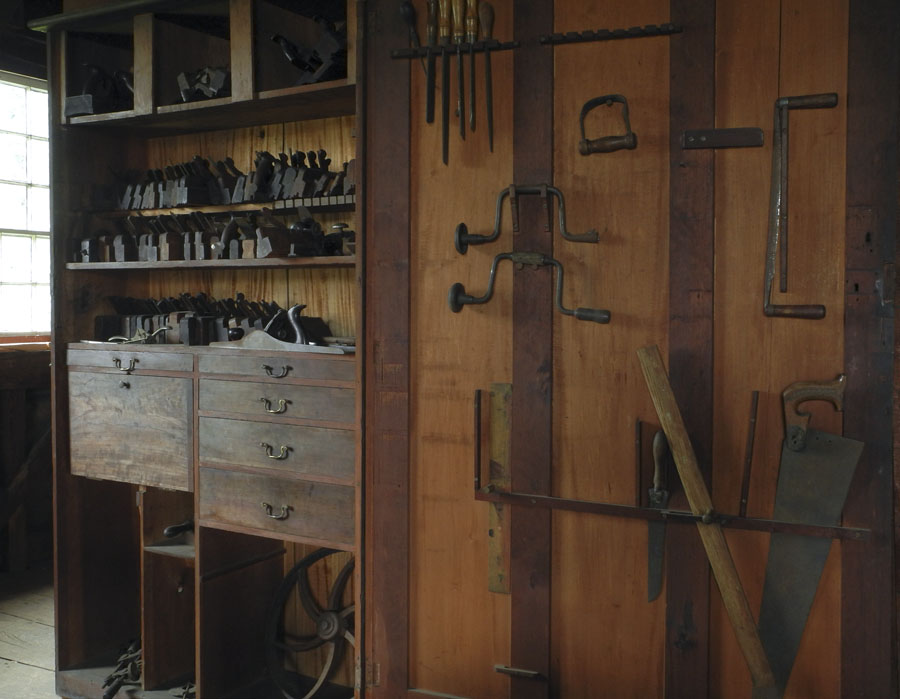
The woodworking shop was in a barn that had been a tannery at one time. There were very large workbenches on view that had vices attached and drawers for storage. According to the museum description:
Shaker cabinetmakers were driven by the necessity of creating practical storage spaces that reflected the gospel simplicity required by their religion. Their methods of joinery were similar to those used by their neighbors, yet their designs and lack of ornamental elements were decidedly not of "the World". 


Beautiful, useful cabinets hold tools for woodworking.


Finally, there is the machine shop, housed in a large building, in half of which was the laundry, run by women. For some reason I find machine tools fascinating; I wrote about a machine tool museum in Vermont, The American Precision Museum, a couple of years ago. I suppose it's part of my visual interest in agricultural machinery, which provides me images for my paintings, because I don't like or trust power tools. In this shop, saws and drills and lathes were run by pulleys and belts powered by water.


Underneath the floor was a water turbine (earlier a water wheel) that was powered with water flowing through an underground channel from a reservoir north of the building. When I visited this building, I was lucky in having a knowledgeable docent who turned on the power; it was quite amazing to see how strong the water was. It then flowed out under fields, in a stone lined aqueduct of sorts, to a wooded area some distance away.


Upstairs was a drill press that had been operated with water power. The belts are elegant linear elements alongside the curves of the machine.


I thought I'd share this very touching photograph with you. It is a portrait of Brother Ricardo Belden, taken sometime around 1953. He was the last of the Hancock Brethren . He worked in this clock shop until his death in 1958. After visiting the Hancock Shaker Village, I felt that the life here had great value to its members, but with no childbearing and no connection to a major religion, I suppose it was inevitable that it couldn't sustain itself.


It was very moving to walk among the buildings and see the artifacts of a now vanished community, artifacts of utility and beauty. This simple wheelbarrow, made wholly of wood, resting among many other objects on the upper floors of the machine shop, touches my heart as I think of the bent backs moving the loaded tray, just as I do now with my red metal one.


Previous posts on the Hancock Shaker Village:
The Shakers: A Community of Faith and Work
At Hancock Shaker Village: Women's Work