Showing posts with label sculpture. Show all posts

October 31, 2021

John Chamberlain: Material and Meaning


I've recently been having very interesting conversations about the meaning that is embedded in an artwork: are we to see abstract work as a composition consisting of shape, color, space, light, or is there content in addition to the formal concerns of the work? John Chamberlain is an interesting artist to think of in this context. I wrote about the marvelous retrospective at the Guggenheim Museum in 2012, where I saw the sculpture as purely about color and shape, and surprising moments of juxtaposition and detail. Seeing a stunning show of Chamberlain's sculpture currently at Gagosian Gallery has prodded me to think about what it means that he used industrial scrap metal and parts of cars in his sculpture. 

In the work above––I'm sorry not to have titles and dates, but some galleries have taken to not having check lists, or even reproducing the work on their websites, which is very frustrating––a curved red clamshell shape sits atop crumpled blue forms, almost like an open mouth. Are we to think of a figure? 


This very large sculpture of compressed and varied forms, one side primarily blues, another yellows, made me think of a landscape in its multitudinous parts and its complexity. It also feels like a raucous free jazz composition, form piled upon form, sometimes discordant, in other parts fluid. 


I couldn't help but see a crowd of moving figures, as though on a busy sidewalk. This is such a dynamic piece, and it reminded me of Philip Guston's painting Monument, a scrum of legs and feet. 


This is a stunningly dramatic piece, with smooth thin forms reaching high, fluid rounded shapes nestled one against the other. But all these observations of mine are about image, what the whole of the sculpture brings to mind. 


As here, with another monumental piece that looks to me like an animated creature, rustling as it moves. Chamberlain's magical expertise with folding, crushing, and welding sometimes lets us forget that this is metal that he's working with, and not malleable clay or cloth.  


Yet there is metal's rigidity and sharp edges, its shiny surfaces, its shapes that are sometimes clearly part of an automobile's body.


In this detail of the other side of the sculpture pictured above, Chamberlain has included parts of a car that are clearly elements of a bumper, smoothly protruding; they could be from a 1951 Ford coupe. Does this clear reference to the origin of Chamberlain's materials indicate that some of the meaning of his work lies in industrial automobile manufacture? is there a critique of American addiction to cars and the open road? or a paean to American know-how and design, as with the American Precisionists of the early 20th century? 

I would answer "no", for the most part. Of course I have to acknowledge the source of Chamberlain's materials, but for me that does not determine the meaning of the work, which I find in responding to its form. I don't know if he was attracted to scrap metal because of its origins, or because of the way it behaved and looked when made into a sculpture. Chamberlain himself, in speaking of the meaning of his work said:
"Even if I knew, I could only know what I thought it meant."
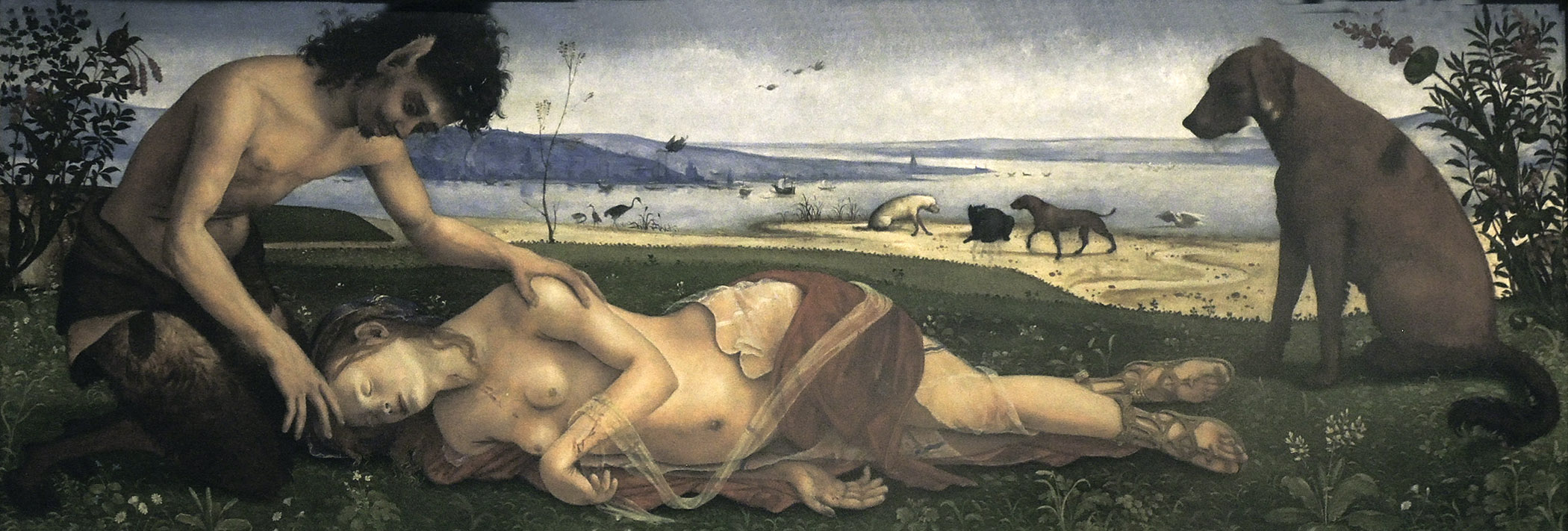
We artists cannot determine what meaning observers find in our work. What we prefer people to see is not always what they will see. For me, looking at a non-objective work is a rich experience, noting the way form and color interact, the quietude or dynamism of a composition. I find meaning in these things, and a deep emotional satisfaction. In recent years I've had two extraordinary experiences standing in front of a painting, paintings which caused me to weep at their beauty and depth of feeling. One was at the National Gallery in London: 


Piero di Cosimo, Satyr Mourning a Nymph, ca. 1495


I wrote about this remarkably tender painting here. Not only is the narrative touching, but the form and structure of the work are in perfect harmony with its story.

The other was a Mondrian in the collection of the Hartford Atheneum:

Piet Mondrian, Composition in Blue and White, 1935


The simplicity and perfection of this painting struck me so strongly. In a photo image it appears much more flatly painted than it does in person. My point in showing these two paintings, so different in subject and separated by centuries, is that response to a work does not have to be tied to its subject; meaning can reside in narrative, and it also can be found in pure form. To be honest, I was surprised at my unbidden spell of weeping in front of the Mondrian, but it proves to me that a reductive work of art can be as important to me as one of representation and narrative; form in itself carries meaning. 


July 11, 2021

At the Met: Egyptian Relief Sculpture

Relief with a billy goat ca. 2551–2528 B.C. Old Kingdom


I am in awe of ancient Egyptian sculpture. The sensitivity to line and form, and rhythm across a wall, that is sustained across centuries is remarkable. It's hard to imagine a culture that stayed so consistent over this length of time, with small variations in style. The close attention to the volumetric shapes of this goat bring it fully to life, even though the representation is simplified and in low relief. Ah, those elegantly curved horns! 


 Relief fragment showing a pile of offerings and part of an offering list ca. 2010–2000 B.C. or ca. 2000–1981 B.C. Middle Kingdom Egypt

Many of these sculptures were found in chambers in pyramid temples, and were offerings to the king, The bounty shown above was thought to provide for life everlasting. This work doesn't have the realism of the relief of a goat shown above, but the abstracted forms and color are very satisfying. This fragment is a clear illustration of how the medium of relief carving is between fully rounded sculpture and painting.


Relief depicting an offering table and part of an inscription ca. 2010–2000 B.C. or ca. 2000–1981 B.C. Middle Kingdom Egypt


Although the details in this relief are more crudely handled, I love the pile of shapes and the duck's head alongside them, resting on curves An exhibition of Middle Kingdom art at the Met several years ago pushed me to start doing low relief sculpture in clay; I wrote about the show in an earlier blog post. As an artist I feel totally inadequate when comparing my reliefs to those from ancient Egypt; mine seem clunky and inelegant. Oh well, I try my best, and it's good to aspire to these role models.


Relief Fragment Showing Waterfowl in a Clapnet ca. 2020–2000 B.C. Middle Kingdom Egypt


This fragment depicts a stack of ducks in repeated curves. I can see that they are different species from the shapes of their heads and the varying curves of their beaks. I couldn't figure out how they were in a net until I looked at the description of this piece on the Met's website. It pointed out that there was till a faint tracery of paint on the ducks' bodies, indicating the net; you can see this if you click on the image to enlarge it. 


5 Lintel of Amenemhat I and Deities ca. 1981–1952 B.C. Middle Kingdom Egypt


Relief block from a building of Amenemhat I ca. 1981–1952 B.C. Middle Kingdom Egypt, with god Horus

The two reliefs above are from the same building, the king's mortuary temple. The artists who carved these reliefs––all the reliefs shown in this post are carved from limestone blocks––were very skilled. The hieroglyphs at the top are especially beautiful in their simplification of objects, which turns them into language. I find that lintel so very beautiful; I want to run my hand along the edges of the forms, to feel their subtle distinctions.


 Reliefs from the North Wall of a Chapel of Ramesses I ca. 1295–1294 B.C. New Kingdom Egypt


This more recent relief made during the New Kingdom is more crowded with activity than earlier works. There are piles of provisions atop piles of provisions, and below, many workers preparing food or libations. The sculpted forms are more rounded than those in the Middle or Old Kingdoms, which increases the feeling of a bustling, overstuffed storehouse. Rhythms are varied and I see a rich visual polyphony.


Relief plaque with a swallow, and with Face of an Owl 400–30 B.C. Late Period–Ptolemaic Period


There's a heightened sense of realism in these two small plaques, made much later than the works above. At this time Egyptian art was influenced by that of Greece; Alexander the Great had conquered Egypt in 332 B.C. An article on the Met's website explains the history and artistic interchanges of this period. I see the Egyptian style in the basic simplification of form, and the carefully observed details; the relief is higher, as is common with Greek sculptural reliefs. The owl is a marvel, a compelling portrait of an inscrutable bird. I know I just wrote that these works are more realistic than what came before, but paradoxically, they are also wonderfully stylized: the artists managed to portray creatures that are both real and ideal, perfect of their kind. It is so interesting to think about this delicate shifting balance between naturalistic representation and abstraction that is evidenced across the centuries in Egyptian art. 


June 22, 2021

At the Met: Animals


Storage Jar decorated with Ibexes, Central Iran, 4,000-3600 B.C.


Humans have lived with, worked with, observed, worshipped, made myths about non-human animals for millennia. When I look at this elegantly delineated ibex, it's hard for me to comprehend that this pot was made 6,000 years ago. In John Berger's elucidating essay, "Why Look at Animals", he describes how humans and animals had lived parallel lives in the past, before the 19th century, in which 
every tradition between man and nature was broken. Before this rupture, animals constituted the first circle of what surrounded man. Perhaps that already suggests too great a distance. They were with man at the centre of his world. Animals first entered the imagination as messengers and promises. 

Berger goes on to describe various ancient myths centering on animals, and how this human/animal relationship changed in modern times. Thinking of that closeness it's not at all surprising that there should be so many depictions of animals in art and artifacts. 


Weights in the shape of a frog, Mesopotamia, Iran, or Cypress, early 2nd millenium B.C.


Very simple lines and minimal form are all that's needed to sculpt the essence of an attentive frog. Upraised head, folded legs, bulging eye; she's ready to leap forward. And her rounded volume asks for a caress.


Wall painting from a bedroom, Roman, last decade of the 1st century B.C.


A sensitively rendered bird stands alert in the center of a dark swath of wall, warmly glowing against the polished surface. Someone who knows bird species could probably identify this one since it is so specific in its details.


Figure of a Hare, Egypt, 11th century


Such a lively little hare, with those large ears pricked and the tiny tail raised. I can't help but think that the maker of this piece particularly enjoyed sculpting that alert expression of anticipation.   


Statue of a Predatory Bird, Iran, 12th-13th century


There is a range of depiction from naturalism to abstraction that is very interesting to me. Different cultures have different approaches, all valid, all producing beautiful work. This predatory bird, with its large head and simple sweep of wings is closer to an abstract rendering, but I can still feel his aggressive posture.  There's a fluid line from the jutting beak to the swelling breast and back through the wings which is very satisfying. 


Bowl with fish motif, Iran, 13th century


Dish, follower of Bernard Palissy, French, late 16th century


Here are two favorite ceramic pieces at the Met, a bowl from Iran, and a later dish from France. They show very different approaches to decoration: one simplified and the other complex and full of detail. I love them both. The Iranian bowl has a clear design, having linear elements contrasting with the circling fish at the center. The French dish also has a central element, that of a looping snake, but surrounding it are fish and crustaceans and shells and foliage and an overall texture. It's as though these two pieces provide a clear illustration of abstraction and realism, and how effective each approach can be.

(I highly recommend clicking on the French dish in order to see more of its details.)


Power Object, Republic of Benin, Fon peoples, 19th century


An elephant is a symbol of strength for the Fon peoples, and silver makes the work a prestige item. In the museum description––link above––it is stated that precious objects such as this are filled with "supernaturally potent materials to protect the monarch". This is a culture in which the magical power of animals had not yet receded. 


Flat Bag, Coeur d"Alene, Schitsu'umsh, Coeur d'Alene artist, 1895-1905


We can compare this simplified beaded image of birds with the more realistic Roman wall painting of a bird above, but I don't see that either one is stronger than the other; they are simply different. On this bag, I especially like the way the artist made patterns out of the wings and tail feathers; those diagonals play against each other, creating an animated design. 


Bronze statuette of a horse, Greek, lat 2nd-1st century B.C. 


I've posted all the works above in historical order, but kept this horse for last. This elegant and proud small stallion, sixteen inches high,  presents me with an opportunity to speak of my relationships with animals. I live in a rural area, so have lots of animals nearby: deer, moose, bear, turkey, woodchuck, raccoon, birds of all sorts, and other small creatures. I love having this animal life around me, unless they help themselves in my vegetable garden. And of course I have pets, which John Berger in his essay says are one result of animal marginalization in our culture. I do treasure my inter-species interactions. My most intense experience of working with an animal, though, came when I had a horse. There was a remarkably sensitive communication with this large animal when I was sitting on her back, speaking to her with the weight of my body, the pressure of my legs, the touch of the bit in her mouth, and also with my voice. It was magical, and made the image of the centaur––the human/horse creature––completely understandable. It also made me feel closer to a time when non-human animals were an integral part of our lives. 

Altoon Sultan, Heifers, Pawlet, Vermont, 1987, 30 x 72 in.


I've worked on this post for a couple of days, and this morning I remembered that I too have a painting of animals in the collection at the Met (not on view). I painted Heifers during a time when I worked on agricultural landscapes, and many of them, being dairy farms, included cows. Cows are curious, and I feel that they wonder about me, as I do about them. This mutual regard across species, this wonderment and magic, makes it clear why artists have wanted to depict animals from the time of the earliest paintings, many thousands of years ago. 


June 9, 2021

At the Met: Wondrous Clay

George Ohr, Vases, 1898-1910


Clay is a mundane, common material, in use for millennia. Its characteristics allow it to be transformed into shapes both ordinary and extraordinary: into objects of everyday use or into fine art sculpture. The Metropolitan Museum of Art has mounted a thrilling exhibition that shows us the range of lively possibilities present in the medium: Shapes From Out of Nowhere: Ceramics from the Robert A. Ellison Jr. Collection. Mr. Ellison has made a generous donation to the Met of 125 works from his modern and contemporary ceramics collection and we are all richer for it. 

Looking at the George Ohr vases, I might think that they were made by a contemporary artist, but no, the "Mad Potter of Biloxi" (see link above) was pushing the boundaries of ceramic art over a hundred years ago. 
 

George Ohr, Vase, 1898-1910; Elisa D'Arrigo, Blue Dyad 1, 2015


Ohr's folded forms are eccentric and beautiful, and have a sense of pulsing life. I very much enjoyed the installation of this show, especially when there was a conversation like this one between's Ohr's vase and Elisa D'Arrigo's writhing sculpture, with its pipe-forms reaching upwards. The surface appears pitted, irregular, as though pushing against a simple idea of beauty. 


Kyoko Tonegawa, Asteroidal Last Gasp, 1985


As with D'Arrigo's piece I'm not sure if this work by Kyoko Tonegawa is functional, or a sculpture...but does it matter? The bulbous form with its lush surface does ask for a touch, a caress. It could also be an ancient life form, whose texture and shape has softened over time. 


Rudolph Staffel, Light Gatherer, 1988


This is the first Rudolph Staffel piece I've seen in person, but I've loved the work I've seen online. He worked with porcelain, and in many of his Light Gatherers the clay is so thin that light shines through it, making it look magically lit from within. 


Kathy Butterly, Pony Boy, 2111


Kathy Butterly is another artist who seems a descendent of Ohr in her draped forms and the modest size of her work. This piece looks to me like it's dancing in a floppy rhythm, with a foot forward and arms upraised. The looseness is held in check with a sharp vertical line and other soft lines emphasizing curves. 


Ken Price, Untitled (Vessel), 1957


There were several pieces in the show which were built using thin slabs of clay, as with this Ken Price vessel. Price is such an interesting artist, whose work ranges across ceramic categories, from biomorphic sculpture to useful or geometric cups. I love this vessel that for me is a figure, with a head divided into shapes. It feels very cubist to me. 


Harris Deller, Suppressed Volume Series, Stacked, Vase with Key Hole Pattern, 1990


This vase by Harris Deller is another slab-built work. I admire the subtle shift in the volumes of the parts. The surface decoration doesn't seem to have anything to do with the form underneath, yet its movement and clarity enhances those minimal volumes. The lines are like contour maps, describing an imagined landscape. 


Chris Gustin, Pink Teapot with Slit #9015, 1990


Wow, I said to myself when I spotted this wacky teapot, whose spout I couldn't find. It's a fleshy accumulation of forms, looking soft and squeezable, like babies' bottoms. (Sorry, couldn't resist that metaphor.) It's just marvelous that the artist made a sculpture of fired clay, which is hard, look like we can push our finger into it and leave a dimple.


Amara Geffen, Arhkaiokurios, 1991


I sometimes have the strangest reactions to work that I assume is abstract, so odd as to wonder if I should admit to it. But here goes: when I saw this Amara Geffen piece I immediately responded to the repetition of the rounded forms, and to the slightly different form held up by the six below. I saw a worship ceremony, with figures elevating a prized member of society, or like the worship of the golden calf. Whatever the interpretation, it's a compelling piece. 


Arnie Zimmerman, Vapor I, 1992


Although I can't really say that I like this sculpture by Arnie Zimmerman––it's pretty far from my usual formalist leanings––but I truly admire its exuberant shapes and its color relationships. I think the color is quite gorgeous, and the choice to have a more neutral central color-shape is perfect. 


Stanley Rosen, Untitled, 200s


Stanley Rosen has a unique approach to making sculpture, with an accumulation of small rolled pieces of clay, one atop another and another, until the form is built. Because the pieces of clay are irregular, the result doesn't have a clear pattern, but rather a quirky description of volumes. A result of this technique is a sense of movement, with the energy of all those elements marching forward or swaying from side to side. 


Anne Marie Laureys, Cloud Unicus, 2017


I think I can say that this sculpture by Anne Marie Laureys was my favorite in the show. I was moved by its soft, billowing forms, seemingly impossible to have created, and by its subtle color. The surface appears brushed, like a velvet cloth. There is something very tender about this work; perhaps it's the deep folds gently turned in upon each other. It's a beautiful work, among many other wonderful pieces in this exhibition that I feel lucky to have been able to see. 


(A note to my email subscribers: I've moved my email list to a new platform, follow.it, and hope that you get this post, fingers crossed. It's scheduled to go out at 7PM. You should also check your spam folder.)


June 3, 2021

At the Met: Faces


Head and Neck from a marble figure, Cycladic, 2700-2500 B.C.


While wandering through the Metropolitan Museum of Art I was struck by the inventiveness and varied approaches to abstraction when it came to depicting faces, both human and animal. In this very early small Cycladic head, all we see is the shape of the face with a protruding nose, yet it is distinctly human, We read this as a face even with minimal information; its forms are simple and beautifully rendered. 


Spouted Vessel, Mexican, Huastec, 13th-15th century


This decorated Mexican vessel depicts a face with an expression of wide-eyed surprise, emphasized by the eyelashes surrounding the protruding eyes and the dark, upturned nostrils. The piece is decorated with elegant abstract designs, moving it away from any perceived naturalism.


I love this wacky bird, eyeing me intently. His polka-dotted neck and abstracted feathers, along with the handles as wings, add whimsy. Of course, I don't know if that interpretation is that of the artist; perhaps they saw this bird as threatening. 


African artists from all over the continent had a marvelous ability to simplify the human face into beautiful shapes, lines, curves, volumes. With its perfect oval form, closed eyes, and calm expression it could almost be the head of a Buddha, as well as a ruler of the Akan people. 


Mask, Cote d'Ivoire or Liberia, Ku peoples, 19th-mid 20th century


From serenity in the work above, there's a shift to an elongated fierceness in this mask with jagged teeth and cylindrical eyes, and a knife-edge slice of a nose. The forms are softened by the gentle curves of the mask's outline.


This headdress is called Janus-faced because there's a similar face backing this one. The eye shapes remind me of the ovals of the memorial head above, but this face is more aggressively abstract; the long, protruding nose with lips below balance the eyes beautifully. I find the saw-toothed edge very interesting; I don't think I've seen that before. At the top of the headdress are two horns, and etched into the wood below them are two ovals for the eyes of an animal. 


I'm fascinated by the upturned head of this magical power figure. He seems to be quietly beseeching the gods. Although the form of his head is stylized, and his body is hung with strange (to me) objects of prayer, he is so very alive. 


With these two masks we are back in the Western hemisphere, but as I look at them I might think that they're African. It makes me wonder whether there is a universality of form in this stylized  type of art, tempered by cultural differences. The move away from naturalism toward simplification brings great power to this imagery that a more delicate realism cannot match, although that has its own strengths. 


This sculpture of a woman's head with its clear, bold features and stylized curls is more naturalistic than the works above, but still quite simplified. Her head rises above a plain sarcophagus (see in link) whose only details are the wavy lines at the top. This makes for a startling apparition when seeing the actual work.


A style closer to a Western idea of realism is evident in this sensitively rendered funerary portrait of a young woman. The flesh appears soft, the features delicate and particular to an individual. Only the hair is abstracted, with the curls as tightly wound circles. 


Portrait of a Carthusian, Petrus Christus, 1446


I had to include one painting in this post, and that of a face that I find intriguing. The heightened realism of Christus' painting invites me to attempt to understand the character of this monk. He is looking out with an expression that is somewhat askance, solemn and questioning. The portrait is so carefully observed, from the features to the delicate, cascading beard. Christus also plays with illusion by painting a fly on the edge of the frame.


Woman's Head, Amedeo Modigliani, 1912


Modigliani's modernism takes us back to an abstracted vision, inspired by the art of Africa. Those oval eyes, long nose, and slitted mouth can be seen as direct descendants of some of the sculpture pictured above, with his personal touch of elongation. 

**I enjoyed thinking about and seeing how differently faces can be appear in art. The Met allows for that with its extensive collections. I would like to remind you that clicking on an image will show it enlarged. I've provided links to the Met's descriptions of some of the objects if the information on their website is especially elucidating.