January 11, 2016

Mary Heilmann: Life into Art


Rose Wave, 2013; oil on canvas, 20 x 24 in.


With a quick glance, we might think that Mary Heilmann is a formalist abstract artist, concerned with issues of shape and color, with the unity or breaking of the picture plane. But, what to make of shocking pink stepped forms....


By the time I get to Phoenix, 2015; acrylic on canvas, 30 x 30 in.


....or of perspectival rectangular shapes, disappearing like road markings into the distance, and titled after a popular song? Heilmann uses the language of formalist painting to deny the formal: to evoke memories, allude to stories, to activate the sensuous. In her recent show, Geometrics: Waves, Roads, etc. , at 303 Gallery, there was so much pleasure in paint, and in the images and objects that color transforms. The overlapping square format of the painting above is one that Heilmann uses often. It has a way of confusing space, which seems to be clear––the white line stops at a horizon––but the entire surface is flat, so it confounds the illusion.


Highway, My Way, 2015; oil on canvas, 18 x 30 1/8 in.


This is a geometric painting, but it's also a poem, an ode to night travel, to headlights in the dark.


Slides from Her Life 


In the catalog for Heilmann's solo museum exhibition To Be Someone, which I saw at the New Museum in 2008, there is a description of the slide show she gives, called Her Life. In it she juxtaposes two images, sometimes her work and a photo, as above, sometimes two photos, which can be of traffic, of architecture, of neon signs. They can allude to childhood memories, a childhood she spent in California. She gives clues about the paintings, though the paintings aren't simply illustrations.


Green Room, Turquoise Lights, 2015; acrylic on canvas, 18 x 24 in.


Heilmann's paint is always luscious, with fresh strokes that play with the geometry, never taking it too seriously.


Geometric Right and Geometric Left, 2015; acrylic on canvas 30 x 30 in.


These two paintings, like By the time I get to Phoenix above, are shaped canvases; they are flat. Like the three shaped paintings in the photo below, they play with color and shape and illusion. The shapes are crisp, the paint fluid. 


Sunny Chaises, installation; painted plywood, each 25 1/2 x 20 1/8 x 24 1/4 in.


Heilmann ventures into the actuality of the everyday, by designing simple chairs that are brilliantly painted abstract sculpture, and an invitation to sit and enjoy being at this show; they tell us that we should linger. A grouping of similar chairs enlivened one of the terrace spaces at the new Whitney Museum of American art. 


Family Tree, 2015; acrylic on paper, 6 1/8 x 6 in.


Paint moves across irregular surfaces, in irregular squares, with three primary colors playing with two secondary ones. I love seeing the different grounds and mediums that Heilmann uses––canvas and paper and wood and ceramics––and her inventiveness with all of them.


First Date, 2015; oil on handmade paper (Ruth Lingen and Akemi Martin), 12 1/2 x 15 5/8 in.


The energy of a first date is sizzling in this work on paper, with two characters, each very different, interacting; one certainly takes over. Even with these disparate elements, a whole is surprisingly created.


Two Logics, 2013; oil on canvas with handmade paper and epoxy, 15 3/4 x 11 3/4 in.


Two Logics has more play with offbeat rectangles and different materials. Another aspect of Heilmann's work that I admire is the modest sizes of her works; all are physically appealing, with a sense of the hand and of the body; none are overpowering, all invite personal attention.


San Andreas, 2012; glazed ceramic on painted wood, 8 3/4 x 9 in.


A sizzling molten core shows beneath the green earth of glazed clay.


Cups on a Table, detail, 2009-2015; painted wood, glazed ceramic, 28 1/2 x 48 x 48 in.


Clay, in the form of thick, brightly painted teacups covers a low red table (see the entire piece here). As with her chairs, Heilmann makes art out of the very ordinary. Her open geometries were a joyous tea party, roads to adventure, waves of color, painterly rectangles. Heilmann's work is a serious delight.

January 7, 2016

A New Painting: "Black Form"


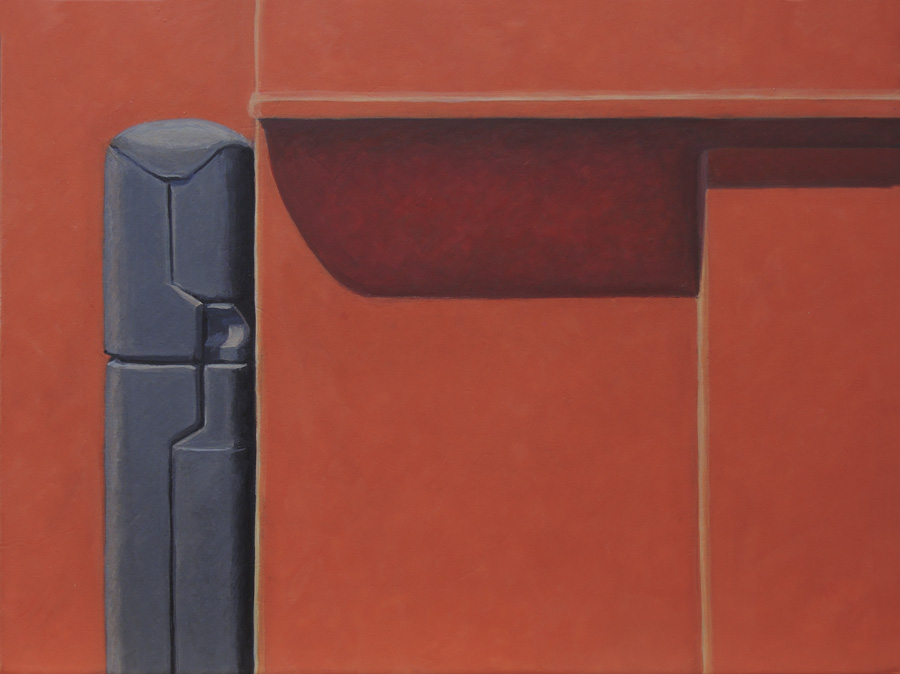
Black Form, 2015, egg tempera on calfskin parchment, 6 3/4 x 9 in. 


This is a simple frontal painting, with very few elements: red planes, shadowed, and a long black form. The drama is in the shadow and in the black that so strongly contrasts with the bright red. I have a story about painting that red, which clearly illustrates Josef Albers' Interaction of Color. I worked away on the red shapes––the shadow colors were just sketched in––painting them several times trying to get a color that worked. The red continued to look dull, without any light in it. Frustrated, I was about to try yet again when I thought....hmm, I'd better paint the shadow first, before repainting yet again. When I got that shadow done, with its cool darks and some bright reflected light, the reds suddenly popped, got bright, looked like they were lit by sun. Color only exists in relationship, and every once in a while a painting gives you a strong reminder of that fact.


Black Form detail


The only small details in the painting are those on the black form: lines that describe indentations and overlaps, plus a small curve. These small incidents engage the eye and play off against the big simple red shapes.


January 5, 2016

Ah, Winter!


Winter has finally arrived after weeks of worryingly warm weather. Although there were some cold days and some winter phenomena––such as the rime ice I wrote about and photographed here on December 6––most days were milder than normal. The New York Times published an article on December 30 titled "Climate Chaos, Across The Map", detailing anomalous weather across the globe. So it was a relief to have cold and snow and sleet. And to see the beauty that is reserved for winter with white ground and laden trees within a neutral landscape, as seen above on the last morning of 2015.


There were continuous soft snow flurries on the first day of the new year. I love winter days like that, with the snow adding some brightness, and deepening the quiet. A day of light snow, watching the flakes fall, is a soothing one.


Quirky small events happen during winter's cold, such as oddly shaped icicles....


....and branches encased in sparkling packages....


....and conifer needles delicately enhanced by icy caps.


A tiny brook in the woods runs a rich black between white banks.


Sometimes geometries appear, such as a dark icy circle surrounded by snow.


 There are poignant details, such as tiny seeds scattered alongside the deep footprint of a deer....


....and fine lines of grasses barely marking the expanse of white. I love the hiatus of winter, the suspension of the growing season; it makes spring all the more precious. Winter can be a difficult season, but I would hate to be without it.


January 3, 2016

A New Textile: "Bound Circle"


Bound Circle, 2015, hand dyed wool on linen, 12 inch diameter


A circle is not a sphere, but this circle tries to be one. I am playing with flatness and illusion in this piece, using the direction of the hooked lines, and the dyed color of the red band, to emphasize each. I thought of the curving green lines as something like a cup, which the straight dark blue lines entered; in those two color-forms is a sense of shallow space. Then the curving red shape, in its movement from dark to light, becomes an illusion of a rounded form, entering the dark.


Bound Circle detail


Even in this detail, in which all the hooking is on a flat plane, the illusion insists on its reality. It is the magic of two dimensions becoming three.


December 30, 2015

Happy New Year! with Indian Gardens of Delight


This year, for my New Year's greetings to my blog friends, I thought of the beauty and delight in the details of nature in Indian miniature painting. Last year I shared sweets, the year before the quilts of Gee's Bend.


It's such a pleasure to sink into these worlds of sensitively stylized flora and fauna. I went to the Metropolitan Museum of Art's online collection and selected details from its holdings of Indian paintings (you can browse over 500 of them here) . There are trees that look close to naturalistic, and animals that are fanciful creations.
(To see the details clearly, click to enlarge the images.)


A courtyard garden blooms....


....and flowers burst from trees.


Fanciful carts are entwined with flowers.


The sun rises on peace....


....and animals live gently in the landscape.


Even the architecture is full of life and charming detail, whether flowers are bursting in the night sky, like fireworks....


....or a layered tree embraces a pink wall. The Indian painters were masters of color, and the relationships of pinks to yellows to blues to greens are delicious.


May you have a year full of beauty, and may all dangers and difficulties be overcome with grace.

December 26, 2015

A New Painting: "Black Curve"


Black Curve, egg tempera on calfskin parchment, 6 3/4 x 8 in.


Some of the compositions for my paintings stick quite closely to the source image, but with others, such as Black Curve, I make changes. For this painting, I simplified shapes and eliminated unnecessary details. There had been white text in the black shape at the upper left, and below the big black curve were complex arrangements of small dark shapes; there was no yellow under there at all. Because what most interested me about this image was the black curve crossing the yellow one, I extended the yellow under the black curve and invented a shadow echoing the curve above it. All paintings, even those based on actual things, have to work as abstractions. 


Black Curve detail

December 23, 2015

At the Met: Elegant Near Eastern Architectural Ornament


Panel from a door or minbar (pulpit) with a repeating vine motif, detail, Iraq, late 8th-first half of 
9th cent.; wood, 70 3/4 x 15 1/2 in. See entire door panel here. 


Many cultures around the world embellish their architectural surroundings with paintings, carvings, and tilework. Currently at the Metropolitan Museum of Art is a beautiful small show focusing on the ornament of the Near East during the years from 500-1000 A.D., Pattern, Color, Light: Architectural Ornament in the Near East. Many of the patterns are based on plant forms, with leaves entwined with curling stems. They are held within geometric shapes, here elegantly carved squares.....


Doorpost with grapevine emerging from a chalice, Egypt, 6th-7th cent; limestone,
25 9/16 x 5 7/8 x 6 7/8 in. 


....and here within the narrow rectangle of a doorpost. The compression of forms within their frame makes the curve of vine more pronounced. The grapevine in this piece is comparatively naturalistic....


Frieze section with bushy plants, Mesopotamia, ca. 6th cent.; stucco, 8 3/4 x 14 1/2 in. 


....when seen alongside this frieze, where the plants have been formed into a more abstract pattern.


Panel fragment with meander pattern, Mesopotamia, ca. 6th cent.; stucco, 13 1/2 x 23 1/2 in.


Engaged column part with meander pattern, Egypt, ca. 6th cent.; limestone, 
12 3/8 x 8 7/16 x 10 1/4 in. 


The two works above combine floral elements with geometry. They got me thinking about the human relationship with nature and with geometry. It seems to me that we have an innate sense of geometry, of right angles, being that most of our architecture is based on rectangles. Even though there are cultures whose houses are round, they are not in the majority. Excavations of ancient sites show rectangular rooms. I do wonder why this is; why is it that people didn't take to the geodesic dome as a dwelling structure? why are we more comfortable in right-angled rooms?


Window with palmettes, Mesopotamia, ca 6th cent.; stucco, 24 1/2 in.


Repeated small circles at the center and outer edge are connected by the spokes of eight leafy shapes.


Panel with beveled carving, Egypt, last quarter of 10th cent.; wood, 18 1/2 x 27 x 3 in.


The depth of this carving emphasizes the luxurious curves of the near-symmetrical patterns.


Cast of ninth century wall panel with beveled vegetal ornament, Iraq, 20th cent.; 42 x 33 in. 


Lastly, here a cast made of ornament that was found in place during excavations in Samarra in 1911-13. It has a wonderful combination of geometry enclosing vegetal forms. Triangles, pointing up and down, are resting on rectangles, and all have curving patterns within them. All of these pieces are a reminder that pattern is endlessly variable and very engaging.


Happy Holidays to all my blog friends!

December 20, 2015

New Drawings, Larger and Smaller: Freedom and Intuition


#57, egg tempera and graphite on paper hand toned with distemper, 15 x 15 in.


While I was thinking about the writing for this post, a couple of concepts related to art making came to mind: freedom, and intuition. First freedom: for me, one of the great things about being an artist is being able to do anything I want with my work, to change its direction, change ideas, mediums, formats, styles. Of course this can have implications outside the studio, such as losing a gallery when work changes direction, but I insist on my freedom of action. It has allowed me to try new ideas, such as these drawings based on Islamic design, which I began making three years ago. 


#58, egg tempera and graphite on paper hand toned with distemper, 15 x 15 in.


I love the way these drawings have allowed me to explore color in a way that is completely different from that of my paintings. The patterns that emerge from the basic design have been varied and often surprising.


#59, egg tempera and graphite on paper hand toned with distemper, 15 x 15 in.


But freedom to begin something must also mean freedom to end it, and I'm now feeling that I've reached the end of my interest in working with this drawing format. When I look at the work itself, I think "oh no, you must keep going", but when I was working on this last group (one drawing ended in the trash) I was no longer happy in the making of them. For me, pleasure in working is very important, which doesn't mean that there isn't struggle or disappointment or uncertainty, but that the work brings satisfaction during its process. I began to feel with these drawings that I no longer wanted to draw the underlying pattern; it was like pulling teeth, to use a cliche. So, for now––because I never know what I'll want to do in future––these are the last of this series.


sd 49, egg tempera on paper painted with distemper, ca. 7 x 7 in.


I don't yet feel at a dead end with these small, painterly drawings. I began doing them about a year and a half ago, using small pieces of paper left over from tearing down large sheets for the Islamic-based drawings. I am still enjoying the process of painting with distemper––glue size (I use gelatin) and pigment––on hand made paper, and then adding a small shape or gesture in egg tempera paint. In the sd 49 the small blue rectangle at the bottom is painted in egg tempera.


sd 50, egg tempera on paper painted with distemper, ca. 7 x 7 in.


With these drawings, so different from most of my work––only my potato prints have a similar aesthetic––which is ordered and planned. These works might be said to have more intuition involved.


sd 51, egg tempera on paper painted with distemper, ca. 7 x 7 in.


Intuition: "an ability to understand or know something without needing to think about it or use reason to discover it, or a feeling that shows this ability." (Cambridge Dictionaries Online) It is certainly true that I am using more of an intuitive sensibility to paint, in distemper, the wide swath of dark red and more translucent red beneath and then to add the dark red line in egg tempera.


sd 52, egg tempera on paper painted with distemper, ca. 7 x 7 in.


Nothing is planned in these drawings; I am looking at the colors I have mixed with size, and with wide brushes apply them. But how much of intuition in art really is just that and how much comes from understanding and experience and years of working and looking?


sd 53, egg tempera on paper painted with distemper, ca. 7 x 7 in.


I feel that I couldn't have made these drawings (and I'm not claiming great quality for them) years ago, because I wouldn't have had the tools, of the hand or the eye or the mind.


sd 54, egg tempera on paper painted with distemper, ca. 7 x 7 in.


So, these drawings continue to interest me in that they challenge an aspect of my art personality that doesn't often have a chance to be used. And they are a way of playing with pure color. I am thinking I might try them a little larger, at 10 x 10 inches, but for that I might have to buy some much larger brushes....