Showing posts with label mollusks. Show all posts

July 31, 2015

Jean Painlevé's Magical Worlds Under the Sea


From Sea Urchins, 1954


There is so much life on this earth that we humans are hardly aware of; it is too small, or out of sight on high mountains or under the sea, or simply unnoticed. I have a favorite Henry David Thoreau quote:
Many an object is not seen, though it falls within the range of our visual ray, because it does not come within the range of our intellectual ray, i.e., we are not looking for it. So, in the largest sense, we find only the world we look for.
Happily, there are people of great curiosity and vision who help us expand our known worlds through their large intellectual ray, such as the scientist filmmaker Jean Painlevé (1902-1989). Over a period of decades, from the 1920s to the 1980s, he made more than 200 scientific films, and is best known for his short films on sea life. I have to thank the artist Michael Brennan for alerting me to this artist, for I have to call him an artist along with a scientist: it is very clear that the aesthetic quality of his work was supremely important to him. It is the aesthetic quality of his films, the visual inventiveness, the sheer beauty, the marvelous scores, from classical to jazz to modern, that makes them special to me.


Sea Urchins


I remember sitting in an elementary school classroom watching film strips or short educational films, but I'm sure we never saw anything as gorgeous as those of Painlevé. Even when he is the scientist––his films are full of complex and detailed information. I should also warn potential viewers that some of them show dissections––and shows us the insides of a sea urchin, it is a beautiful object, mysteriously dangling in a dark space.


From Hyas and Stenorhynchus: marine crustaceans, 1927


A selection of Painlevé's films, some made with his partner Genevieve Hamon, are available from Netflix, published by The Criterion Collection in a set called "Science is Fiction" (you can see a clip from The Love Life of the Octopus at the link). In the film above, tiny crustaceans, only an inch and a half long and decorated with algae, dance to the music of Chopin.


From How Some Jellyfish are Born, 1950


To film these tiny creatures, only 1-2 mm long (that's less than a tenth of an inch!) some seaweed was placed in a very small aquarium, with the camera magnifying them.


How Some Jellyfish are Born


We see so much more than with the eye....and who discovered these animals, and how?...We can see those bulbous extremities, which turn out to have hundreds of poisonous cells to paralyze their even tinier victims/food source. As the tentacles wave about in the film, all I can see is loveliness, but life is not so simple.


Two stills from Sea Ballerinas (Brittle Stars and Feather Stars), 1956


 In this lovely 13 minute film, with a score by Pierre Conté, starfish are seen moving like elegant ballerinas. We are also shown the brilliantly patterned undersides of some brittle stars, which the narration describes as like oriental rugs.


Sea Ballerinas (Brittle Stars and Feather Stars)


The feathered tiny stalks on the arms of the Feather stars are for breathing and for gathering microscopic food particles. We are told that "They look like strange incantations in motion". There are many moments of visual and verbal poetry in these films.


Sea Ballerinas (Brittle Stars and Feather Stars)


There's also a lot of humor. Painlevé presents us with the conductor Galathea, a species of squat lobster, who sure looks like he's conducting this floating feather of a star fish.


From The Sea Horse, 1933


One of the most wondrous creatures to inhabit our planet is this fish....yes, it's a fish....whose upper body is the shape of a horse. I wonder how this evolutionary quirk happened.


The Sea Horse


It turns out that the most fascinating fact about this fish is not its shape, but its reproductive strategy. It is the male of the species, seen above, that gestates the young in a pouch in his body; the female deposits her eggs there, he fertilizes them and carries them until birth. In the screen shot above, he is in labor, and you can see the tiny seahorses that have emerged from his pouch. This little animal shows us that gender roles don't have to be fixed as we humans know them.


From The Vampire, 1945


This brief 9 minute film shocked me; it was so different in tone from all the others I'd watched: it began with "strange and terrifying" creatures, diseases spread by insects, and some scenes from Murnau's film Nosferatu; the inspiration for the vampire coming from animals in nature. Creepy creepy creepy. Then we're introduced to the South American vampire bat. Horrifying. It wasn't until I read the interesting essay by Scott McDonald on the Criterion site that I learned the film, made just after the war, was a political statement, expressing a hatred of the Nazis; Painlevé had to spend years in hiding during the occupation of France.


From Acera, Or The Witches' Dance, 1972


These short films are mostly about wonder, and beauty, and for me the most lusciously gorgeous of all was Acera, about a small sea mollusk. These rounded creatures are dramatically organic forms in a dark universe.


Acera, Or The Witches' Dance 


The become monumental.


Acera, Or The Witches' Dance


They are also the most elegantly lovely dancers as they float; a "fold of skin forms a cloak around its body, allowing it to move and swim". Delightful lilting music accompanies the buoyant dancers, who bound up and float down to attract a mate. You can't imagine from a still image how wonderful these mollusks are, how beautifully they are filmed; it is a project of sheer joy. And a project to show that sexuality isn't fixed, since these creatures can be male or female, or both at the same time. Life is a wonder, and much richer and more varied than we imagine.


August 16, 2012

Curiosities


A selection of curiosities at the Wadsworth Atheneum


How many of us have collections of shells, or rocks, or other interesting things we've picked up on our travels? or of salt shakers, or quilts, or teapots. This urge is partly an aesthetic one, a desire to see things we think beautiful, or strange, or interesting, gathered together in a pleasing way. It is also evidence of curiosity, of a desire to have the wide world near us, perhaps to understand it better. I began to think about this when I visited the Wadsworth Atheneum, where they had a small gallery dedicated to the "Cabinet of Curiosities", a Renaissance room full of objects of art and nature. They were known in the German as Kunstkammer (art room) or Wunderkammer (wonder room), and are precursors to museums.


Nautilus Snai, Jeremias Ritter, German, ca. 1630; nautilus shell, silver gilt, 


This charming piece, a snail shell fashioned into a golden steed, was one of the examples of an art/nature hybrid that might have been part of the Wunderkammer. 


Charles Wilson Peale, The Artist in His Museum, 1822; oil on canvas, 103 3/4 x 79 7/8 in.


Cabinets of curiosities were established, as Wikipedia informs me, not only by aristocrats, but also by merchants and people involved in science. One of those here in the United States was Charles Wilson Peale, an artist also interested in natural history. He opened a museum in Philadelphia in 1784; one of his thousands of bird specimens, a wild turkey, is at the lower left, and mastodon bones are at the right. He had worked to unearth and mount a mastodon in 1800, which we can see behind the curtain.


My much more modest collections are throughout my house, such as odds and ends gathered in this wire basket: rocks picked up in Australia and Europe, colorful antique marbles, a railroad spike from the Australian desert, small sculpted coins by the artist Beriah Wall.


And on a shelf, a conversation between a delicate bird skull and two brightly colored ceramic salt shakers. It's good to be reminded of the world's variety of wonders as we go about our daily lives.


August 6, 2012

Beach Stories


This past weekend, sitting on a low beach chair, my legs in the sand, my eyes closed under the protection of a straw hat, hearing the murmur of family conversation but listening to the incessant sound of surf, I was reminded that I am never so relaxed as on a warm breezy day at the beach. There is something about the overriding whoosh of the sea that enters into the rhythms of my body, slowing and calming them. I am in the midst of reading Moby Dick, and think that because of it I'm having a tendency to think in metaphors about the seaside; Melville uses a tremendous amount of metaphor and allegory, whether writing about whiteness, or a doubloon, or a whale that's free or "tagged". Do our bodies, which are more than half water, yearn for the sea? 


Shells are moved and worn by the tides, left behind by a bubbly wave, pushed about by circumstance.


Once-living things are left piled along the strand, alongside a sea-weathered rock, which looks as though it was made of the sand it rests on, a compacted sandstone; it is a transformative process, like alchemy changing one material into another, just as the shells will break down over years and become part of the sand.


Another piece of rock tells a different tale, of small animals adhering to the rock and leaving their imprint.


The seagulls are a joy to watch as they waddle about on shore, or take to the air where they become soaring, graceful creatures. On the sand they are very amusing; last summer I spent an afternoon sitting quietly among them, noticing the differences of coloration of feather and beak, laughing at their attempts to grab a little something to eat.


There are always some plants that manage to thrive under what seem to be the most adverse conditions: in a bit of sand between rocks, doused by salt air and water. They are a lesson in perseverance.


The geometry of slat fencing plays off beautifully against the green and sandy dune it is protecting, but it is also a reminder of the wildness that came before.


And the marks of human carelessness are unfortunately always in evidence. Will we ever learn?


July 6, 2012

Morning Dew


I stepped out this morning onto a bright, wet lawn, and saw circles of light scattered about. These "fairies' handkerchiefs" are one of the visual treats of a dewy morning as small droplets of water are caught in round spiderwebs close to the ground.


The creator of this fanciful web is the grass spider, who is sheltered in a funnel within it.


Beads of moisture rise up in fine strings from the weedy lawn, making it into a tiny light show.


A translucently clothed snail wanders across a wet hosta leaf, sipping as it goes.


Water droplets hang from a hosta bud, carrying their surroundings within their globes. The sun soon dries this errant moisture, but it will return another morning with its glistening light.


January 24, 2012

"Microcosmos": The Hidden World of Insects


The camera is high above a pleasant, bright meadow, then swoops down lower and lower until we are in grass, towering above us as in a fecund tropical jungle. An insect climbs a stem with gravity-defying grace, and we are now in a microcosm of our everyday world. The 1996 French film 
Microcosmos: The Grass People shows us usually unseen miniature life, full of color and beauty, and sheer strangeness; the technical prowess of the macro photography is awe inspiring.


This marvel of a caterpillar looks like it was put together by a very hip, inventive fashion designer, with vivid pink on its head repeated in the tips of a kind of double tail. This should have been the design for the Alice in Wonderland caterpillar.


Another caterpillar has colors that mimic leaf and stem, part of nature's protective mechanism.


The film presented insects that are familiar to us, along with the surprises. This sequence showed a bee entering a flower, and as it pushed inwards, the pollen bearing anther dips downward to deposit pollen on the bee.


Not only plant fertilization is filmed, but also a remarkable view of a pair of snails (mollusks, not insects) mating to swelling music, with all the romance and passion of any steamy sex scene. There is a marvelous wit in this film, with all the drama we expect from a nature film featuring much larger species.


We see sinuous mating, and we see a vigorous battle between two beetles.


A creature is born, emerges from a delicate egg and then turns around and eats it.


There is the terror of death, as an insect is entrapped by a carnivorous plant...


or is amazingly wrapped by a spider, whose silk comes pouring out of its body.


There is the storage of food, with ants dragging seeds many times larger than themselves into an underground chamber. Here is the true to life illustration of the La Fontaine fable of the grasshopper and the ant.


And there are tales of endurance, as insects survive floods and drought. In a display of clever perseverance, a beetle whose ball of dung was caught up on a stick manages to dig out around it, giving itself leverage to push the ball free. There were quite a few tense moments as I rooted for the beetle's success.


At the end of the film, an embodiment of light emerges from a dark watery background. It rises higher and begins to spread its fine legs. I feel as though I am watching an apotheosis, an exalted moment in insect life as something emerges from primordial ooze and takes shape. In a film with many moments of stunning beauty, this caused me to sit with mouth agape. It wasn't until I researched the film later (the cast of characters was in French, and not translated) that I discovered that this was a mosquito hatching! I think I will carry the images of the mosquito as goddess the next time the pesky little things are biting. This film reminded me that the diversity and ingenuity of life is greater than I realize, and even more full of wonder.

December 19, 2011

Splendor from the Sea


The small wonders of the natural world with which I'm familiar here in northern Vermont are mosses and lichen and fungi, with an occasional charming little snail. The shells of land snails are very plain and workaday, though, compared with their mollusc cousins from the sea.


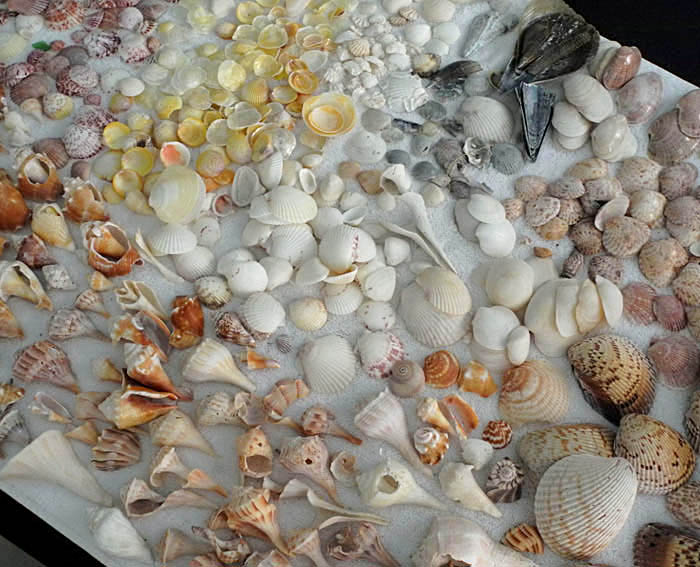
This vivid collection of seashells looked like a treasure chest that had been emptied on a Brooklyn dining room table. My sister and her husband had been to Sanibel Island, famous for the mounds of shells found on its beaches, shells of all different types, colors and shapes.


I love seeing the geometry of the spiral forms of what I believe are whelk shells. Bands of color flow down and across the shells, according to the mathematical Fibonacci Spiral.


Conch shells also display the spiral construction. It's a marvelous mystery to me that nature has an underlying rational order.


Cockle shells come in a beautiful array of colors, with patterns that look as though they were carefully painted in order to heighten the effect of the crisp corrugation.


I never knew that seashells came in plaid. What a delight these coquinas shells are!


Finally, some very delicate shells, irregular in form, glistening like mother of pearl, with pools of yellow or pink. Looking at all these shells, noticing each variation in color and shape, was like going on a surprising trip to a new and unknown world, full of delight.