May 16, 2014

A New Boxed Paintings: "Shapes"


Shapes, egg tempera on calfskin parchment, 3 x 3 x 3/4 in.


When I was working on my last boxed paintings, Squares, which you can see here, I first made a 3 inch square box to contain the paintings, but realized that was too small, so made a 4 inch box. I did keep the 3 inch box though, and thought that a project using shapes might work with this size. So I began cutting out shapes: rectangle, square, triangles, circle, oval, octagon, pentagon, hexagon, diamond, trapezoid, parallelogram.


Shapes, top and inside of box


I give a preview of what's inside the box by the several shapes on the cover. I had a hard time deciding how to paint the inside of the box, even discarding my first attempt. I realized that with the complexity of the shapes, I needed a very simple background.


Shapes, paintings side 1, ca. 7/8 - 1 1/4 in.

Shapes, paintings side 2


 At first I thought I would just paint each shape a solid color, but then decided that would be dull, so I painted shapes on top of the shapes.


Squares and Shapes


This photograph gives an idea of the relative sizes of a 4 inch and 3 inch box. I don't think I'll be working this small again....but, then I think of some of those marvelous tiny medieval manuscript books, prayer books that are only 3 or 4 inches, so maybe......


May 14, 2014

A Walk in the Woods: Ah, Spring's Treasures!


I hadn't been in the woods in weeks––bad weather, traveling, an awful cold, and intense vegetable garden work all kept me away––but on Sunday I did my familiar loop. What an immense change had occurred in those few weeks! It was now true spring, and carpets of tiny woodland flowers decorated the path, with the delicate magenta-striped Spring Beauty, Claytonia virginica, most abundant, and so cheerful.


The other small spring flowers in the woods are more scattered, though still a delight to see, like the Round-Lobed Hepatica....


....and the yellow....


...and purple violets. With their downward nodding heads, the violets seem a shy flower, so it's even more of a pleasure to notice them.


Another of my favorite woodland wildflowers is Bellwort, a graceful and delicate beauty. It has spread along a stone wall that bounds the path, this section of which is an "ancient road"; farther along is a very old cellar hole, evidence of earlier occupation.


Along the same stretch of road are the most spectacular spring flowers, Trillium erectum, aka Wake Robin. The flowers are large, a good three inches, with only 3 petals and very large leaves. They seem almost too showy and grand to be wildflowers. If you enlarge this photo by clicking on it, you'll see an ant walking across the edge of a petal and the shadow of another on a leaf. It is a busy time for the insects too.


It's not only flowers that show their beauty in early spring; as new fern fronds emerge, each species with its own form, they seem as though they are dancers gracefully swaying to silent tunes.


Or like Busby Berkeley dancers, they curl towards a center, ready to unfurl outwards, spreading their blades wide.


In the woods there's not only new green life, but also seeds and seed heads ready to spread thousands of tiny seeds for new plants. This is the seed head of the marvelous and unusual Indian Pipe plant, a plant that is white because it's without chlorophyll; it lives by being a parasite on its willing hosts, trees and fungi. You can read more about this strange plant at the link. I always feel happy when seeing their white apparition in the woods, and I felt very lucky to have found these beautifully formed seed heads. Each year, each season, all these wonders delight me afresh, as though I am seeing them for the first time.


May 12, 2014

New Forms: Early European Abstraction at Yale


Kurt Schwitters, Relief with Red Segment, 1927


It was such a pleasure to recently visit the newly expanded galleries at the Yale University Art Gallery, discovering one treasure after another. I wrote about the gallery dedicated to Mesoamerican art here; last year I wrote about their collection of African art, which was already on view, and about a small selection of their earlier European paintings, focusing on Angels and Demons. On this trip I was thrilled to see Yale's outstanding collection of early 20th century European abstract painting, a vividly fertile period of new ideas, enlarging the meanings and techniques of painting. Last year the Museum of Modern Art mounted a grand exhibition on the early years of abstraction, Inventing Abstraction: 1910-1925, which I wrote about here. Seeing the paintings at Yale reminded me how exciting the work of this period is.


Kurt Schwitters, Merz 1003 (Peacock's Tail), 1924


I find myself falling into clichés when thinking of the three Schwitters works I've reproduced here, like they "knocked my socks off"! When I think of Kurt Schwitters it's his poetic small collages; I was not at all familiar with these larger assemblages, dynamic in form, rich in color.


Kurt Schwitters, Oval Construction, 1925


The three dimensional aspects of these pieces, whether subtle as in Merz 1003, or dramatically volumetric as in Oval Construction, add energy and presence; they almost make me want to run up to my work room and start making constructions. Very inspiring.


Suzanne Duchamp, Accordion Masterpiece, 1921


I thought that this work had a similarity to the Schwitters, both in structure and in its use of unusual materials, here silver leaf. The shimmering silver in Duchamp's painting made a form that was hard to pin down: it moved about with the light, forward and back, a secular halo.


Juan Gris, Newspaper and Fruit Dish, 1916


This Gris has a wonderful stacking of forms and rich color contrasts. Not all early abstraction was non-objective; the cubists brought us a new way of seeing the world. I remember that at a large Picasso retrospective at MoMA years ago, we could see him step close to the edge to leap into non-objective painting, but then drawing back. Since I too am tied to images of the world in my paintings, I like to have the example of Picasso to think of, who after all is a great painter. 


Fernand Leger, Composition No. VII, 1925


I love the layering of shapes in this Leger, the contrast of the large curving forms of the vase with the stacked straight lines. It has a little humor to it: a magazine? on a table with a vase? everything flipped to its characteristic view, a very modern still life. 


Paul Klee, Joyful Mountain Landscape, 1929


I'm not much of a Paul Klee fan, finding his work too sweet for my taste, but I liked the angled planes of this painting, and the interesting color relationships.


Carl Buchheister, Red and Green Steps, 1925


Back to the non-objective, my true love of this period, here is a painting by an artist I had not known. A serious, yet somehow joyful collection of squares. They are joined by colored rectangles of different sizes and transparencies, and red semi-circles adding bounce. The squares seem illumined against the dark ground.


Laszlo Moholy-Nagy, G5, 1926


Moholy-Nagy combines geometric elements in a way that seems simple, but to balance the subtle tensions of thick line and thin, round and straight form, transparent and opaque paint, acute and gentle diagonals, is not easy.


Theo van Doesburg, Simultaneous Composition, 1929


Simultaneous Composition could probably be mistaken for a work by Mondrian. van Doesburg and Mondrian were friends for a time, both participating in the group de Stijl that van Doesburg had founded in 1917. But, one thing I think that Mondrian did not do was have lines overlap shapes, as the lines do here, so that the linear grid looks as though it is in front of the color shapes, giving the painting a quality of movement.


Piet Mondrian, Composition with Yellow, Blue, Black, and Light Blue, 1929


Mondrian's paintings are still; they have classic form derived from essentials. I always have a feeling of the universal when looking quietly at a Mondrian painting, like a glimpse into Plato's ideal forms.


Piet Mondrian, Fox Trot A, 1930


This painting is almost empty, but its three lines on a white diamond are miraculously expressive. They quietly animate a space that now seems boundless rather than contained. Mondrian, and the other painters I've shown, began the 20th century with an enormous outpouring of original forms, which painters have built on over the years.


May 11, 2014

Buds: Unfolding Gifts


It is still early spring here in northern Vermont, with most trees still bare of leaves and daffodils and forsythia the only flowers blooming. But there's evidence of beauty to come as buds on trees and shrubs swell, disclosing hints of what they contain. The elegant structure of a lilac bud opens to show tiny violet spheres.


The long leaves surrounding the tightly gathered rounds of the Nannyberry bud look as though they might start spinning and fly away.


The American Cranberry, Viburnum trilobum, has a much frillier package, with lacy leaf-ends folded over the flower bud.


A deep rich burgundy sprouts from a honeysuckle stem, soon to be new green leaves.


The narrow buds on the apple trees promise leaves but not blossoms; this is their year of rest.


Furled green leaf buds are a soft contrast to the thorns on a Rosa rugosa cane.


I love looking out my back windows at this time of year to see the knobby buds on the White ash tree, dotting the tree with their dark protuberances. Looking more closely, I see rounds of flower buds cupped by opening scales, looking a little bit like the lilac bud. These different small packages are promises of new life, of the rebirth that comes with Spring.


May 8, 2014

A New Painting: "Yellow Rectangle, Green Cylinder"


Yellow Rectangle, Green Cylinder, egg tempera on calfskin parchment, 8 1/2 x 6 1/2 in. 


While working on this painting I had to constantly keep in mind the relationship between the two named elements: the yellow rectangle at the upper left and the vertical cylinder catching light. I thought I'd finished the painting three times, and twice I went back and reworked the colors of those two features (never mind painting and wiping off and repainting the large area of shadowed green: too dark, too light, too warm, etc). The tricky part of the two main characters was their balance: I wanted the cylinder to be a forceful presence but at first the yellow was too intense and the green not intense enough, leading to the painting being dominated by the yellow shape. So I darkened the yellow and made it a less intense color and intensified the green, which I thought looked great. But a day later I realized that the dull yellow was too dull; it had lost all vibrancy and life. I went in again with a more intense yellow. Because egg tempera is translucent, the color layers affect each other: that layer of intense yellow over the darker, more tertiary yellow brought to it enough brilliance, but not too much, to create a better balance with the cool intense green. 

This is just to say that paintings that appear quite simple (to me too) are often quite a challenge. And it was almost as much work to get a decent photo on this blog; I uploaded many variations before settling on this as close enough but not quite. Ah well.....


May 7, 2014

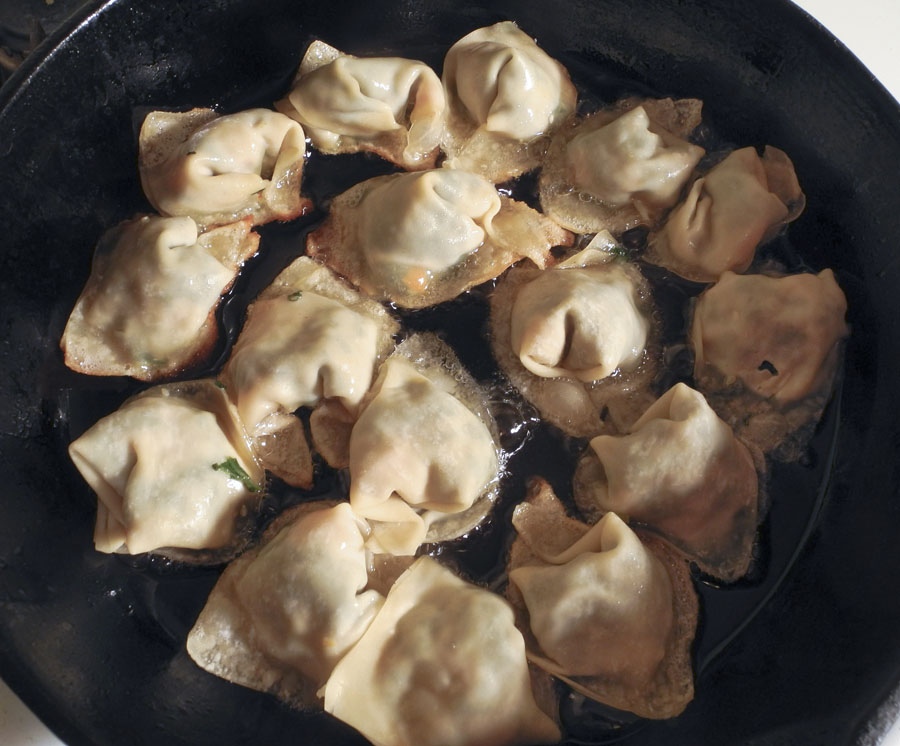
Spinach Wonton


The spinach I recently planted in the garden has just begun to germinate. It'll be a while before it's large enough to pick, but I still have plenty of last season's spinach in the freezer. This dish is a great treat for me, a little Asian taste in the Northeast Kingdom, and pretty simple to prepare. 


I was going to try to make my own dough, but then got lazy and bought a package of wonton skins. The following recipe, which came with a package of wonton skins, fills about 50 pieces, as many as are in a package. 

1 Tbs vegetable oil
1 clove of garlic, minced (or more, to taste; I used 2 big ones)
2 small carrots, finely chopped
1 medium onion, minced
2 cups chopped cooked spinach, which is around 12 oz.
3 Tbs sesame seeds

Saute the onion till golden, then add other ingredients and cook for about 5 minutes.
Combine in the bowl with the following ingredients:

1 egg
1/2 cup bread crumbs
1 teas freshly grated ginger (I added more since I love ginger)
1 Tbs sherry 
3 Tbs soy sauce

Put a heaping teaspoon of the filling at the top of the wonton skin as shown above. Moisten the edges with water, fold into a triangle, making sure the edges are sealed, and then overlap the two corners. 


To cook, glaze a frying pan with vegetable oil, heat it, and place wontons in pan. Cook until the bottoms are lightly browned, then add 1/2 cup of water, cover, and cook at a simmer for 10 minutes. Most of the water will have boiled off and the noodle dough will have become transparent, as in the first photo. I like these with more soy sauce, but I'm sure they are good with other condiments.

The wontons will freeze very well, so if you're not cooking all of them, tray freeze and then pack into a bag. You can cook them without defrosting.

Enjoy!


May 5, 2014

Robert Mangold: Shape, Line, Light


Framed Square, blue; acrylic and black pencil on canvas.


Over many years, Robert Mangold's concerns in his paintings have stayed constant: upon a colored shape––rectangle, triangle, curve, column, or irregular figure, with two or more canvases abutting (scroll down for examples here)––lines, curved or straight, are drawn in pencil. In his recent show at Pace Gallery, Mangold developed a theme he had only touched on before: a shape within a shape, leaving an empty center. The paintings, body-sized, have a beautiful presence: classical, calm, lyrical.


Framed Square, blue detail


The translucent paint handling brings light into the paintings, as does the empty center. The lines in the works are not solely the drawn pencil lines, but also the straight, deep lines formed by joined canvases.


Framed Square, lemon yellow; acrylic and black pencil on canvas.


Lines flow in a balanced, elegant curve from corner to edge, moving outward and inward in a continuous loop. The curves change the character of the square and trapezoidal canvases; their minimalism becomes poetic.


Framed Square, lemon yellow detail


If you click to enlarge this detail, you'll see that there was uncertainty and shifting in the placement of the lines. The final painting feels very assured.


Square with Open Circle II, 2011; acrylic and black pencil on canvas.


The lines also push a balanced image, a centered open shape, into movement, as though it is caught in a net and being tugged along. In this work a single diagonal line creates a different tension.


Framed Square with Open Center III, 2013; acrylic and black pencil on canvas.


With two diagonals crossing the square, there is a greater sense of balance, even with the uneven circular lines.


Framed Square with Open Center II, 2013; acrylic and black pencil on canvas.


I enjoy looking from one painting to the next, to see how Mangold uses his lines to touch edges, bulge outward, cross each other; following the lines' flow becomes something of a visual puzzle. I am also interested in how the different colors change the mood and space of each painting. They could be metaphors for weather conditions giving rise to varying kinds of light: the soft light of fog, the bright intense light of midday sun, the half-light of dusk or dawn.


Angled Ring I, 2011; acrylic and black pencil on canvas.


Not all the paintings had their inner shapes centered; here the large circle is pushing against the leftward point.


Framed Rectangle; acrylic and black pencil on canvas.


 With a long rectangle, the lines become waves, softening the hard edges of the painting.


Installation at Pace Gallery


It seems to me that Mangold must think of Matisse in his use of line and color, and the light contained within a color. His paintings are luminous and open, and embrace the gracefulness found within geometry.


May 2, 2014

A New Textile: "Construction (Red Circle and Bars) "


Construction (Red Circle and Bars), hand dyed wool on linen, 19 x 18 in. 


When I was working on the studies for this new piece, I was thinking of and looking at Malevich's Suprematist works, with their simple geometric forms moving and overlapping on a light ground....


Kazimir Malevich, Suprematist Composition, 1915; oil on canvas, 17 1/2 x 14 in. 


...such as this painting. Maybe some day I'll play with overlapping forms, but for now, I am hooking separate pieces that I then sew together. I mixed colors that were a less saturated and duller than bright primary or secondary colors. I wanted a softer effect rather than a brilliant one. One thing I regret: once I had the work sewn together, I felt that it could have used a red line at the bottom of the green rectangle; it would have unified the work a little better. It's something I couldn't see until the work was done and it was too late to change it. Oh well, the best laid plans.....


Construction (Red Circle and Bars) detail