March 27, 2021

A Renewal


It's been several years since I've posted on this blog, but some reading I've been doing lately has got me thinking that I might enjoy writing again. It's early spring here in northern Vermont, the ice is receding from the edges of the pond, green leaves are visible under the shallow pond water: a time to start afresh. 

The poems of Alberto Caeiro, a heteronym of Fernando Pessoa are making me aware again of the value of looking closely at the world around me: 
The astonishing reality of things
Is my daily discovery.
Each thing is what it is,
And it's hard to explain to someone how much joy this gives me,
And how much that joy suffices me. 
And
In my gaze, everything is clear as a sunflower,
I'm in the habit of going for walks along the roads,
Looking to the right and to the left,
And now and then looking back...
And what I see at each moment Is something I've never seen before,
And I'm very good at that...
I know how to feel the profound astonishment 
A child would feel if, on being born, 
He realized that he truly had been born...
I feel newborn with every moment
To the complete newness of the world...

Caeiro asks us to look, to truly see, with no preconceptions, no thought. I've also been reading several modernist French writers, such as Jean Frémon, Pierre Reverdy, Franck André Jamme, and Philippe Jaccottet whose prose styles are inspiring. It is Jaccottet's Seedtime, selections from his notebooks, that also made me think about making notebook-like entries in my blog, along with photographs. Although the blog is titled Studio and Garden, I don't think I'll post my artwork here, but will leave that to Facebook and Instagram. But I do hope to write about art that I see in museums and galleries, once I'm back to visiting those wonderful, much-missed places.


In the woods, the mosses have been refreshed by yesterday's rain, and their intense greens can't be matched in the natural world. Their shapes vary, from tiny tree-like forms to soft cushiony shapes, some that make resting on a moss-covered rock inviting. 


In the first entry in Jaccottet's Seedtime, he urges us towards a "complete forgetting": 
Attachment to the self renders life more opaque. One moment of complete forgetting and all the screens, one behind the other, become transparent so that you can perceive clarity to its very depths, as far as the eye can see, and at the same time everything becomes weightless. Thus does the soul truly become a bird. 


January 9, 2017

At the Met: The Power of Simple Form


Shell Ring ,(Yua), Abelam people, Papua New Guinea, 19th - early 20th century


What is it about beautiful objects that is so compelling? Often, when I have some time to wander the galleries of the Metropolitan Museum of Art, I find myself looking at things, at artifacts and ancient sculpture; I visit old friends and discover new ones. I don't quite know why these often take precedence over spending time in the painting galleries; perhaps it's the satisfaction of seeing three dimensional things I can imagine running my hands over; perhaps it's their mystery. On my most recent trip I looked through the galleries of the Arts of Africa, Oceania, and the Americas and saw a few objects of stunning simplicity, where the purity of form spoke very strongly.  The shell ring, made from the shell of a giant clam, is a form of wealth for the Abelam, and also a part of ceremonial life. The irregularities of the surface play against the perfection of its curving form.


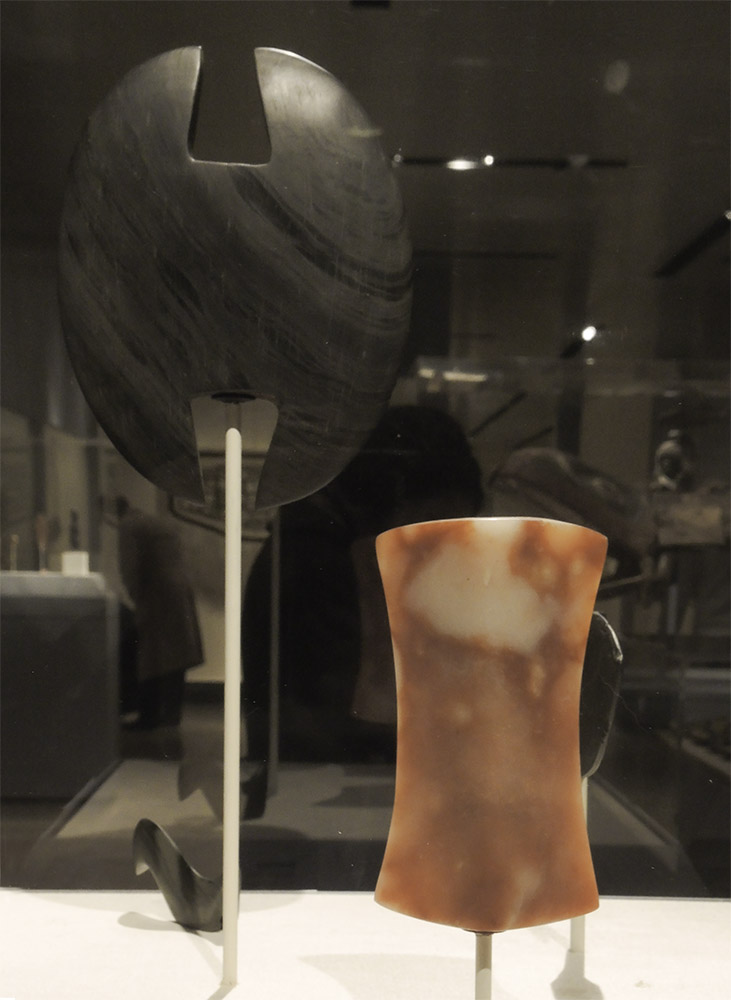
Bannerstones, archaic Illinois and Ohio, 3rd - 2nd millenium B.C.E. 


These ancient carved stones were used as spear weights. I love seeing very old utilitarian objects that were crafted with exquisite care, each one an aesthetic object. The fact that thousands of years ago different peoples around the world sought beauty touches me deeply.


Lidded Bowl, Marquesas Islands, 'Enana peoples, late 18th - early 19th century.


The simple shape of this bowl is described as bird-shaped in the Met's wall label. I hadn't recognized that, but I did respond to its graceful curves, which end in a stylized human head.


I'm not sure what this object is because I photographed the incorrect wall label; I'd thought it was a fishing float from the Solomon Islands. But whatever it is, the dark irregular sphere and its elegant decoration are wondrous.


Shield, Australian aboriginal artist, mid to late 19th century


I love both the extended oval form of this shield and its geometric decoration that pushes against the curved edges. The central horizontal band of red creates a break in the rhythm, a sophisticated syncopation.


Egyptian ointment jars and pots for makeup, 1800-1500 BC


The Egyptian jars and the two porcelain works below are objects that I photographed on previous visits to the Met, but which fit in with the theme of clear and simple form, form which I find so pleasurable. I look at Egyptian works often, especially Egyptian reliefs, which inspired me to begin my series of relief sculpture.


Chinese Qing dynasty porcelain, late 17th - early 18th century


On the Met's second floor, in cases to the left of the grand staircase, are many elegant Chinese porcelains, beautiful in color and in shape. I love these pieces, not the highly decorated vases, but the ones that are mainly a single color––white or yellow, or oxblood–––on a pure form.


Moon Jar, Korea, second half 18th century; porcelain, 15 1/4 x 13 in.


There is a gallery dedicated to Korean art in the Asian wing at the Met, with intriguing objects on view, especially ceramics. The Moon Jar with its gently swelling form and delicate coloration is a favorite of mine.


Barnett Newman, Untitled Etching #1, 1969; etching and aquatint, 23 3/8 x 14 11/16 in.


After admiring the objects from the Americas and Oceania, I felt that the pure, simple form of this Barnett Newman etching had an increased resonance and weight. It's not only a modernist abstraction, but it is also an heir to a millennial-old tradition of art's fundamental aspect, pointing to a quality of transcendence. The clearing away of extraneous detail and of narrative, the focus on the essential, gives to all these works a sense of the extraordinary, the magical, and shows the power of art to elevate and enlarge us.
 

December 19, 2016

Where to Find Meaning?


Hello and Happy Holidays to all my long-lost blog friends. I want to share with you a brief essay that I am honored to have included in the final, online, issue of the long-running art journal M/E/A/N/I/N/G, edited by Mira Schor and Susan Bee, which focuses on how to find meaning in this current political climate; there are many contributors, artists and writers. My essay is at the bottom of this page, and here below.


“I am here to wonder.” Goethe

It is difficult to understand how to respond to the political shock that descended on so many of us in early November. Where to turn, how to think, what to do? For me, it is necessary to go towards what I find essential, which is paying attention to the small moments that bring joy and beauty and surprise: winter sunlight reaching far into a room, highlighting the delicate serrated edge of a seed head; a tiny snail crossing an immensity of leaf; bright light illuminating a plastic tank; the taste of a garden tomato warmed by the sun; a tangle of tree roots pushing against city pavement; the emergence of a seedling, still a miracle to me. To slow down and notice everyday things provides sense and spirit and calm to emotional chaos. 

“The moment one gives close attention to anything, even a blade of grass, it becomes a mysterious, awesome, indescribably magnificent world in itself.”
Henry Miller

I walk in the woods, taking the same path several times a week, and each time it is different in feeling and in light, each time there are things to see that I hadn’t noticed before: a bit of moss, a fluff of seeds, a leaf dangling from a spider’s thread, all marvels.

“I think what one should do is write in an ordinary way and make the writing seem extraordinary. One should write, too, about what is ordinary and see the extraordinary behind it.”     Jean Rhys

And there is art, my own and the sweep of art history. In my painting and sculpture I too attempt, like Jean Rhys, to transform the ordinary and overlooked; details of farm machinery––panels and bolts, light and shadow crossing metal and plastic surfaces––become complex formal compositions. When I was a younger artist I felt the need to make large dramatic paintings, but now I value intimacy and close looking. And I value being part of a very long tradition of picture making by Homo sapiens going back 40,000 years, when humans painted in caves, making images of remarkable sensitivity. We don’t know the purpose of these paintings, but to me they indicate a need to recreate the world, to make something beautiful from nothing. Across millennia peoples have made images and have decorated objects, not from necessity but from desire. One of my deepest pleasures is to wander the galleries of the Metropolitan Museum of Art in NYC for hours, crossing the globe, visiting favorite objects and discovering new ones. I’ve long felt that art-making was an essential part of being human but was nevertheless startled to read the following while writing this piece; it appears in the NY Review of Books November 24th issue, in a review about brain science by the early pre-history professor Steven Mithen. He asks “what gave us ‘the Homo sapiens advantage’?”

It wasn’t brain size because the Neanderthals matched Homo sapiens. My guess is that it may have been another invention: perhaps symbolic art that could extend the power of those 86 billion neurons.…

I am part of a tradition of making; I am part of the world. In paying close attention to both, I find meaning. 


September 14, 2016

On Presence in Art

Piero della Francesca, Saint Augustine, 1454-69; oil and tempera on panel, 53 1/3 x 26 1/6 in.
images courtesy of the Frick Collection website 


Three years ago there was a remarkable exhibition at the Frick Collection, Piero della Francesca in America. At the time, I wrote about this painting of Saint Augustine:
Standing in front of this painting of Saint Augustine, in the Oval Room at the Frick Collection, was like being in the presence of a powerful soul, one who looks past the immediacy of dailiness to an inward essence of life and faith.


Seated Luohan, ca. 1000, Yixian, Hebei Province, China. Earthenware with 3 color glaze, 41 inches high.


The quality of character in the Piero––a direct severity and inner calm––was similar to that of the sculpture of a Buddhist holy man.


Kazimir Malevich, Suprematist Painting: Black Rectangle, Blue Triangle, 1915, oil on canvas, 
22 1/2 x 26 1/8 in.


How do I describe presence when it doesn't apply solely to figurative art? Malevich's simple abstract paintings go beyond a design with two shapes on a plane; there's a sense of physical weight, and emotional depth. They are two shapes that express a reality beyond the shadows in Plato's cave.


Ellsworth Kelly, Black Relief III, 2010; Oil on canvas, two joined panels; 75 1/4 x 65 3/8 inches.


I feel similarly about Ellsworth Kelly's work. A sweep of black on a white rectangle, beautifully balanced, moves out towards us as though inhabiting the space before it, not satisfied to settle onto the wall. Here also, shapes become essences.


Richard Serra, Every Which Way, 2015; weatherproof steel, 16 slabs, overall 11 ft x 53 ft 6 in x 21 ft. 


Richard Serra's sculptural drama and its huge size can't help but having tremendous presence. This work in particular was very strong, with the slabs standing like personages, and silent witnesses to our tragic events.


Catherine Murphy, Polka Dotted Dress, 2009; oil on canvas, 52 x 52 in.


Of contemporary representational painters, I think that Catherine Murphy's work most clearly embodies an idea of presence, where common objects become much more than themselves, transcending their particularities and becoming dense with meaning.

I am thinking about this quality now because I realize that as I work on my paintings (see recent paintings here), I push them from a fluid, painterly beginning to a solid and clear form, form with a sense of weight that I hope leads to presence. The precision in my paintings and sculpture (see recent relief sculpture here) is not aiming to be photographically "realistic" but to get at the essential, the tangible, to conjure an image that speaks emphatically. This is a quality that I don't believe exists in my textiles (see here and here), which are objects rather than presences. Presence does not define good art; it's just one element that might or might not be a part of the work. So, readers, what do you think about this quality? is it something you think about or believe is important, or maybe not?


June 26, 2016

A Hiatus....


I began writing this blog on August 1, 2009, so it will soon be 7 years old. It was quite different when I began, with many brief posts each week, but as time went on I wrote longer posts which were more thoughtfully (I hope) developed. It's been a pleasure sharing my ideas about art and books and films and nature with you, dear readers, but now I need a break. Of course, if I want to write about something from time to time, I will do so, but I have to get away from feeling obligated to write. Even writing about my own work sometimes bores me...enough already! According to Blogger, I've written 1,459 posts, and they're all accessible. You can look through them by the labels listed at the right side of the online blog––such as art history, recipes, reading and writing, ruminations––(for email subscribers, click on "Studio and Garden" at the top of the page to get to the web version); you can also put search terms in the box at the top of the page, or simply click through to older posts. I have an active presence on Facebook, posting nature and art images almost daily, so you can follow me there. I will continue to show my new work on Facebook, and you can see albums of earlier work too.

Thank you so much for your kind interest; it's been fun, and I may be back at any time.....

June 23, 2016

A New Textile: "Surround"


Surround, hand dyed wool on linen; overall 13 1/4 x 22 1/2 in.


Two shapes, illusionistically modeled, surround a third. The colors are related in that I mixed the blue and magenta to make the purple. Although the cool red shape is not modeled to seem as though it has three dimensions, the irregularity of the dye process adds some lively variation to the color. I wanted that shape to be flat, as an anchor to the others. 


Surround detail


In order to get the range of values for this piece....


Surround detail


....and for this, I dip dyed a piece of wool so that one end had more dye and the other less, with a graduated range of color across the wool. I hooked the wool vertically, which helped with the illusion. At first I had hooked the blue piece following the curved outlines, but it looked awful; I pulled all the wool out and began again, with vertical lines.


Surround detail


For the magenta piece I hooked the wool in lines following the outline of its irregular shape. All the parts of this piece are related, yet different, following each other in their curved outlines. 


June 20, 2016

In the Cuban Vanguard: Three Women Artists


Amelia Pelaez (1896-1968), Tray with Fruit, 1941; oil on canvas in original frame, 28 x 35 in.


It is wonderful when a gallery offers us the opportunity to see work that is unfamiliar, from a country or culture generally overlooked. Galerie Lelong, in their exhibition (until June 25) Constructivist Dialogs in the Cuban Vanguard: Amelia Pelaez, Lolo Soldevilla, & Zilia Sanchez does just that. The show presents the work of three women who worked in modernist styles, each different, and each engaging. They were all supported by the Lyceum women's club gallery in Havana. Pelaez, the earliest of these three artists, worked with cubist ideas (she studied in Paris in the early 1930s) but her vivid sense of color, the heat and rhythm coming from Tray with Fruit, is culturally Cuban.


Amelia Palaez, Untitled, 1959; gouache on paper, 22 x 30 in.


Intense color shines from behind a lattice of black lines in the painting above, an image thought to derive from Cuba's mediopuntos, colonial period stained glass windows.


Amelia Pelaez, Untitled, 1952; hand painted ceramic, 5.1 inches high.


This delightful piece with its lively lines is a painting in three dimensions.


Loló Soldevilla (1901-1971), Stabile, 1954; metal and wood, 16 x 19 x 3.5 in.


Soldevilla's work seems much more tied to European constructivism in its geometric forms than that of the more image-oriented Pelaez. She too spent time in Paris, in the early 1950s. Stabile has five elements in balance: the solid squares atop verticals, the open circles rolling on horizontals; the piece does not move, yet appears fluid; it bounces.


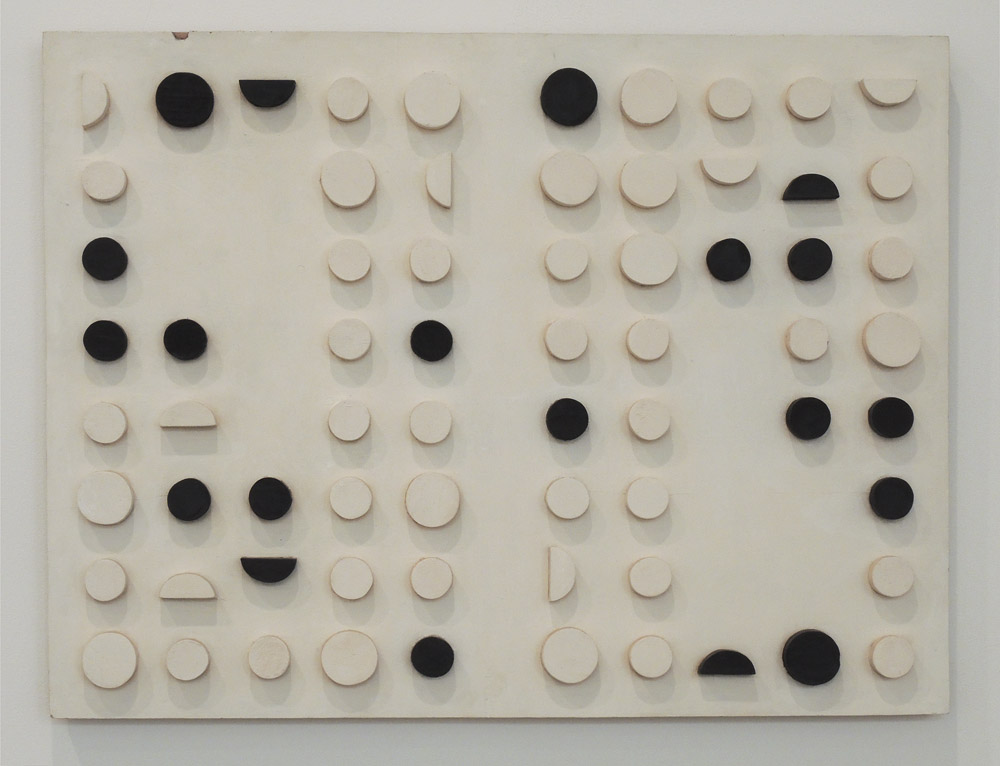
Loló Soldevilla, Astral Dream, 1957; mixed media on wood with wooden components,
30 1/2 x 39 1/2 x 1 1/4 in.


Looking at this relief is like looking at the night sky, trying to find patterns within the random shapes and colors.


Loló Soldevilla, Untitled (Construction), 1954; painted wood, 15 x 22 x 2 1/2 in.


I like that the regularity of this piece is disrupted by the roughness of the cut circles and background.


Loló Soldevilla, Untitled, 1954; collage on paper, 11 x 9 in.


Soldevilla also made some beautiful small collages, of geometric forms that are slightly offbeat.....


Loló Soldevilla, both: Untitled, 1954; collage on paper, 9 x 11 in


....or more pure. The bright colors bring a lighthearted lilt to the work.


Zilia Sanchez, Amazons, 1993; acrylic on stretched canvas, 71 x 72 x 12 in.


Zilia Sanchez's sculptural paintings are wild and sexy and sensual; their sedate blues and whites keep them grounded in cool abstraction.


Zilia Sanchez, Moon V, c. 1973; acrylic on stretched canvas, 74 3/4 x 79 1/2 x 10 in.


Swelling forms, interlocking....


Zilia Sanchez, Erotic Topology (of the Amazons series), 1968; acrylic on stretched canvas,
41 x 56 x 12 in.


....or simply protruding....


Zilia Sanchez, White Moon, 1984/89; acrylic on stretched canvas, 23 3/4 x 19 x 4 3/4 in.


....create poetic metaphors of the body, and of longing. All three of these artists––of different periods and education and even places of residence (Sanchez left Cuba in 1962)––came from a Cuban sensibility, but one also connected to widespread artistic thought; with these elements they each created an exciting body of work that I was very happy to see.


June 12, 2016

June, June, June!


White Rugosa rose

 June is bustin' out all over!
All over the meadow and the hill!....
....Just because it's June, June, June....
Rogers and Hammerstein, Carousel

I sing snatches of this song to myself during the burst of flowering of June, the most wonderful time in my garden, a month of roses and irises and peonies. The rugosa roses I planted have begun to bloom.....


Pink Rugosa


....and they're wafting their delicious fragrance through the air. They are especially lovely early in the month, before the insects––rose chafers and Japanese beetles––arrive.


Wild rose


 This tiny rose is a wild species that was growing in my backyard when I moved here. It isn't showy, but I like it for its air of tradition.


Tree peony


June is also peony month, though so far only the beautiful pale yellow tree peony is blooming. It too is sweetly scented; a single flower spreads its fragrance from a vase on my kitchen table.


Oriental poppy


There are lots of buds on the Oriental poppy plant this year and they've begun to open, at first looking like a spread fan.


Old fashioned bearded iris


Only two perennials were in the garden when I moved into my house over 20 years ago: the common daylilies in front of the house, and this pale yellow iris.


Siberian iris "Caesar's Brother"


I love the delicacy of form of Siberian irises, and this deep purple variety is a stunning one.


Siberian iris "Summer Skies"


Then there's the aptly named "Summer Skies" with its pale blue and white petals. Siberian irises are moisture lovers, so I have some of these growing by the pond....


Yellow flag iris


....along with the water-loving yellow flag irises, Iris pseudacorus, supposedly the model for the fleur de lis. 


Korean lilac "Miss Kim"


The main event of lilacs happens in late May, but the Korean lilacs, much smaller shrubs, bloom later. Their tiny flowerets look like miniature trumpets, and they blast out the most delicious fragrance.


Snowball bush, a viburnum


The lovely viburnums bloom in June. I look out the window behind my desk and see these white puffballs nodding in the wind.


Columbine


Wildflowers are blooming: the bright yellow hawkweed dots the lawn and buttercups the fields. At my house, columbine grows wild in the tall grass beyond the mowed lawn of the backyard. Its complex flowers ask for close attention.


Blackberry blossoms


I took these photographs on Friday afternoon, during a brief spell of sunny, not too cold weather. It has been chilly, gray, damp, and blustery for a week, and when I saw these blackberry blooms I remembered the definition of "blackberry winter": a cold spell during their bloom time. So it's not unusual after all to have a week of temperatures 20 degrees below the average! It's blackberry winter, but I long for a return to spring when it will be pleasant to work in the garden, enjoying the sights and scents of June.


June 10, 2016

A New Clay Relief: "Spin"


Spin, painted porcelain, 9 3/4 x 8 1/4 x 1/2 in.


I was intrigued by the overlapping curves of this composition, which are emphasized and repeated by the soft rounded raised lines. The four semi-circular shapes above the strong diagonal are somewhat parallel to the picture plane, or move a little forward at their tops, while the lowest one moves back. I'm not sure how clear the photo is in showing the receding bottom edge of that lowest shape. To emphasize its difference its interior line is in sunken relief rather than being raised like the others.  


Spin detail


I love the process of shaping different kinds of lines in clay: rounded and straight, soft and sharp. 


Spin detail


I pay attention to the edges of the piece, and have the forms drift onto the sides. As you can see in the first photo, the forms don't stay within a rectangular boundary but move in and out according to their spacial placement. Moving actual forms in actual space, however shallow, is very exciting; it's a different kind of excitement from the illusionism of painting: both are wonderful.