December 16, 2015

Donald Judd and Giorgio Morandi: Simple Forms and Depth of Feeling


Donald Judd, Untitled, 1991; Cor-ten steel and yellow laquer; four units, each 39 3/8 x 39 3/8 x 
19 11/16 in.


I was trying to understand the mood I was in when at the Donald Judd show at David Zwirner (until Saturday) because I was on the verge of tears while there. Here was work that was intensely formal––about shape and dimension and repetition and balance and weight and color––that was so beautiful in its clarity and reserve that I was deeply touched. The materials of the sculpture, though industrial, are gorgeously sensuous: the Cor-ten steel has a rich orange-red surface, and the acrylic sheets capture light and reflections.


Donald Judd,  Untitled, 1987 and Untitled, 1989 


There is a sense in the best minimalist art that we are seeing what is essential in the world, a perfect balance of forms that transcends materiality. 


Donald Judd, Untitled, 1987; Cor-ten steel and blue acrylic sheet, 39 3/8 x 39 3/8 x 
19 11/16 in.

Donald Judd, Untitled, 1989; Cor-ten steel, 39 3/8 x 39 3/8 x 
19 11/16 in.


The two works above are especially moving to me; perhaps it is their square shape, and the planes within that square having a powerful presence. They have a right-ness to them, within the square and in their relationship to the space outside.


Donald Judd, Untitled, 1990; Cor-ten steel and ivory acrylic sheets; 4 units, each 9 7/8 x 
19 11/16 x 9 7/8 in.


There were a few works in the show made up of repeating units, in a group of 4 as the first work posted, or this group in a horizontal alignment....


Donald Judd, Untitled, 1990; Cor-ten steel and black acrylic sheets; 6 units, each 9 7/8 x 
19 11/16 x 9 7/8 in.


....or these 6 going vertically up the wall. They add another formal element, that of repetition, and ask how we see differently when an object is not unique, but plays like a part of a musical composition.


Donald Judd, Untitled, 1990, detail


Looked at closely, these divided rectangles are richly mysterious with their dark interior planes that either sink into black or subtly reflect the room.


Donald Judd, four untitled works from 1989; Cor-ten steel, one piece with yellow acrylic; 
each 39 3/8 x 78 3/4 x 78 3/4 in. 


Also in the show are four large floor pieces, each 1 x 2 x 2 meters, each having a different division of its interior space.


Detail of one of the above works


I am someone who finds it very satisfying to look down at a clear division of space within a large rectangle. Judd managed to evoke complex feelings using basic forms.


Giorgio Morandi, Natura morta (Still life), 1947; oil on canvas, 8 1/16 x 10 13/16 in.


Walking upstairs at Zwirner gallery from the Judd show, where a beautiful show of Morandi paintings and prints was hanging, I was struck by a similarity of concerns for the two artists. Although Morandi's forms aren't minimalist, he painted the same simple objects again and again in different configurations, playing with basic ideas of relationships of form and space and color. Whether the objects are in a line at the front edge of a table....


Giorgio Morandi, Natura morta (Still life), 1949; oil on canvas, 12 x 17 15/16 in. 


....or compressed against its outer edge, I feel that the things depicted are more than just studio props; they become, like the Judd sculpture, essential forms, touching on transcending the ordinary.


Giorgio Morandi, Natura morta (Still life); oil on canvas, 12 15/16 x 15 13/16 in.


Morandi searched for underlying reality through perception, trying to understand shape, color, space, using his hand, while Judd's search used geometry and manufacturing.


Giorgio Morandi, Natura morta (Still life), 1962; oil on canvas, 12 3/16 x 14 3/16 in. 


But both artists explored elemental relationships of form, and through variations in those relationships, sought a kind of perfection. For me, both paths are deeply moving.


December 9, 2015

Sculpture: Picasso's Pleasures


Bottle of Bass, Glass, and Newspaper, 1914; painted tin plate, sand, iron, wire, and paper.


There's no question that Pablo Picasso was a sensualist, in his life and in his art, so it is not surprising that the painter worked in three dimensions throughout his life. The current show, "Picasso Sculpture", at the Museum of Modern Art presents over 100 of his sculptural works, from very tiny to large; my sense was that Picasso enjoyed every minute of their making. My favorite paintings of Picasso are from his Cubist period, and those are the sculptures that I liked the best in this show. They are almost paradoxical: in Cubism the world was reduced to flat planes, with sculpture it is being made into tangible volumes again, though of an abstracted nature.


Glass, 1914; painted tine plate, nails, and wood. 


Some of Picasso's cubist sculpture was fairly simple: a few interlocking flat and curved planes.....


Glass of Absinthe, 1914; painted bronze with absinthe spoon.


....while others had more complex form. The materials involved––and Picasso explored many––helped to determine the form.


Glass and Newspaper, 1914; painted wood, pencil, and oil on wood panel.


The almost flat painted wooden box is closer to the paintings, but the added form of the glass brings some whimsy to the composition.


Still life with Guitar, variant state, 1913; paperboard, paper, thread, string, twine, and coated wire.


I love Picasso's deconstruction and reconstruction of musical instruments, such as this guitar....


Violin, c.1915; painted sheet metal and iron wire. 


....and this violin, though it's difficult to discern the violin amid the colorful, almost riotous planes.


Head of a Woman, 1931; plaster.


Head of a Woman, 1932; plaster


There were a few other pieces in this show that engaged me, such as these two images of women in plaster. The first, though more naturalistic, has the forms of the face simplified and dramatized. This drama is heightened in this second, a large head. Though nothing like a real person, the actuality of the shapes, their clarity and assuredness and inventiveness, make this head remarkably alive.


Engraved ceramic fragments, pebbles, bone, 1945-47.


There was much in this show that was charming and delightful (maybe a little too much for my taste) and these tiny engraved pieces were my favorite of that type; perhaps it was because they were so small, so unassuming.


Head of an animal, engraved pebble


It was also because they referred to ancient art, and the forms that are simplified yet so sensitive to observation.


Flowers in a Vase, 1951-53; painted plaster, terracotta, and iron.


This is one of Picasso's "cute" sculptures that I enjoyed, perhaps because I'm a gardener. He really did seem to be getting a kick out of making things: fun things, silly things, sometimes more serious things.


The Bathers, 1956; wood.


Lastly, some wood assemblages of figures at the beach; the one in the foreground is a child. This exhibition confirms yet again Picasso's remarkable inventiveness––and who else would think of combining a bicycle seat and handlebars into the image of a bull's head?––his constant exploration, his joy in making art.


December 6, 2015

A Magical White World


I awoke in the dark this morning. Opening the door to let the cat out, I noticed that the ground was white, but not with snow. As the day brightened, the landscape became a dazzling sight: fog's moisture had deposited icy crystals on trees and shrubs and grasses, creating rime ice. The combination of the crystalline branches with the soft fog was very beautiful. 


Grasses were outlined in white, and a tree looked like a soft cloud.


As the sun began to peek through the fog, its glow made the ice glitter.


The delicate white-coated dried ferns are wonderfully contrasted with the circular pattern of green lichen.


Looking closely at the ice, we can see its spiky crystals, changing the character of a rounded dried flower.


Even the spider silk attached to this seed head is covered with rime ice....


....and hydrangea petals have a decorative edge.


A few hours later, at 11:30 AM, the frost has melted from the ground, but remains on shrubs and tall grasses, looking like a mad mix of seasons. Winter has its trials, but only winter can us bring such unusual beauty.


December 3, 2015

Adventures with Clay: Fun! Amid the Disasters


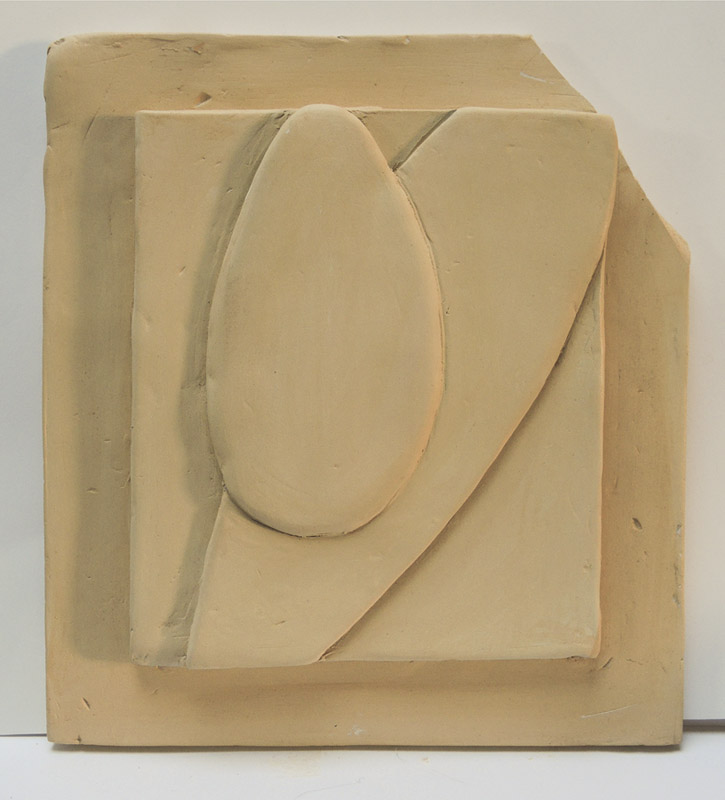
One, clay (Activa Plus) with egg tempera paint; 7 1/2 x 6 in.


It's happened to me again: another case of restless art syndrome. I have again been inspired to try something new after seeing a show that I loved, in this instance the exhibit "Ancient Egypt Transformed: the Middle Kingdom" at the Met, which I wrote about here. I began to paint on parchment because of seeing "The Hours of Catherine of Cleves" at the Morgan Library in early 2010. Seeing Tantric drawings at the Drawing Center in NYC inspired me to move my textiles from the floor to the wall. Relief sculpture has long interested me, and the stunning work in the current Egyptian show got my head buzzing and my hands wanting to make some low reliefs. I am solely a two-dimensional artist, knowing nothing about working in three dimensions, so I thought I'd try playing with some air dried clay. I tried many different clays, each with their problems for me. The clay above, Activa Plus, seemed the hardest of the air dried clays, but just porous enough to be able to paint, and I do want color in the work. One thing I want to point out is that none of these pieces are "finished"; they are all experiments, playing around, figuring things out. I don't know if anything I do in future will rise above the amateurish, but I enjoy sharing my process.


Two, clay (Amaco air dry); 7 3/4 x 6 1/2 in.


I began by thinking I would use similar imagery to my paintings on parchment, abstracted details of agricultural implements, but then found that I preferred the path of abstraction, closer to the ideas I used for my textile work. At first I've been drawn to rounded forms, probably because of thinking of the figurative aspects of Egyptian reliefs.


Two, painted with egg tempera


This clay was very nice to work with, but dried much too soft and brittle. My little piece is like a broken Egyptian panel, though not thousands of years old. It was very porous, so the paint sank right into it. The other air dried clays I tried were the Crayola product (didn't like working with it); Creative Paperclay, which was fibrous and impossible to cut or model smoothly, as was the Polyform Model Air, though both were a beautiful white. I have another Amaco product on order, an air-hardened clay, which should be tougher than the soft stuff above.


Three, Sculpey; 4 3/4 x 5 in.


And I tried a polymer clay, which was lovely to model with, but I dislike its plastic surface. One of the things I like about this process is the softly irregular surface of clay; it has a lot of character. All these pieces, except the one above, were done from sketches. This one was improvisational; I cut circles using a set of different size cookie cutters.


Four, Sculpey; 7 3/8 x 6 in.


This is the only straight-line geometric composition of this group. I did 3 or 4 others that landed in the trash. I'm not happy with the balance of elements, but thought I'd include it anyway.


Five, porcelain clay; 7 1/4 x 5 1/2 in.


Finally some real clay that has to be fired, delicious to work with. I am very lucky to have a local friend with a ceramics business who's given me a lot of help and advice, and clay and an offer to fire the work I do: thanks so very much, Deborah Jurist of Mountaine Meadows Pottery. I am such a beginner that I had to look up "air bubbles in clay" because I was getting them: I didn't realize I had to either knead or wedge the clay. I do realize that I have to learn to take better photos of these reliefs, maybe using artificial light. I use natural light to shoot all my other work.


Five detail


What I loved most about working on these pieces was line: outline, the line around forms, that could be hard or soft, rounded or crisp, blended or sharp. In Egyptian and Persian reliefs the outlines are sensitive and fluid. In Persian and Indian manuscript paintings the flat forms have an allusive roundness because of elegant lines. I like the challenge of using layers not more than 1/8" thick to describe three dimensional volumes, hoping that line does a lot of the work.


Five with frame; 9 1/2 x 8 in.


My idea with these pieces is to have the image panel sitting within a frame. Being that I still can't control the attachment of parts in terms of dryness and flatness, the frame part of this piece bowed, then cracked when I tried to flatten it. Oh well. I hope I eventually figure it out. Meanwhile, I'll have the image panel fired, hope it doesn't break apart in the kiln, and if it stays whole, I'll try painting it. And hope I can do better next time. I'll be taking a hand building clay class in January, and that should help a lot with my technique issues. But, even with all these problems, I am having a great time with this new medium. 


Ben Nicholson, White Relief, 1934; oil paint on mahogany, 29 x 39 x 1 1/4 in.


This relief by Ben Nicholson is another inspiration for me, a beautifully simple arrangement of geometric shapes that feel so perfectly in balance. I would be very happy if I could do anything approaching this quality of rightness.


December 1, 2015

Dried Plants: Color, Shape. Pattern


Before the ground is covered with snow I want to celebrate the browns and grays and dirty yellows, the interesting shapes and patterns, of plants whose growing season is over. It's a very different beauty from the greens of spring and summer, but the subtleties I see now have very attractive qualities. The mallow seed heads above are delicately veined and translucent, opening to show the black seeds inside. There's a burst of weathered red, worn and shrunken, of a rose hip.


Thin lines of dried daylily leaves make paths across a granite rock.


The cut-back leaves of Siberian iris are a burnt sienna hue, and have a texture like a head of unruly spiked hair.


There are also tall columns of stately leaves....maybe phlox?


One of my favorite plants––baptisia, or False Indigo––has leaves and seed pods that turn black in the fall.


Some leaves curl upwards, like gently closed hands, showing different colors inside and out.


The dried leaves of the annoyingly invasive Canary reed grass are a bright light ochre at this time of year, and seem to catch light.


Then there are the ferns, whose rich red-browns add a deeper tone to the landscape. Some ferns are a complex tangle....


....and others have simpler, more elegant curves. This dried frond looks especially beautiful alongside the gray-green lichen. Even the dying end of the year has its loveliness.