July 15, 2015

Bugs on a Flower


There are some flowers that seem to be especially attractive to insects. In the spring, the lilacs host all sorts of insects, large and small, some of which you can see in this blog post. I first noticed this delightful flower blooming wild in my field last year; this year it had spread, and I saw that it was covered with insects of all sorts, including this tiny butterfly, with its proboscis dipping for a meal.


I couldn't identify the flower, but a Facebook friend pointed out that it looked like a Centaurea, and indeed it does look like the Centaurea montana above that is in my garden.


This beautiful little spider is color coordinated with the flower.


Many bees visited the blooms, from smaller....


....to larger....


....to extremely tiny. You can see the yellow pollen on the legs of the brilliant shiny green bee; its coloration is sumptuous.


And finally, an itty-bitty worm with an elegant brown and beige pattern (you can click on the photos to see these insects more clearly). Flowers that are simply a visual delight for us are sustenance for some in the insect kingdom.


July 13, 2015

A New Painting: "Points"


Points, egg tempera on calfskin parchment, 8 1/2 x 7 in. 


After the cool simplicity of my last painting––Bar and Shadow, which you can see here––Points is quite boisterous with its multiple shapes of intense color and its layering of space. It almost has an air of a cubist composition. I like trying this and that, finding different kinds of compositional structures. I don't like to repeat myself, though I sometimes think (rarely, actually) that my work might be better if I focused like a laser.....but it's just not in my artistic character at this point in my life.


Points detail

July 9, 2015

Strawberry Muffins


It's strawberry season here in northern Vermont. Along with strawberry shortcake, a recipe I love is this one for strawberry muffins, which came from a container of Stonyfield Farm yogurt. Using yogurt instead of milk adds extra flavor to the muffins. I usually freeze some chopped strawberries so I can make these during the winter. The same recipe works well for blueberries or raspberries (I'd much rather have a raspberry muffin than a blueberry one).

1 cup all purpose flour
1 cup whole wheat flour
1/2 cup sugar
1 1/2 teas baking soda
2 eggs
1 cup yogurt
1/4 cup butter, melted
1 teas vanilla
1 cup chopped strawberries

Preheat oven to 375º.
Mix flours, sugar, and baking soda in a bowl.
In another bowl, beat eggs, then mix them with the yogurt, melted butter, and vanilla.
Toss the strawberries in the flour mixture, then pour liquid ingredients into the flour and blend.
Spoon batter into greased muffin tins: 12 for smaller muffins, 10 for larger (I prefer fewer larger muffins).
Bake for 20-25 minutes, until top is golden and batter is cooked through.


July 8, 2015

At the Hood: The Secret Patterns of Ukara Cloth


 Igbo People, Nigeria; Giant ukara, used for a backdrop in an Ekpe lodge; ca early 2000s; 
indigo dyed cotton, 233 x 78 in.
All works in this post are made in the past 30 or 40 years; all are in the collection of 
Professor Eli Bentor of Appalachian State University. 


Just like some other animals––bowerbirds, for instance, where the males decorate their nests to attract females––humans have a deep aesthetic sense. Therefore, many objects made for practical or ceremonial use are beautiful, which enhances their meaning and worth. There is currently a show of stunning Ukara indigo dyed cloth at the Hood Museum of Art, made for the Ekpe male secret society of Nigeria and Cameroon. Whether very large, like the backdrop cloth above, or smaller, meant to be tied around the hips, their designs are based on a grid of abstract or imagist patterns.


The designs are called nsibidi, and their meanings are secret, known only to members of the society. They are full of energetic life, enhanced by the breaking of the grid by images of animals, reptiles, and human figures.


Here is a smaller piece that emphasizes squares filled with geometric patterns. A small leopard overflows his square, changing the regular rhythm.


A very interesting part of the story of this cloth is that it is not made by members of the Ekpe society, but is commissioned and produced in a distant village by the Ezillo people. The drawing of the patterns on the industrially produced cotton is done by an Ezillo man, based on a grid.


The cloth is then handed on to another man who sews the designs using raffia.


The job of indigo dyeing, which is a complex process, is done by women.


The raffia is then removed, often by young people; this is not a job that is for only men or women. Where the cloth was tied, white patterns are left, a kind of resist dyeing. You can see the wrinkled texture of the cloth where it was bound with raffia.


Although I know nothing of the meanings conveyed by these cloths, I appreciate them as marvelous objects whose simple patterns join in a powerfully rhythmic way.


Their combinations of geometry and image speak to essentials in life and in how we see the world; repetitive pattern seems to be the heartbeat of art.


July 6, 2015

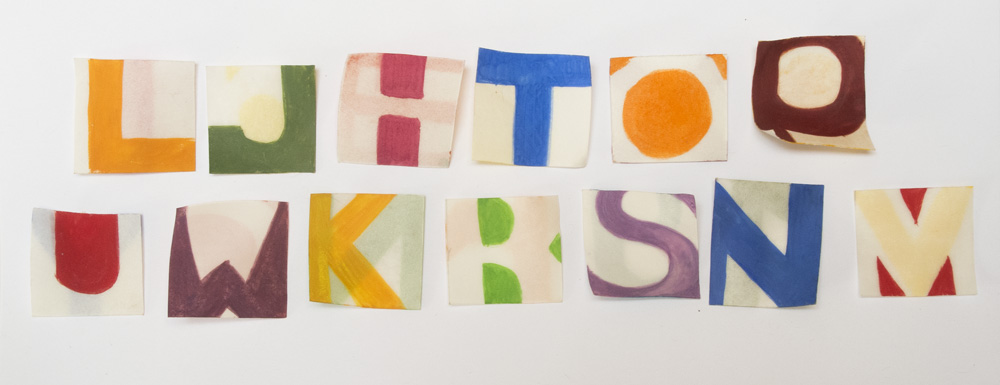
A New Boxed Paintings: "Alphabet" (for Al Held)


Alphabet, egg tempera on calfskin parchment, box size 3 1/4 x 5 3/4 in.


I've just completed a new work in my series of very small paintings inside a box, this one on the theme of the alphabet (you can see a previous work here, with links to others) Letters are symbols and their shapes are interesting abstractions.


Alphabet, top and inside of box


I tried to find a combination of letters for the top of the box that wouldn't read as a word (or a well-known tv show) and that would be visually engaging. But ah well, the inside of the box: do you mind the love and kisses?


Al Held, The Yellow X, 1965; acrylic on canvas, 144 1/2 x 178 in.


I stole the idea of using the alphabet to make abstractions from Al Held. A couple of years ago, Cheim & Read gallery mounted an exhibition of his Alphabet paintings, and it was a powerful show of what their press release rightly called "monumental paintings". They have been in my mind ever since.


Alphabet, paintings side 1, ca. 1 1/4 x 1 1/4 in.


My very small images have very little in common with those of Al Held, but I enjoyed the challenge of trying to see some letters in a new way. It isn't easy to remove their ready associations; letters are so insistently themselves.


Alphabet, paintings side 2, ca. 1 1/4 x 1 1/4 in.


Because the parchment is translucent, I try to have a visual relationship between the image on each side. And although I a box usually contains 12 little paintings, with an alphabet of 26 letters, this box has 13.


July 1, 2015

At the Hood Museum of Art: Inuit Spirits


Karoo Ashevak, Canadian Inuit (1940-74), Shaman and Spirit Figure, ca. 1970-74.


The Hood Museum of Art at Dartmouth College is a museum small in size but sweepingly large in its collections. It occasionally has in-depth shows of collections not usually on view––see my posts on their Australian Aboriginal art here and here; on Cubism here; on Japanese prints; on Native American ledger drawings; Native American art––and the curators occasionally change the art in the permanent collections galleries. When I was at the museum last week, I was stopped dead by this sculpture in cases that had previously held Chinese art. Expressive, frightening, powerful small figures called out their insistent presence in this world, while seeming to come from another.


Karoo Ashevak, Untitled (Shaman), ca. 1970-74; carved whalebone inlaid with walrus ivory, baleen, and stone. 


In the Inuit belief system, a shaman could pass between the animal, human, and spirit worlds. Ahevak's sculpture brings us face to face with the uncanny, with beings far from ordinary. Because of their strong formal qualities––the repeated curves, the low relief in contrast with the deep spaces of mouth and nostrils, the emphatic rhythm of teeth––their insistent narrative has a deeper resonance.


Karoo Ashevak, Untitled (Spirit Figure), ca. 1970-74; carved whalebone inlaid with walrus ivory, baleen, and stone. 


The frightening aspect of this spirit figure is consistent with Inuit cosmology, in which everything had a spirit, and in a hostile world there was much to fear. Looking at this piece formally, its shifting planes seem to reference cubism, but whether the artist intended that, or the forms came solely from his sensibility, I don't know. Ashevak and other Inuit artists of his generation were encouraged to carve by cooperatives that were established by the Canadian government.


Karoo Ashevak, Bird Spirit, ca. 1964-69; possibly the jawbone of a whale.


Though not as fearsome a spirit, this bird has tremendous energy captured in its flattened form.


Osuitok Ipeelee, Canadian Inuit (1923-2005), Singing Owl, 1982; green serpentine


An owl appears to be raising its arms/wings in ecstatic song. Ipeelee was a well respected artist, who loved to teach others, as he was taught by his father. A quote from his says that when
you're a carver, if you get your ideas of what you're going to make, you have to follow each step by looking at your imagination. 

Simanek Sagiatuk, Canadian Inuit, born 1930, Polar Bear, ca. 1980; serpentine.


Here is a more conventional depiction of a familiar arctic animal, but it is sensitively observed, a bulky animal in graceful movement. I was especially glad to see the work of Ashevak and Ipeelee at the museum, sculpture that was so personal and so vividly alive.


June 29, 2015

New Hooked Wool Drawings


2015 #9, hand dyed wool and egg tempera on linen, 15 x 12 in.


Like my last group of hooked wool drawings, which you can see here, hooked wool lines anchor the structure of these new compositions. Using line alone, without hooked shapes, is not something I set out to do; it just happened. In the piece above, I used a sinuous double line, more curvy than my usual curves; the color emphasizes a bit of cartoony goofiness.


2015 #10, for Ellsworth Kelly, hand dyed wool and egg tempera on linen, 20 x 19 1/2 in.


These simple curves are an homage to Ellsworth Kelly, a great artist, who has continued to paint and advance his work at the age of 92. At first I thought I'd make four separate pieces, but then felt that the work would be more compelling on a single piece of linen. Each section is one color with white, and a Kelly green line.


2015 #10 detail


When I photographed this detail, I realized that I'd left the little tails of the wool dangling at the top and bottom of the green line to the left. Taking photos can focus the attention.


2015 #11, hand dyed wool and egg tempera on linen, 19 x 15 in. 


Primary colors; lines straight and curved, isolated and interlocking; all floating on a linen ground. 


2015 #11 detail


Lines can do such different things, and can evoke different moods and qualities. 


Here are the three pieces hanging together on the wall, to give a sense of their sizes, which is hard to tell from individual photos.


June 25, 2015

Allium Antics


Of the alliums in my vegetable garden––garlic, Egyptian onions, scallions, onions, chives––chives are the most conventionally ornamental. Their flowers are lovely puffs of pale violet, whose florets decorate salads beautifully.


Then there are the small explosions of scallion flowers, bristling with energy.


Form becomes much more complex when we get to the garlic. Stiff-necked garlic sends up scapes that curl into rounds....


....and interact rhythmically; they seem as though they are describing musical notes. The scapes will eventually flower at their ends, but I cut them off so all the plant's energy goes into making larger bulbs. They are good to eat; see, for instance, the recipe for Garlic Scape Pesto.


The prize for grand gestures, however, has to go to the Egyptian, or Walking, onions, which writhe and twist and curl into the strangest of shapes.


In early spring, they are the first greens, like fat chives. Then there are thicker leaves (or are they scapes?), some bound into a tight package....


....and they break free and squiggle about: up, down, across.


Each green undulating line ends in a white dome, that opens to small bulbs, called bulbils, some of which will sprout in turn; if they flop over onto the ground, new plants will grow, hence their other name of "Walking Onion". There's nothing regular in these meandering forms; they are delightfully wacky. I can't think of any other vegetable that takes quite so much liberty, and is so wildly varied, in its form; I love having them in the garden just for the visual pleasure that they give me.


June 22, 2015

A New Painting: "Bar and Shadow"


Bar and Shadow, egg tempera on calfskin parchment, 9 x 6 3//4 in. 


Every once in a while I do a painting that pleases me; its form, color, structure, light, feels especially satisfying. It's not that I don't like other paintings; if I didn't like them they would be wiped away. I can hardly explain why Bar and Shadow is one of those paintings that affects me in this way, but I am happy looking at it. It's not a matter of quality, which I am not judging; others may think differently about this painting. I think here it is the blue-gray color, almost neutral but not quite, and the angled bar which becomes a curving shadow, the balance of elements, which pleases.


Bar and Shadow detail


I also enjoy the warm reflected light in the recessed area. I'm not trying to toot my own horn here: I imagine that those of you who make things––whether art or gardens, meals or ukeleles––experience a particular satisfaction from time to time. 


June 17, 2015

Alex Katz: The Expansive Landscape


4 PM, 2014; oil on linen, 144 x 108 in.


Alex Katz's landscape paintings are a paradox: as large as they are, they seem intimate; they portray ordinary views, yet are surprising and extraordinary. This feeling I had while seeing Katz's exhibition at Gavin Brown's Enterprise reminded me of a favorite quote from the writer Jean Rhys, from David Plante's book Difficult Women:
I think what one should do is write in an ordinary way and make the writing seem extraordinary. One should write, too, about what is ordinary, and see the extraordinary behind it. 
Katz's simple titles––a time of day, a description of place––tell of noticing something marvelous within an everyday world. It was a stunning experience to see the painting 4 PM, glistening on a back wall, seen through doorways.  The painting seemed as alive, and its subject as real, as the bars of light cast onto the polished floor: a hazy sun, leaves back lit, flickering in moving air.


4 PM detail


Another paradox: the brushwork is loose and painterly, yet conveys the specifics of light and place.


12:30 PM 2, 2014; oil on linen, 108 x 132 in.


At midday the light is very different from later afternoon. Through a wall of trees is a bright yellow band (flowering grasses?); a sweep of grass leads up to them.


12:30 PM 2 detail


The leaves are painted as fluid masses of varied greens, the tree trunks vertical striations of color.


Black Brook 18, 2014; oil on linen, 96 x 120 in.


This painting is compelling for a very-little-there-ness that is rich in effect. Brilliant yellow greens bounce off a dark expanse of water.


Black Brook 18 detail


There is such economy in the marks of the brush, and such grace. I think that one thing that makes the viewing of these paintings an intimate experience is the pleasure in walking up to them and getting an almost physical sense of paint as object, paint as light.


Fog, 2014; oil on linen, 108 x 216 in.


With Fog, Katz painted a very different landscape, one barely visible.


Fog detail


To convey trees lost in mists, he used broad strokes of the brush with very little detail. It is a haiku of a painting.


Untitled Landscape 1, 2014; oil on linen, 96 x 120 in.


A hillside is shadowed against a bright sky with clouds shaped like scudding raindrops. The black hill is subtly painted with variations of tone on its surface.


Untitled Landscape 1 detail


A long lifetime of painting––Katz is 88––has led to a fresh assuredness in making images.


Night House 1, 2013; oil on linen, 126 x 96 in. 


There are also paintings of night: a house dwarfed by trees is welcoming with warm light pouring forth.


Untitled Cityscape 5, 2014; oil on linen, 108 x 84 in. 


In a dark city a beautifully modulated gray sky is lit by a band and triangular shapes of light. It floats above a dense building, drawn on the opposing diagonal to the light band. It's a mood very different from the wooded dark.


Untitled Cityscape 5 detail


The gray sky is translucent because of the way the color is laid on the canvas. A lit window anchors the painting at the lower right, and is a quiet counterpoint to the bright areas of sky. The dark mass of building has weight even though it is flatly painted.


Luna Park, 1960; oil on masonite, 40 x 30 in.


From this early, relatively small painting, we can see that Katz's approach to the landscape hasn't changed that much over the years, although his primary focus was for many years on the figure. As good as those figure paintings are, there was a coolness in his approach; his concern with "style" put them at something of an emotional remove. The landscapes, though, are full of poetic sentiment: of beauty, of air and light, of memory, of tenderness.