Showing posts with label design. Show all posts

January 9, 2017

At the Met: The Power of Simple Form


Shell Ring ,(Yua), Abelam people, Papua New Guinea, 19th - early 20th century


What is it about beautiful objects that is so compelling? Often, when I have some time to wander the galleries of the Metropolitan Museum of Art, I find myself looking at things, at artifacts and ancient sculpture; I visit old friends and discover new ones. I don't quite know why these often take precedence over spending time in the painting galleries; perhaps it's the satisfaction of seeing three dimensional things I can imagine running my hands over; perhaps it's their mystery. On my most recent trip I looked through the galleries of the Arts of Africa, Oceania, and the Americas and saw a few objects of stunning simplicity, where the purity of form spoke very strongly.  The shell ring, made from the shell of a giant clam, is a form of wealth for the Abelam, and also a part of ceremonial life. The irregularities of the surface play against the perfection of its curving form.


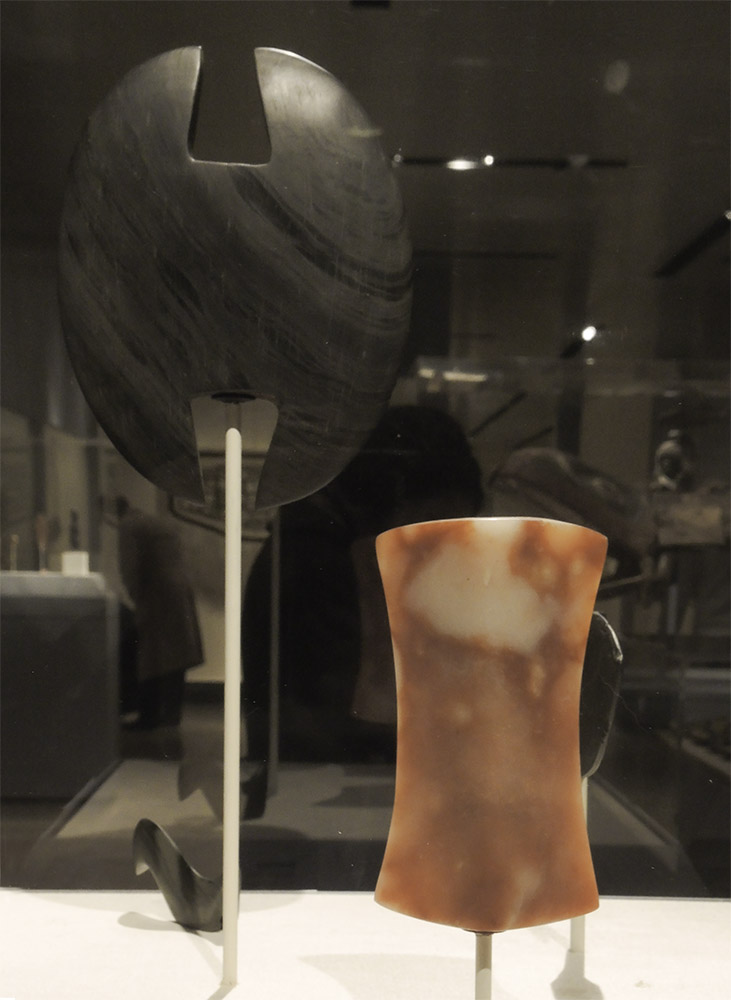
Bannerstones, archaic Illinois and Ohio, 3rd - 2nd millenium B.C.E. 


These ancient carved stones were used as spear weights. I love seeing very old utilitarian objects that were crafted with exquisite care, each one an aesthetic object. The fact that thousands of years ago different peoples around the world sought beauty touches me deeply.


Lidded Bowl, Marquesas Islands, 'Enana peoples, late 18th - early 19th century.


The simple shape of this bowl is described as bird-shaped in the Met's wall label. I hadn't recognized that, but I did respond to its graceful curves, which end in a stylized human head.


I'm not sure what this object is because I photographed the incorrect wall label; I'd thought it was a fishing float from the Solomon Islands. But whatever it is, the dark irregular sphere and its elegant decoration are wondrous.


Shield, Australian aboriginal artist, mid to late 19th century


I love both the extended oval form of this shield and its geometric decoration that pushes against the curved edges. The central horizontal band of red creates a break in the rhythm, a sophisticated syncopation.


Egyptian ointment jars and pots for makeup, 1800-1500 BC


The Egyptian jars and the two porcelain works below are objects that I photographed on previous visits to the Met, but which fit in with the theme of clear and simple form, form which I find so pleasurable. I look at Egyptian works often, especially Egyptian reliefs, which inspired me to begin my series of relief sculpture.


Chinese Qing dynasty porcelain, late 17th - early 18th century


On the Met's second floor, in cases to the left of the grand staircase, are many elegant Chinese porcelains, beautiful in color and in shape. I love these pieces, not the highly decorated vases, but the ones that are mainly a single color––white or yellow, or oxblood–––on a pure form.


Moon Jar, Korea, second half 18th century; porcelain, 15 1/4 x 13 in.


There is a gallery dedicated to Korean art in the Asian wing at the Met, with intriguing objects on view, especially ceramics. The Moon Jar with its gently swelling form and delicate coloration is a favorite of mine.


Barnett Newman, Untitled Etching #1, 1969; etching and aquatint, 23 3/8 x 14 11/16 in.


After admiring the objects from the Americas and Oceania, I felt that the pure, simple form of this Barnett Newman etching had an increased resonance and weight. It's not only a modernist abstraction, but it is also an heir to a millennial-old tradition of art's fundamental aspect, pointing to a quality of transcendence. The clearing away of extraneous detail and of narrative, the focus on the essential, gives to all these works a sense of the extraordinary, the magical, and shows the power of art to elevate and enlarge us.
 

May 5, 2016

At the Met: The Ordinary Becomes Extraordinary


Walter Dorwin Teague, "Bluebird" Radio, 1934; manufacturer: Sparton Corporation; 
glass, chrome-plated metal, fabric, painted wood.


I love good design, and seeing the attention paid to all aspects of a manufactured object: a thing in everyday use can be beautiful. Currently at the Metropolitan Museum of Art is a display of American modern design from the John C. Waddell collection, gathered in a couple of cases in the contemporary galleries. The wall label informed me that modern design in the US was in a sorry state at the time of the Exposition International des Arts Decoratifs et Industriels Modernes in Paris in 1925, but afterwards, with the inspiration of that exposition, a new effort was made by artists and designers and they produced "strikingly innovative objects". The radio above certainly is a stunning thing....


Walter Dorwin Teague, "Bantam Special" Camera, 1936; manufacturer: Eastman Kodak Company; 
metal, enamel.


....as is this camera. They were designed by Walter Dorwin Teague, who was considered the "dean of industrial design", a leader in the field along with Henry Dreyfuss, whose objects are below, and a few others. These modernist objects have a dramatic and satisfying aesthetic presence. It would be nice to own this radio and this camera just to be able to look at them. 


Henry Dreyfuss, Electric Toaster, 1932; manufacturer: Birtman Electric Company;
chrome-plated metal, plastic, glass.


This toaster is an inventive combination of flat black planes and a big rounded chrome belly topped by an open rectangle. It's an improbable combination of elements that's visually exciting.


Henry Dreyfuss, "Big Ben" Alarm Clock, 1938; manufacturer: Westclox Company;
metal, chrome-plated metal, enamel.


I'm pretty sure I had one of these clocks when I was young. It's one of those everyday things that we wouldn't pay any attention to, but shown in a museum we take another look and notice its crisp design. Dreyfuss also designed the Princess telephone.


Henry Dreyfuss, Kitchen Utensils, 1934; manufacturer: the Washburn Company;
metal, painted wood.


I love the shapes of the handles on these kitchen utensils; they're utilitarian and amusing at the same time.


Henry Dreyfuss, Thermos Bottle and Cups, ca. 1933; manufacturer: The American Thermos Bottle Company; metal, glass, plastic, paint, cork.


This thermos features another surprising combination of shapes, as in the toaster above: a long, flat-sided body topped by a rounded cup, all painted red and black, like a harlequin.


Wolfgang and Pola Hoffman, Cigarette and Match Holder with Ashtray, ca. 1930; manufacturer: Early American Pewter Company; pewter. 


I wonder if designers these days are spending any time working on cigarette accoutrements. But these two pieces....


Donald Deskey, Cigarette Box, ca. 1928; manufacturer: Deskey-Vollmer Inc.; 
painted wood, silver leaf.


....are beautiful examples of the former glamour of smoking cigarettes. For a fascinating look at good contemporary design, see the film Objectified, by Gary Hustwit, which I wrote about here. An industrial designer has a difficult task: to make the object both useful and attractive; I'd like to honor those who achieve it.


July 22, 2015

At the Hood: The Elegant Shapes of African Weapons


Knife, Democratic Republic of Congo


It is strange to admire objects of war and violence as aesthetic objects, but when they are as beautifully formed as the works in The Art of Weapons at the Hood Museum of Art, it becomes too easy to separate artistry from use. On view are highlights from the museum's extensive holdings, which were collected during the late 19th to early 20th century, the age of colonization, which brings up other moral questions. But....I'd like to simply admire the fine craftsmanship and elegant design of these works. The knife above, with its sweeping curve punctuated by open circles, is a study in motion (but as I say that I see it sweeping through the air towards its destination); there is an interesting contrast between the fine blade and the rounded handle.


Fang or Kota people, Gabon, Bird-headed ceremonial knife.
Photographed from museum catalog, essay by Ugochukwu-Smooth Nzewi, Curator of African Art


This is a marvelous abstraction of a bird, its huge beak becoming a blade. From the exhibition catalog, I learned that ceremonial knives were used "in ritual and ceremonial contexts, such as rites of passage that involved circumcision, and as a protective charm against anti-social forces".


Knife, Democratic Republic of Congo

The swelling form of this blade contrasted with the wire-wrapped wooden handle is very beautiful. The darker shape at the center creates a repeated rhythm.


Kuba people, Democratic Republic of Congo, Ceremonial Knife. 
Photographed from museum catalog.


This ceremonial knife is known as an ikula. It would have been worn on the right hip by free men in Kuba society, denoting high rank. Reading about this knife in the catalog, I was amazed to find out that the complex wooden handle is inlaid with wire to form the patterns. This is craftsmanship of a very high order.


Knife


This is an unusual shape, with metal blade perfectly integrated with its wooden handle.


Bwaka or Gobu people, Democratic Republic of Congo, Throwing knife.
Photographed from museum catalog.


This is quite a brutal weapon when thrown at a foe; its complex form added to its deadliness. Throwing knives were highly valued, "used as currency for commerce and as a symbol of political office or social status".


Iron spear, Sudan


I look at this spear and have a deep sense of satisfaction: the shape seems to me to be perfect in its proportions; the relationship of height to width, the gentle swelling outlines, the central light vertical line, combine to make something that seems an essence of form.


Hippopotamus leather shield, Sudan


The exhibition also included defensive weapons, such as shields. The large leather shield above is remarkable for its pattern of bumps, which create a linear design within its long curve.


Hippopotamus leather shield detail


I don't know how these small protrusions were created, but they do make a lively and interesting surface.


Shield, Democratic Republic of Congo


This shield, with its dramatic abstract design, is made with organic fibers and wood, the fibers very intricately woven. The central black lines jump to light triangles on black, a strong formal invention. Because these weapons were not just used in war, but had other social meanings, their high quality and beauty served another purpose. From the catalog:
African weapons are emblems of authority, social rank, ritual commemorations, royalty, strength, identity, divine power, life, and death.

May 21, 2015

At the Met: Feasting and Fighting in Persian Art


"Timur before Battle", folio from a dispersed copy of the Zafarnama of Sharaf al-din Yazdi; Iran, 1436; ink, opaque watercolor, silver, and gold on paper; 11 1/2 x 8 in. 


I love manuscript painting––whether Indian, or Persian, or Islamic, or Medieval European––for its intimate size, its clarity of form and attention to detail, its beautifully wrought storytelling. So I was happy to see the small exhibition currently at the Metropolitan Museum of Art, Bazm and Razm: Feast and Fight in Persian Art. These two activities were important to kingship; how surprising to learn that the ruler was valued for his ability to engage in battle and to hunt, but also to enjoy the bounties of the table, of wine and of music. It is hard to imagine our contemporary leaders being expected to excel at feasting. From the wall label at the show I learned:
In the bazm mode, the king's ability to savor worldly pleasures such as food, wine, poetry, and music was praised.  The opulence and ceremony at court, with lavish displays of dress, jewels, luxury objects, and textiles, as well as the maintenance of an extensive entourage and harem, wer all measures of the shah's distinction. In the razm mode, a ruler's success was marked by his ferocity, courage, tenacity in battle, and ability to defeat the most brutal enemies as well as his prowess in riding, hunting, weaponry, and strategic games. 
The commemoration of these events has brought us many beautiful paintings. In "Timur Before Battle", the artist repeats curves, behind which are soldiers, the king, and a golden sky. The diagonals of banner staff and umbrella emphasize those curves. Within this simple structure are fine details of armor; all is joyously colored.


Prince in a Garden Courtyard, Iran, 1525-30; opaque watercolor, ink, gold, and silver on paper; 
8 9/16 x 4 3/4 in. 


The elements of feasting are shown in this painting: food, wine, and music in a lovely setting. Persian painting is almost miraculous in its depiction of precise, complex details. The attention paid to every aspect of the scene is intense, and close to magical in the painting's small size.


"Preparation for a Feast", folio from a Divan of Jami; Iran, late 15th century; opaque watercolor, ink, and gold on paper; painting 6 15/16 x 4 3/4 in. 


Getting ready for a large feast could take days; this tiny painting shows many parts of the meal being prepared, from slaughtering of animals, to making bread, to various cauldrons on the boil.


"Preparation for a Feast" detail


On the lower right, food is being ladled into bowls. The composition of the painting, structured only by the sky at top bisected by a tree, and a small stream towards the bottom, emphasizes the hectic activity.


"Entertainment in a Garden", folio from a Khamsa of Amir Khusrau Dihlavi, Matla' al-Anvar, detail; Iran, second half 16th century; opaque watercolor and gold on paper; painting 12 5/8 x 7 1/8 in.
See the entire painting on the Met's website. 


At the bottom of this busy scene of a feast are musicians and guests. The painting is surrounded by a geometric and floral pattern, made more precious with gold.


Tile, Iran, second half 17th century; stonepaste, polychrome glaze within wax resist outlines; 8 x 8 in.


Included in the exhibition are objects related to the twin themes; here, a tile showing a shallow wine cup and a bowl of fruit.


Kamanche and Dayere, Iran, 19th century


The kamanche, a bowed instrument, and the drum, the dayere, can be seen in the painting above, "Entertainment in a Garden". They are beautiful objects in themselves, and though of a later date, are traditional in form and use.


"Bahram Gur Shows His Skill Hunting while Fitna Watches", folio from a Haft Paykar of Nizami; Iran, mid 16th century; opaque watercolor, gold, and ink on paper, 13 1/4 x 8 1/4 in. 


Even in a scene of death, the artist presents the action within the vitality of flowering plants.


Hunting Scene, detail; Iran, mid 16th century; ink, transparent watercolor, and gold on paper; 7 1/4 x 11 3/4 in. 
See the entire painting at the Met's website.


There is also a great sensitivity in the depiction of animals and of plants.


Artist 'Abd al-Vahhab, "Zal Slays Khazarvan" from the Shahnama of Shah Tahmasp; Iran, 1525-30; opaque watercolor, ink, silver, and gold on paper; painting 11 1/16 x 7 3/16 in. 


The symmetry of the grouped armies and the two leaders locked in battle enhances the drama of the event.


"Zal Slays Khazarvan" detail


Even in paintings of mortal combat, Persian artists revel in the decorative: the violet hillside, the pool surrounded by flowers and roiling rocks. This attention to the loveliness found everywhere makes these paintings a pleasure to look at, to wander through, no matter the subject.


Mace, Persian, 19th century; steel, gold; 32 1/2 in. 


Here is a later example of the ox-head mace with which Zal slayed Khazarvan. It is a lovely thing, and the wall label tells me that it:
....is mentioned in Iranian myths and epics as a symbol of the victory of good over evil and order over chaos. 


Helmet, Persian, 18th-19th century; steel, gold; height with mail 28 in., without mail 6 7/8 x 8 in diameter. 


It is so interesting to see objects that are the models for those in paintings of an earlier time. There is as much beauty in these things of war as in those of music, and as much grace as in the paintings.


May 4, 2015

At the Met: The Plains Indians: Beauty, Glory, and Tragedy


George Beaver (Pawnee), Ghost Dance Drum, 1891-92; wood rawhide pigment, 23 in. diameter


The Metropolitan Museum of Art has mounted an incredibly powerful and moving exhibit, The Plains Indians: Artists of Earth and Sky (until May 10). The show contains many masterful works, but it is the narrative arc––from pre-contact to the height of plains culture to contemporary––that makes for such an emotional viewing experience. It is especially emotional for me: I lived for a year, 1975-76, in the small town of Wagner, South Dakota, where I was an artist-in-schools for K-12. Wagner is on the Yankton Indian Reservation, an "open" reservation, so I had many Native American children in my classes and met several plains indian artists, including Arthur Amiotte, who did the last work I show in this post. It was a time of great activism in the American Indian Movement; I was in South Dakota not long after the 1973 Wounded Knee protests and they were on everyone's mind, especially since it was the bicentennial of the founding of the United States.

I am beginning this post with two beautiful late nineteenth century works, both associated with the Ghost Dance spiritual movement. The drum has a dramatic image of Thunderer, ruler of the Sky World, and swallows as elegant flying shapes below it.


Ghost Dance Dress, Southern Arapaho artists, Oklahoma, ca.1890; native-tanned leather, pigment, metal cones. 


This dress was made by a participant in the Ghost Dance. It exhibits, as do so many of the works in this show, a strong and clear design sense, with a vivid use of pattern. This spiritual movement, so full of hope for a return to a world before Whites invaded their lands, was a desperate effort by Plains Indians that was doomed to fail. It began with one man in 1889, the Paiute spiritual leader Wovoka, who preached that dancing the Ghost Dance would banish evil and reunite the living and the dead in peace and prosperity. He urged non-violence and getting along with the Whites, but when the practice reached the Lakota Sioux, they changed its meaning; the Ghost Dance I knew about was one in which its performance would eliminate Whites from their lands, and would return the world to what it had been before contact. The US Army's fear of the Ghost Dance and the Lakota resistance led to the killing of Sitting Bull, and then the massacre at Wounded Knee in 1890. This tragic story, too familiar for all native peoples, underlies my responses to this show, heightening the aesthetic value of the works.  


The Hero Redhorn or Morningstar, Mississippian artist, Spiro Mound, Le Flore County, Oklahoma; 1100-1200; bauxite, 8 7/8 in. 


This small sculpture is simple and strong. It depicts a mythical warrior whose story has been told for centuries. His forward-bending pose and shadowed gaze gives him the air of a seer. Some of the plains indians, such as the Lakota Sioux, were originally from the Mississippi region. 


Shell Mask Gorget, late Mississippian artist, South Dakota, 1500-1700; marine shell, 5 5/8 x 4 1/2 in.


This piece, found in South Dakota, the land of the Lakota, may be a link between the early Mississippian culture and the plains nations. It has a startling simplicity, and for me relates to the human face. It was an adornment worn at the throat and may have had religious meaning. 


Horned Headdress, Eastern Plains, ca. 1780; split bison horns, sinew, deer hair, horsehair, porcupine quills, glass beads, wood, metal cones, cotton cloth, rawhide, birch back, silk ribbon, pigment; 
16 1/2 x 12 x 10 in. 


The complexity of materials in this glorious headdress becomes unified by the clear repetition of triangles over horizontal bands of porcupine quills. Native American peoples had a great sensitivity to the use of pattern in their work. I wrote about this three years ago––"Pattern in Native American Art"––after seeing an exhibit at the Hood Museum of Art. The glass beads used for the blue and white triangular elements, and the metal, are a clear indication of trading with Whites.


Buffalo Effigy, possibly Crow, Wind River Basin, Freemont County, Wyoming; 1600-1800; limestone, L. 8 3/8 in. 


 This small sculpture give an impression of massive strength and power. Possibly used in hunting rituals, it demonstrates the importance of bison to the native peoples. They were used for food and their hides for clothing and shelter, their hair for rope, and their hoofs for rattles; nothing was wasted. They were hunted on foot before horses were introduced by the Spanish in the 17th century; once horses became part of the plains culture, hunting buffalo became easier. They were an essential animal. John Williams terrific novel, Butcher's Crossing, describes, in clear and graceful prose, the wasteful slaughter of these once-numerous creatures.


Robe with Mythic Bird, Eastern Plains artist, probably Illinois Confederacy, ca.1700-1740; native-tanned leather, pigment, 42 3/8 x 47 7/8 in.


There were several painted robes on view, including this early piece, probably collected at a trading post near what is now Saint Louis. The repeated rhythm of the sharp points is enhanced by cross-hatching on the unpainted surfaces; inscribed circles add a counterpoint to the linear elements. 


Robe with Box-and-Border Design, Northern Arapaho, ca. 1865; native-tanned leather, pigment; 69 x 96 in. 

The design of this robe was traditional for Plains women, and was painted by women. The central yellow area contains a patterned box with three descending arrow shapes; it is surrounded by linear patterns that follow the shape of the hide, emphasizing its origins. It is interesting to me that the hides were not evened out, cut into a regular rectangle, but left in the shape in which they came off the animal, acknowledging, even honoring, their origins.


Parfleche Envelope, Cheyenne, ca. 1850; buffalo rawhide, pigment, native-tanned leather, 25 3/4 x 13 3/4 in. 


Plains Indians used parfleche envelopes as containers, sometimes draped over a packhorse in pairs. All the ones I've seen over the years are painted with marvelous geometric patterns. The painting on this envelope is somewhat fanciful, with the black protuberances coming from green and red forms, and with the curving, outflowing green shapes.


Woman's Side Fold Dress, 1800-1825; Lakota or Cheyenne; native-tanned leather, porcupine and bird quills, brass buttons, cowrie shells, glass beads, metal cones, horsehair, plant fiber, woven cotton tape, wool cloth; 49 1/4 x 29 1/2 in.


This was one of the most dramatic garments in the show. The large plain fold, topped with a double line of brass buttons, shining on a dark ground, makes a beautiful contrast with the horizontal lines of colored quills.


Woman's Side Fold Dress detail


The pattern has single bands of quills and thicker bands, all punctuated by red dots (not sure of their material).


Wedding Robe, ca. 1895, detail, native-tanned leather, glass beads, wool felt.


A similar pattern can be seen on this detail of a wedding robe, even with the red dots, this time of felt. The big difference is the use of glass beads here, an item gotten in trade with Whites, as opposed to the traditional quills above.


Woman's Dress, Lakota artist, probably South Dakota, ca. 1865; native tanned leather, glass beads, tin cones; 61 1/2 x 53 3/4 in. 


The flow of lines across the sleeves and bodice of this dress is arresting; as the eye moves across the surface there's almost a feeling of musical tones, with the curves contrasted by small geometric shapes above and below.


Black Prairie Chicken, Yanktonai, Fort Peck, Montana, Hand Drum, ca. 1880-85; wood, native-tanned leather, pigment.


This drum was one of my favorite objects in the show: made by a healer, whose Indian name was Sheo Sappa, it was used in ceremonies. The simple drama of black shapes on a light ground, of the central figure––probably Thunderer, ruler of the Sky World––with its red body and eyes and horn headdress, gives this painting a quality of the elemental and magical.


Feast Bowl, Dakota or Yankton artist, Minnesota or South Dakota, ca. 1850; wood (maple), 
brass tacks. 


For all of you who love to eat, here is Eya, the Eating Monster. Actually, though, he is a malevolent being, wanting to devour all around him. I love this small head with its shiny brass eyes at the end of a large wood bowl. It's amusing that such a monster would be part of traditional feast sculpture.


Arthur Amiotte (Oglala Lakota), Wounded Knee #111, 2001; ink and paper on canvas, 36 x 48 in.


In his complex collage, Arthur Amiotte commemorates the world of the Ghost Dance and the massacre of 1890 at Wounded Knee, showing the people, their land and spirituality. Although Plains Indian culture is not now what it was at the height of its power in the nineteenth century, it is still vibrant, even with all the difficulties of contemporary life. Thanks to the Met for presenting the art of these great peoples.